10 NBA Players With the Most to Lose at Training Camp
The NBA reopening its doors is generally a joyful occasion. For a handful of players, though, training camp is also a stressful affair.
The NBA reopening its doors is generally a joyful occasion. For a handful of players, though, training camp is also a stressful affair.
Some people are fighting for a spot on their team. Others are trying to save their careers. Plenty of players are vying for the right to fend off someone—if not multiple someones—coming for their minutes.
When spotlighting who has the most on the line, we will be on the lookout for position battles, second acts and NBA livelihood. We'll stick to only the most notable situations.
Players under guaranteed contracts who might still get bounced from their roster. Incumbent starters who could get displaced from the opening five. Rotation mainstays facing role reductions. Familiar faces trying to restart once-promising careers. These all take precedence over your typical training-camp invitee trying to earn an opening-night roster spot.
The Stakes: A guaranteed spot in the rotation
Somebody from the Washington Wizards' perimeter jumble will find themselves displaced amid the body-count glut and elevated expectations . By process of elimination, Bub Carrington lands near the front of the chopping-block line.
Trae Young, AJ Dybantsa and Kyshawn George are all going to receive their fair share of on-ball reps. For all of Washington's depth, it's light on long-range flamethrowers. That gives Tre Johnson a level of security, as does the fact that he was drafted at No. 6 barely a year ago.
Bilal Coulibaly's offensive limitations could let him slip by the wayside, but the Wizards need an ace defensive option unless they envision Dybantsa becoming that guy. Even if they do, he'll need time to become that guy. Coulibaly will remain a necessity at least to start the year.
This leaves Carrington to compete for minutes with Will Riley, Justin Champagnie and Khris Middleton. That internal jockeying is only complicated by Washington's frontcourt.
Having Anthony Davis, Alex Sarr and Deandre Ayton all on the roster implies a commitment to dual-big units. That inherently limits how many four-guard/wing lineups the Wizards deploy. So where Carrington's positional size and on-ball poise once guaranteed him a prominent spot in the rotation, it doesn't anymore.
The Stakes: Remaining a part of the frontcourt plans.
Somebody from the Utah Jazz's regular rotation is getting the boot this season. Kyle Filipowski joins Isaiah Collier and Brice Sensabaugh in the "How important are these guys to a team trying to win?" pressure cooker.
Collier is safest. Utah doesn't have much playmaking behind Keyonte George and Darryn Peterson, both of whom could start. Brice Sensabaugh could get buried behind veteran arrivals Josh Okogie and Josh Green, but anyone shooting 38 percent from deep for their career while slinging 'em at a rate of nearly nine per 36 minutes has an easier time overcoming defensive (and ball-stopping) challenges.
Jaren Jackson Jr. and Lauri Markkanen are going to cannibalize minutes at the 4. The competition at center isn't overwhelming, but the Jazz have gotten flamed whenever Filipowski plays the 5. Lineups with Jusuf Nurkić, Jaxson Hayes or Jackson in the middle all profile as better options.
Please don't even think about head coach Will Hardy rolling Filipowski out as a de facto 3. Utah's jumbo-sized concoctions have their limits. This is one of them. Filipowski hasn't shot nearly well or frequently enough from distance to indulge the defensive concessions ingrained into that experiment.
Where does that leave him? It's a great question. And it may already have an answer. For Filipowski's sake, he better hope he still has time to flip it.
The Stakes: A spot in the starting lineup...if not the rotation at all.
Jalen Green's place in the Phoenix Suns' pecking order is more tenuous than it should be for a team's second-highest-paid player. What he theoretically does best isn't necessarily duplicative, but between last year's hamstring issues and a rickety track record, his fit remains the subject of skepticism.
Can his athleticism lead to more pressure at the rim and better efficiency once he gets there ? Can he consistently be more than a league-average shooter on spot-up jumpers? If he has the ball in his hands, can he play-make effectively enough to lighten Devin Booker's workload?
History doesn't portend optimistic answers to these questions. Green needs to change that, because pay grade and potential aren't enough to promise him anything.
Phoenix has Collin Gillespie, Jordan Goodwin and Luke Kennard to gobble up backcourt minutes alongside Booker. The price paid for Miles Bridges is nothing if proof that the Suns plan to feature him when Booker's catching a breather. The same presumably goes for Dillon Brooks following his extension.
If Green isn't checking enough of the complementary boxes or living up to his perceived strengths, his status as a starter isn't the only thing at stake. A general spot in the rotation will be, too.
The Stakes: His place in the backcourt pecking order—and Portland's future.
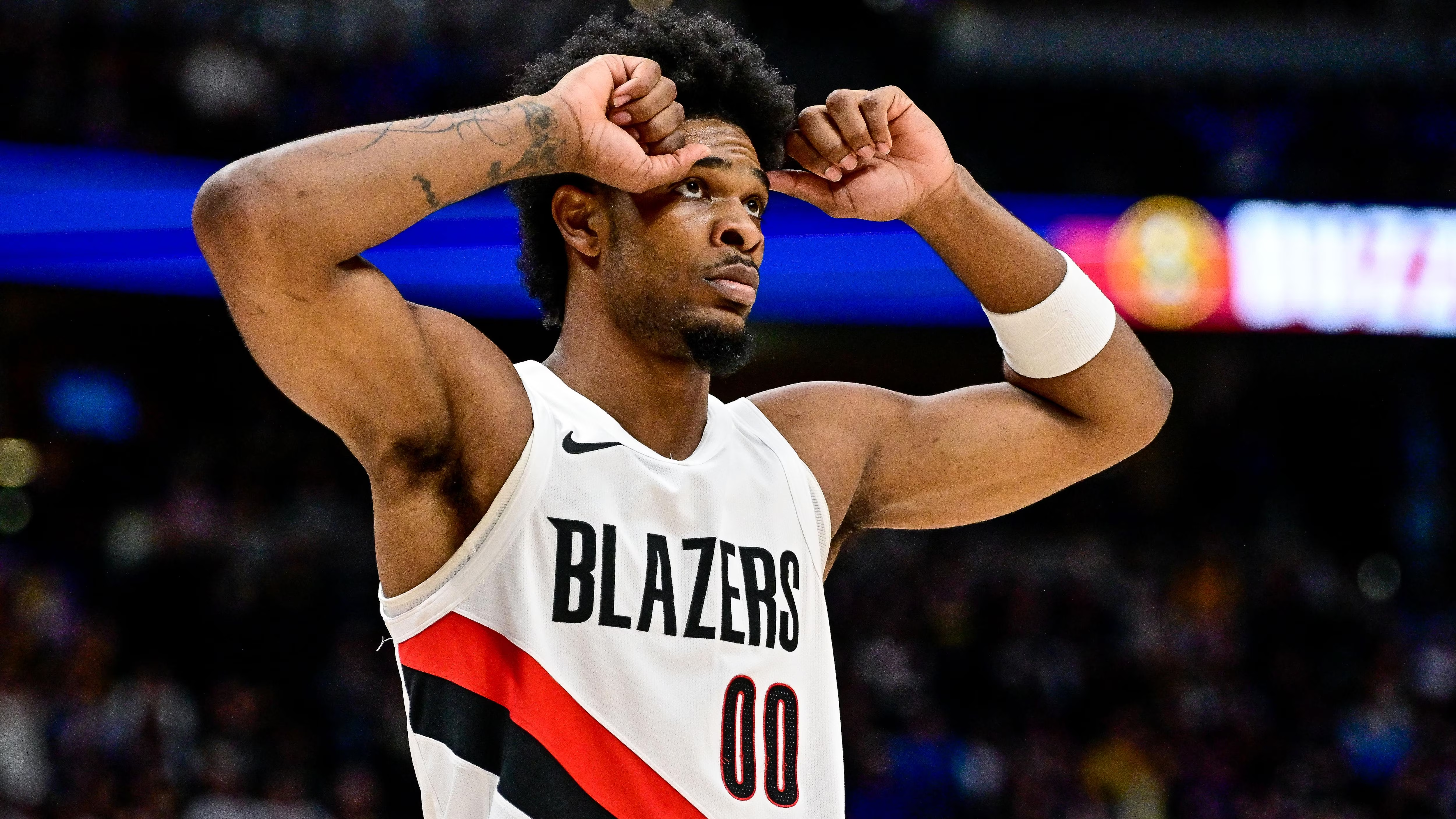
Little about how the Portland Trail Blazers have operated over the past few seasons suggests they're confident in Scoot Henderson's availability or overall ability. The flashes he showed last year when healthy, particularly as a starter, weren't enough to stop them from continuing that trend this summer.
Ja Morant's ball dominance, questionable shooting and suspect defense are now entering the mix. Damian Lillard is returning from an Achilles injury. Shaedon Sharpe's torn right meniscus buys flexibility, but it's temporary. Portland also has Deni Avdija's star turn and Jrue Holiday on the roster.
Deploying Holiday like a wing lets the Blazers tap into three-guard structures pretty easily. Lillard has plenty of experience playing off the rock as well. But he and Morant have generally spent more than 40 percent of their offensive possessions as on-ball creators. Avdija, meanwhile, is coming off a 99th-percentile season of on-ball volume.
While everyone is under pressure to adapt, Henderson is the least established. His on-ball percentage will need to drop. His volume and efficiency out of spot-ups, hand-offs and screens will have to climb. His defense will have to be good enough to log heavy minutes alongside at least one of Lillard and Morant.
Failing to work within Portland's roster framework doesn't just stand to cost Henderson minutes. Entering a contract year, his ability to reorient his game could determine what jersey he's wearing past the Feb. 11 trade deadline.
The Stakes: His spot in the starting lineup.
If you are not surprised by this inclusion, well, you should be. Despite a checkered health bill over the past two years and scoring lines that make the points-per-game's crowd eyes bleed, Herb Jones has proven time and time again that he helps drive some of the New Orleans Pelicans' most effective lineups.
Naturally, the soon-to-be 28-year-old will continue to start entering next season, just as he has for 97 percent of his career games.
Shamit Dua of In The N.O. dropped a small-but-significant truth bomb on Twitter, writing: "I think [the Pelicans] want to start [Jeremiah] Fears. Would not be surprised to see Fears, Dejounte [Murray], Trey [Murphy III], Zion [Williamson and Yves] Missi."
Starting a sophomore not known for his stopping power over a potential All-Defense candidate isn't head coach Jamahl Mosley's style. But perhaps he's turning over a new, offense-first leap. Or maybe this is a mandate from up top.
Either way, it appears Jones will have to scrap and claw to retain his starting role.
The Stakes: Backup power forward minutes.
Nikola Jović finished last season outside the Miami Heat's rotation. As he kicks off a four-year, $62.4 million extension that's at risk of aging into one of the NBA's worst deals, the path back into head coach Erik Spoelstra's good graces isn't going to be easy.
Healthy Giannis Antetokounmpo eats up 30-36 minutes of the power forward rotation. That doesn't leave much wiggle room for his primary backup.
For the record, Jović isn't guaranteed to be the primary backup. Even if the Heat view Bobby Portis as their second-string 5, he'll still see minutes at the 4 if Nick Richards makes the roster. Failing that, the Heat have no qualms about sliding Andrew Wiggins or Simone Fontecchio to power forward.
Jović's utility rises if Miami can buy time with him at the 3 or the 5. It can't. His one-position limitations put him at a disadvantage no matter what. They do him even more harm with Giannis in town.
Without a top-notch training camp, Jović may begin this year where he finished last season: on the outside looking in at everything Miami is trying to do.
The Stakes: The final starting-lineup spot, but also more.
Four of the Los Angeles Lakers' five starters are etched in stone: Luka Dončić, Austin Reaves, Walker Kessler and Quentin Grimes. For a hot minute, it looked like Jake LaRavia would comfortably round it out.
Then, the Lakers signed Sandro Mamukelashvili. And Ziaire Williams. And Matisse Thybulle. Then the Adou Thiero hype train continued rolling along.
Now, you can't help but wonder whether LaRavia is fighting for more than a chance to start. Or whether he's even an option to start.
Based on what the Lakers need most, Williams is the best fit to cherry-top the opening five. Wing minutes will be available coming off the bench, but they'll be harder to pin down if head coach JJ Redick is willing to play Mamu at the 4 and Thiero is getting regular burn.
On the bright side, LaRavia's path to assurance is clear: take more than 4.2 threes per 36 minutes , make more than 32.1 percent of them and defend at a higher level than last season. Whether he can satisfy enough of this checklist is a separate matter—one that'll determine not just when he plays, but how much.
Terrence Shannon Jr., Minnesota Timberwolves
The Stakes: Winning the seventh- or eighth-man role.
Terrence Shannon Jr. wrapped up an injury-riddled sophomore campaign by once again showing signs of life in the playoffs. The pressure he put on defenses going downhill left head coach Chris Finch lamenting how he'd been used when healthy.
"We've learned, with [Shannon], he's gotta have the ball in his hands ," Finch explained. "Silly me, we played him out of the corner most of the season, but he's way better with the ball in his hands at the top of the floor."
This assessment now comes across as an indictment.
Putting the rock in TSJ's hands is no longer as feasible with Anthony Edwards, LaMelo Ball, Ayo Dosunmu and Jonathan Kuminga ahead of him in the pecking order. With the Minnesota Timberwolves' top-six—if not top-seven (Joan Beringer)—spots in the rotation locked up, Shannon needs to do more of the accessory work.
That doesn't mean he has to live in the corner. It does mean he needs to hit his threes, make quicker decisions with the ball, consistently defend and compete for rebounds. If TSJ isn't able to deliver on the first two items, Jaylen Clark overtaking him in the hierarchy will be the least of his worries. In that scenario, he could find himself fending off Cody Williams.
The Stakes: Head coach Ime Udoka's affection.
Reed Sheppard more than tripled his total court time from his rookie to sophomore season. All it took was Fred VanVleet missing the entire year and the Houston Rockets resisting the urge to add a veteran ball-handler better than Aaron Holiday.
Dynamics have shifted entering Sheppard's third season. VanVleet is back. We can't discount the Rockets signing Marcus Smart. Though his knack for defending up allows him to replace both Josh Okogie and the idea of Dorian Finney-Smith, Houston is still adding two guards it didn't have last year to its rotation.
Sheppard's shooting gives him some measure of job security. Nobody on the Rockets came close to making as many threes last year. He was one of just 10 players leaguewide to make 39 percent or more of his triples on more than 500 total attempts.
Still, Sheppard hasn't flashed as much on-ball escapism as initially hoped. Despite ratcheting up his playing time last year, Udoka didn't entrust him with a ton of featured responsibility. Sheppard ranked in the 35th percentile in on-ball possessions used.
Roster construction explains some of the usage, including times when the 22-year-old is treated like the fourth or fifth option in crunch-time situations . Alperen Şengün, Amen Thompson and Kevin Durant all usurp him in the pecking order.
None of which lowers the stakes for Sheppard. His margin for error shrinks with both VanVleet and Smart around him. The Rockets don't seem poised to expand his usage even if he's raining haymakers and holding his own on defense. Unless he becomes undeniable, Sheppard's chance at a star or fringe-star turn in Houston seems to be running out of steam.
The Stakes: Retaining his status as the third big.
Don't look now, but the Oklahoma City Thunder have a quadrillion centers on the roster.
OK, actually, it's five. But that's still one-third of a 15-man roster.
Chet Holmgren and Isaiah Hartenstein have nothing to worry about. Jaylin Williams is a different story.
Thomas Sorber, selected 15th overall in 2025, is set to make his NBA debut after missing last year with a torn right ACL. The Thunder also just drafted Aday Mara at No. 15 . While his summer league performances were iffy, he tore it up during FIBA action with Spain.
Getting both rookie bigs minutes is a must, which puts Williams' court time in jeopardy. This wouldn't have been the case in years past. OKC has always excelled at juggling player development and relevance. Head coach Mark Daigneault would have sprinkled in reps during blowouts, or on nights in which he felt comfortable taking it easy on Holmgren or Hartenstein.
The Thunder's stakes are different now—higher overall and more difficult to navigate. They faced their first second-apron crunch over the offseason. It cost them Lu Dort, Aaron Wiggins and Isaiah Joe. The depth that has traditionally bought them the flexibility necessary to develop their mystery boxes is now the mystery boxes themselves.
Between that and what could be stiffer night-to-night competition in the new lottery era, more of OKC's experimental reps have to come when it matters. Williams better watch his six. The Thunder's financial situation leaves them little choice other than to try finding and developing his and even Hartenstein's eventual replacement.
Dan Favale is a National NBA Writer for Bleacher Report. Follow him on Bluesky ( @danfavale ), and subscribe to the Hardwood Knocks podcast, co-hosted by Bleacher Report's Grant Hughes .
Topics in this story
Gathered from external sources. Rights to this text belong to whoever originally published it.