Are the Heat suddenly a threat in the East? How Giannis Antetokounmpo is making an impact in Miami
The Heat are riding a five-game winning streak and operating like a top-10 unit on both ends of the floor during this run.
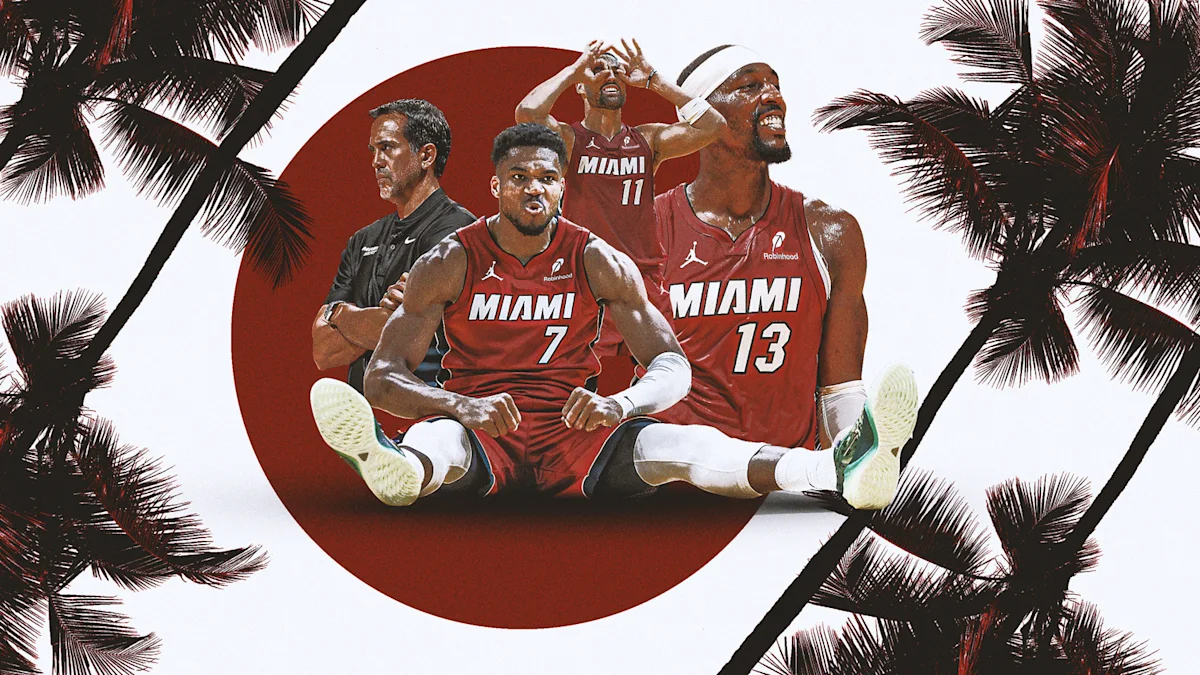
MIAMI — It's go-time for Giannis Antetokounmpo.
There's nothing fancy about the start of this possession. Giannis inbounds the ball to Davion Mitchell, who trots up the left sideline while Giannis fills the middle of the floor. Mitchell pitches it back to Giannis above the break, with Rockets center Alperen Şengün tasked with navigating whatever comes next.
Two dribbles to the left. A gather and spin to the right — through the arms of Şengün — into a lefty layup.
A little over a minute later, it's time for a Mitchell-Giannis pick-and-roll in the middle of the floor. Klay Thompson, Miami's resident flame-thrower, is stationed in the left corner, but he won't stay there.
Mitchell begins his attack, taking three dribbles on his way to Paint Touch City. While Mitchell attacks, Thompson lifts to the left wing to put Kevin Durant in a pickle. Fulfill his low-man duties — tag Giannis on the roll so he doesn't have a lob opportunity — or follow Thompson so he doesn't receive a kickout for a 3.
Durant chooses the latter, giving Giannis an acre of space to roll into.
Two more points after Mitchell promptly tosses a lob.
Following a missed pull-up 3 from Fred VanVleet, the ball finds Giannis' hands after a rebound scramble. Seven seconds later, Giannis adds a transition bucket to his third-quarter resume.
Next, it's a left elbow touch against Jabari Smith Jr. that ends in free throws — he makes both.
Two minutes later, it's a transition spin-and-finish against Smith Jr.
Then it's another transition attack, this time with Tari Eason and a late-arriving Isaiah Crawford as and-1 victims.
Finally, it's a left block touch against Eason, who fights his tail off to prevent Giannis from establishing deep positioning. His reward? Giannis converting another and-1 immediately after receiving an entry pass from Ryan Conwell.
It's a 14-point quarter for the former MVP, and that's without getting into the four assists he dished out. What made this particular outburst special is when it happened.
It was a tone-setting, game-sealing third quarter — the infamous "turd quarter" for those in the know; it should come as no surprise that the Heat are, once again, in the negative to start the year — that the Heat needed with Bam Adebayo being held out due to right hip tightness.
(He's since been listed as "probable" for Wednesday night's game against the Milwaukee Bucks — Giannis' first matchup against his former team.)
There were natural questions about what non-Giannis minutes would look like in a Bam-less context; because of Giannis' dominant quarter, the Heat got to navigate those waters in the fourth quarter, with a 20-point lead as a buffer.
It was also helpful that Giannis didn't need to turn on that level of aggression in the first half. Miami's defense was ironclad in the first half, and it got plenty of scoring production from the others — headlined by Conwell's 12 off the bench, and Thompson's 11 — allowing Giannis to simply defend, rebound, distribute and utilize his superstar gravity to unlock things for others. "He was Magic Johnson for the first 14 minutes of the game," Heat head coach Erik Spoelstra told reporters after the game .
"And when he needed to be aggressive, he found different ways to get downhill and do what he does," Spoelstra said. "He wasn't a bull in a china shop to start the game; it was setting everyone up. That's what we're talking about: exponential impact. He can have that exponential impact on our offense just by being who he is — arguably, on any given night, the best player in the league."
There's context to sprinkle in on the Rockets' side — they were on the second night of a road back-to-back, down Amen Thompson and others (Steven Adams and Marcus Smart chief among them) — but Monday's 128-110 win over the Rockets was arguably the Heat's most complete win of the season.
Here the Heat sit, riding a five-game winning streak and operating like a top-10 unit on both ends of the floor during this run.
Per Cleaning The Glass, the Heat sit eighth in overall offensive rating (117.6) while sporting the third-ranked half-court offense (101.8, 5.8 points above league average) in the league. It's an outstanding place to be considering the preseason expectations — potentially explosive, but likely a clunky unit as the personnel got used to each other.
The largest baseline question entering the year was two-pronged: how well would Giannis slot into Miami's screens-are-optional system from last season, and how much would the Heat bend on said-principles to accommodate Giannis' skill set?
Broken into three intervals — Miami's first four games, their next five games, and the current five-game winning streak — here's what their rate of screening (on and off the ball), dribble handoff (DHO) work, and the success of drives (plus the percentage of drives they're seeing help defenders) looks like with Giannis on the floor compared to last year. All numbers, per 100 possessions, courtesy of Second Spectrum:
And here is how Giannis has fared in those contexts compared to last season:
In summary: the Heat have certainly incorporated more screening and handoff work into the offense than last year, with everything aside from off-ball screening trending up as the season sample grows. Giannis specifically has been less involved in actions compared to last year, but that screening context has arguably made life easier for his teammates (more on that shortly) while the general spacing construct has led to clearer driving lanes than he's used to seeing.
We knew that Spoelstra was going to work diligently to find the right balance of everything. When to put the ball in Giannis' hands and where; when to space him, and where; who to pair him in actions with. Those questions were (and are) most important in relation to his All-Star frontcourt partner, Bam Adebayo.
With neither being shooters that strike fear into the hearts of defenses, there was a natural clunkiness they'd have to work through. During the Heat's 0-4 start, Adebayo struggled to make shots, and Giannis had pockets of indecision when trying to assert himself.
A quieter observation was how clunky their (re)spacing felt; the amount of times Giannis would perform an ill-timed (or ill-paced) cut during an Adebayo post touch was, well, let's just call it #LessThanIdeal.
(As a brief aside: Giannis (59) and Adebayo (55) rank third and fourth in total post-ups this year. A Spo team leading the NBA in post-ups? Who had that on their preseason bingo card?)
A notable setup that's emerged as of late: pick-and-rolls involving one as the screener, while the other is spaced in the dunker spot . It serves the early benefit of clearing space above the break so those ball screens can develop:
Giving Giannis or Adebayo space in the middle of the floor can feel perilous. Both are having tremendous midrange shooting seasons at the moment, but it's more important that they have room to load up for paint touches.
Because they're threatening finishers — Antetokounmpo in particular is one of the best in league history — it forces teams to help in different ways, unlocking passing reads (corner kick-outs in particular) that both are good enough to capitalize on, quickly.
Nickeil Alexander has to make a decision between providing extra relief to prevent a pass to Adebayo, or staying home to prevent a corner pass to Pelle Larsson:
With Alexander-Walker flowing toward Adebayo, Giannis promptly makes the swing to Larsson against Alexander-Walker's momentum for an open 3:
(Another aside: There's also the benefit of having a tremendous athlete near the basket for offensive rebound opportunities. Though they didn't all come from dunker spot lurking, it's worth noting that Giannis and Adebayo combined for nine offensive rebounds in that Hawks game.)
On the year, the Heat have logged 43 picks with one of Giannis or Adebayo as a screener, with the other in the dunker spot. They've generated an absurd 1.26 points per trip in that context, giving shades of a potential "end game" setup with more reps.
It's important, according to Spoelstra , that the Heat don't lean on any singular thing. Being able to seamlessly flow between different spacing alignments and different actions is where the Heat ultimately want to get to.
"I know I say it all the time, but it doesn't necessarily matter what the trigger is," Spoelstra told reporters ahead of Monday's win against the Rockets.
"Sometimes the trigger may be a pitch-ahead drive; it might be a pick-and-roll; it might be a post-up. I think we're developing more out of our menu, more diversity. If we just go to one thing all of the time, that efficiency will probably go down."
"Right now, we're tapping into quite a few different things. Hopefully, while we're doing that, we're going to guys' specific strengths. But it does take some trust, for the guys to be open to doing some things that might be a little bit different than how they've done it, and then [doing] things they really feel comfortable doing. That's part of it when you have some new players and you're trying to put it all together."
Watching Giannis lurk around the dunker spot or act as a screening or handoff hub for perimeter players aren't new concepts; he did so — and showcased he could do so at a high level — during his best years in Milwaukee. Practically doing so at the expense of some of the on-ball work — not only are the inverted pick-and-roll reps (with Giannis as the ball-handler) down, but drives in general are lower in volume — is where the adjustment comes in.
To Giannis' credit, he's been able to build real chemistry with Thompson and Mitchell in different ways. It's largely been off-ball and handoff work with Thompson; the differences in size and skill-set put defenses in a bind whenever they're in action together.
As simple as a pindown is, you have to think really hard about how you want to guard it. If you try to navigate it over the top, you run the risk of falling behind Thompson and either opening up a shot for him or, if the screener defender steps up, a passing window for a rolling Giannis.
Try to duck under a screen, and you risk Thompson sprinkling in jumper after jumper. Switch the action, and you're in double trouble. You're switching a smaller defender onto Giannis; we know he can pulverize mismatches, or at the very least, draw double teams because of the fear of pulverizing those matchups. And because Thompson doesn't stop moving without the ball, the bigger player switching onto him still has work to do.
During the win streak, the Heat have generated 1.5 PPP (!!!) on trips featuring a Giannis off-ball screen for Thompson. Their handoff partnership (1.21 PPP) has been similarly tough to deal with during this run.
With Mitchell, it's been more traditional pick-and-roll. There's been 5-out, middle-of-the floor goodness. The aforementioned dunker spot spacing (flat spacing, for the win) with plenty of room to operate with up top. With Mitchell trotting up a sideline, the two can flow into empty-side actions to further place defenses in what-do-we-do scenarios.
Mitchell has continued to grow as a ball-screen operator, weaponizing his speed (and penchant for paint touches) to generate looks for himself or others. Because he can turn on the jets at any time, he's done a better job of working at slower speeds to begin these actions. It allows his screener (Giannis in this case) to make cleaner reads; they can establish themselves to actually make contact, or more realistically sell the setup to make screen-slipping more effective weapons.
The driving cadence, the shifting of gears, and the growing timing and placement of Mitchell's passes (the quick-hitting pocket passes are simple but incredibly effective) have made him one of the league's most efficient pick-and-roll creators, even within Miami's low-volume context.
To that point, I present you two data points:
Among 42 players that have received at least 200 on-ball picks this year, Mitchell's 1.12 PPP mark ranks seventh in the league.
The Heat are generating an absurd 1.46 PPP on trips featuring a Mitchell-Giannis ball screen, tops among 52 duos to have logged at least 75 reps together.
The "exponential impact" that Spoelstra spoke to hasn't quite played out statistically, at least not yet. Giannis has made his team's offense better in every season of his career, but this year's differential (+0.4, per Cleaning The Glass) would easily be the lowest of his career.
That comes with the very obvious "lineup construction matters!" context; the thing about on-off numbers is that the "off" portion can say just as much about the backups (and the lineups they're facing) as they do about the player in question (Giannis).
But it's clear that the seeds that were planted earlier in the season are starting to bear fruit right now. The Rockets game on Monday was a loud example of Giannis being able to amplify things without needing to dictate his own terms (first half), but still being capable of doing so when the game calls for it (third quarter).
That's a formula that can only work when others pull their weight, but it's an easier one to replicate when players are empowered to do so the way they are in this offense. Mitchell is playing well; Thompson is playing free. Adebayo is finding his way and playing decisively. Youngsters like Ryan Conwell and Myron Gardner are playing freely. It's the kind of confidence-building that obviously feels loud during a winning streak, but ultimately should bode well as we get deeper into the season. Having proof-of-concept to lean on makes it easier for players to buy-in, and makes it easier to re-center things when adversity hits.
It's probably unfair to expect the Heat to maintain a 127.4 offensive rating like we've seen during the winning streak, but it should alarm the league that the Heat has this kind of juice in them.
Topics in this story
Gathered from external sources. Rights to this text belong to whoever originally published it.