Maikel Garcia trade: This blockbuster deal looks like a win-win for Mariners and Royals
For two AL clubs coming off dismally disappointing seasons, this is a fairly stunning shake-up, a bold trade underscoring each front office's priorities in r...
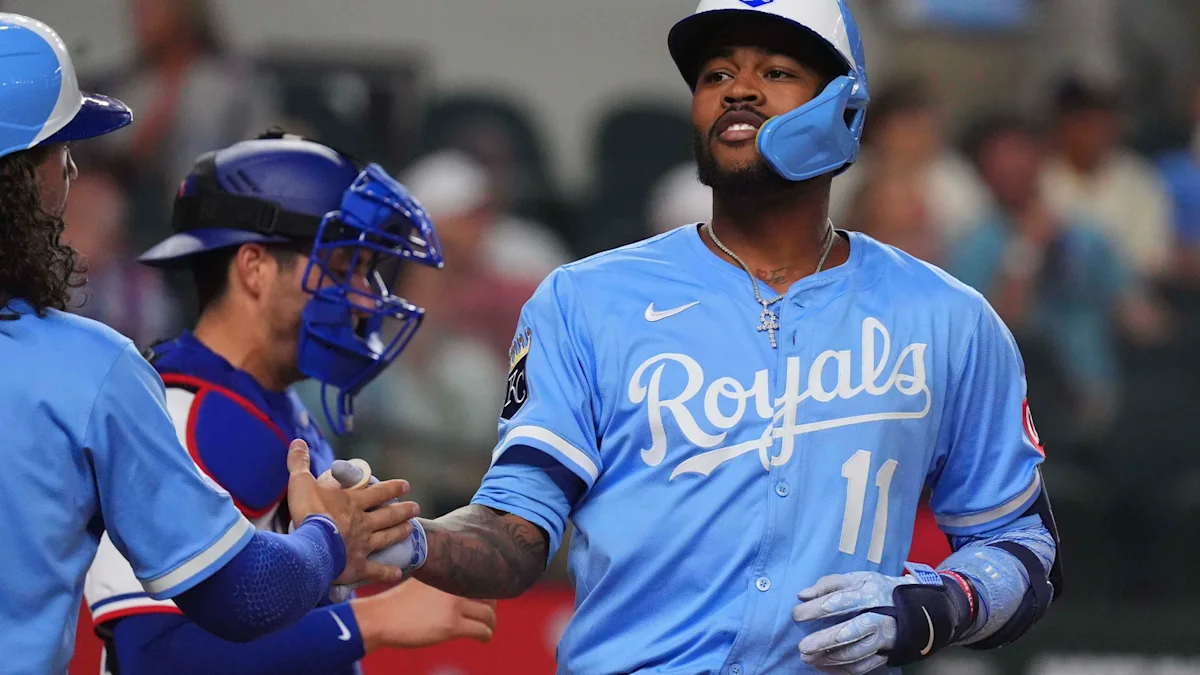
To the surprise of absolutely no one, the first blockbuster trade of the MLB offseason went down Wednesday courtesy of the swap-happy Seattle Mariners.
It was no secret that the Mariners were willing to part with some of their enviable starting pitching depth in order to upgrade their position player group, and they found an intriguing partner in the Kansas City Royals. The deal is headlined by 26-year-old Gold Glove third baseman Maikel Garcia, shipped to Seattle along with right-handed pitchers James McArthur and L.P. Langevin in exchange for three major-league arms: right-handed starters Bryce Miller and Logan Evans, plus lefty reliever Jose A. Ferrer.
For two American League clubs coming off dismally disappointing seasons, this is a fairly stunning shake-up, a bold trade underscoring each front office's priorities in regards to improving their respective rosters this winter.
It was less than a year ago when Garcia signed a long-term extension with the Royals that appeared to lock him into the hot corner alongside shortstop and franchise pillar Bobby Witt Jr. for the foreseeable future. That deal guaranteed Garcia $57.5 million with escalators for more, running through the 2030 season with a $21 million club option for 2031. It was the culmination of Garcia's astonishing decade-long development, from signing with Kansas City in 2016 as a skinny teenager out of Venezuela to becoming one of the most impactful infielders in the majors.
While Garcia's bloodlines put him on the radar early in his career — Ronald Acuña Jr. and Alcides Escobar are among several of Maikel's big-league cousins — his progression as a prospect was a slow burn. He methodically climbed the Royals' system and debuted as a 22-year-old in 2022, but he was primarily a speed-and-defense bottom-of-the-order hitter (77 wRC+) across his first two major-league seasons despite promising underlying metrics suggesting untapped potential at the plate.
Then in 2025, Garcia enjoyed a huge breakout with the bat, better translating his exceptional below-the-surface skills (plus plate discipline, strong hard-hit rates) into actual production (16 home runs, 120 wRC+). In tandem with his outstanding defense and fantastic baserunning, Garcia was suddenly an all-around force. He made his first All-Star appearance and finished with 5.6 fWAR, which ranked 14th among all major-league position players. That huge step forward motivated Kansas City to commit to Garcia with a sizable extension, while Garcia was willing to forgo free agency by a few years in order to secure an enormous guaranteed sum as a 25-year-old.
Before the 2026 season had even begun, Garcia further validated his upward trajectory by starring for Team Venezuela in the World Baseball Classic. He hit .385/.393/.577 across seven games and was named tournament MVP as Venezuela claimed its first WBC title with a riveting triumph in the finals over Team USA. Garcia then returned to the Royals and started the regular season strongly, hitting .285/.353/.437 over his first 39 games. But a muscle strain in his left hand began to bother Garcia shortly thereafter, and his production plummeted until he was eventually placed on the injured list in late June. That nagging hand ailment plus a left hamstring strain in August limited Garcia to 13 more games the rest of the way as the Royals tumbled down the standings and totally off the radar in the second half.
By the end of the year, Garcia had played in just 82 games and posted a .715 OPS with three home runs, an underwhelming encore to his breakout 2025 and one of several things that went wrong for the last-place Royals. But much higher on the list of reasons behind Kansas City's wayward campaign was its abysmal pitching staff that ranked 27th in ERA and 29th in fWAR. A poor bullpen was the biggest culprit behind those rankings, but the rotation sorely underperformed as well outside of Michael Wacha.
It was clear that improving on the mound would be a priority for Kansas City this offseason, but it was unclear how the Royals could achieve such gains. No one was expecting a run at Tarik Skubal, but would they splurge (by their standards, anyway) on a free-agent pitcher or two? Could they gather enough from their shallow farm system to add a proven pitcher via trade?
Perhaps these avenues could still be explored. But first, general manager J.J. Picollo has decided to trade a significant major-league piece in Garcia in order to address this glaring need — and found a pitching-rich trade partner in the Mariners who were eager to collaborate.
What's the upside for Mariners in this Garcia gamble?
As the Mariners have drafted and developed an entire homegrown starting rotation over the past half-decade, there has been widespread speculation league-wide regarding their willingness to part with any of that depth in order to upgrade other parts of their roster. Those whispers grew quite loud this summer at the trade deadline as Seattle tried to get its season back on track, but the Mariners ended up only subtracting veteran Luis Castillo from the rotation in a money-motivated trade with the Chicago White Sox that included getting reliever Seranthony Domínguez, outfielder Nolan Jones and catching prospect Boston Smith. Castillo's contract and poor performance made him a different kind of trade chip rather than an especially valuable piece used to acquire a meaningful major-league upgrade.
And so, by the time the Mariners made it to the end of their miserably disappointing campaign, questions again resurfaced about whether Seattle would finally make a major deal involving their wealth of starting pitching. At the GM Meetings in Las Vegas last week, president of baseball operations Jerry Dipoto addressed that possibility head-on.
"We're eight deep, in my mind, on the pitching side," Dipoto said. That octet consisted of three buckets of pitchers. The first is the most proven trio of Logan Gilbert, George Kirby and Bryan Woo, each of whom has been an All-Star in recent years. The second is another trio of right-handers — Miller, Emerson Hancock and Evans — who have varied wildly in effectiveness and availability but project as dependable rotation options in 2027. Rounding out the implied group of eight was the pair of top-tier pitching prospects in 22-year-old left-hander Kade Anderson and 20-year-old Ryan Sloan, the former of whom made his major-league debut last August.
"We've always been open to listening," Dipoto said. "We have sometimes been the protagonist in engaging. Obviously, we've not gotten to the point outside of Luis Castillo this summer where we've done something. It'll take a lot. Excuse me. It'll take a lot for us to move one. And I think in general our preference would be to keep all your pitchers — you're gonna need them.
"But if it can allow us access to a hitter we otherwise wouldn't be able to access through prospect packages, position-player deals, or free agency — then we have to be open."
That sentiment set the stage for the kind of deal that came together Wednesday, as Garcia perfectly fits the description of a player worthy of finally cashing in these starting pitching chips.
With Randy Arozarena expected to depart in free agency, the Mariners were hoping to make an impactful addition to the position player group in some form, but that didn't necessarily mean bringing in another big bat of a similar ilk. Dipoto has made it crystal clear that improving Seattle's "atrocious" defense was a priority this offseason, and while Garcia's offensive track record is more mixed — and how his bat will translate to hitter-unfriendly T-Mobile Park remains to be seen — his terrific glove is undisputed. That made him an especially ideal target. He could slot in seamlessly at third base, or cover shortstop depending on how Seattle views the next steps for 21-year-old Colt Emerson, the talented infielder who endured a bumpy first taste of the majors in 2026. The versatile veteran Brendan Donovan — limited to just 39 games because of various injuries in his first season as a Mariner — could also cover third base depending on Emerson's readiness, but now projects to mostly handle left field in Arozarena's absence.
Even an average version of Garcia could be a real difference-maker for Seattle on both sides of the ball. His plus contact skills and baserunning brings some much-needed balance to a lineup that badly lacks that style of play, and his elite glovework should aid in the Mariners' run-prevention efforts. And if Garcia can flush his injury-marred 2026 and restore his full-fledged All-Star form, the Mariners may have landed a true foundational piece, and one under contract for the long haul. Add in an intriguing injury bounceback candidate for the bullpen in McArthur — who quietly logged 18 saves for the Royals in 2024 — and a swing-and-miss machine in the Québécois right-hander Langevin (LAWN-juh-van), and the Mariners may have gotten more than just an everyday infielder.
How Kansas City plans to replace a mainstay like Garcia is unknown. But the Royals evidently viewed pitching as their biggest problem and have added three potential solutions to a staff that unquestionably needed a whole lot more help than the lineup. The post-Garcia Royals still feature a strong offensive core with Witt, Jac Caglianone and Carter Jensen, but adding arms was paramount if the Royals want to reenter the mix as a contender in the AL Central.
Miller is the de facto headliner heading to Kansas City on the basis of his peak performance in the majors — a 2.94 ERA across 180 1/3 innings in 2024 — but his performance and health have fluctuated to an extreme degree over the past two seasons. Though he has not undergone surgery, Miller has dealt with bone spurs in his right elbow dating back to 2025, when he was quite poor during the regular season (5.68 ERA) before showing surprisingly well across three postseason outings. The start of his 2026 campaign was then delayed by an oblique strain. He was spectacular once he rejoined the rotation, posting a 1.71 ERA in 52 2/3 innings through his first nine outings. The rest of the season, however, was a disaster: Seattle lost 12 of his final 13 outings as Miller's ERA soared to 6.14 and nearly all of his pitches were pummeled.
His durability remains a major question mark, but Miller has time to get right as a possible anchor in the Royals' rotation (he's under contract through 2029). Like new rotation mate Seth Lugo, Miller has an absurdly deep arsenal, having showcased nine different pitch types since he debuted in the majors with his four-seamer, splitter and slider leading the way. On top of his intriguing profile as a pitcher, the proud Texan was a beloved personality in Seattle's clubhouse and should make fast friends with his new organization, and could become a fan favorite in a hurry in Kansas City if he can become a staple on the Royals' starting staff.
Evans is more of a mystery box, having made 15 starts as a rookie with Seattle in 2025 before suffering an elbow injury necessitating Tommy John surgery that put him on the shelf for all of 2026. The 25-year-old right-hander was the quintessential development story within Seattle's renowned pitching apparatus, an unheralded 12th-round pick with a 6.78 career ERA in college who surged to the big leagues in just two years. Like Miller, Evans, too, has a diverse repertoire — he threw six different pitches at least 10% of the time as a rookie — but below-average fastball velocity could limit his overall ceiling to more of an inning-eating back-end arm. If he can find another tick or two of velocity post-surgery, there could be more upside here.
Ferrer finalizes the three-pitcher package, traded for the second straight offseason after arriving in Seattle from Washington last December in a one-for-one swap for catching prospect Harry Ford. Ferrer is tremendous at coaxing ground-ball contact, which was unfortunately far too often penalized by the Mariners' lackluster defense behind him. Seattle was unable to generate more whiffs from the hard-throwing lefty — his strikeout rate actually went down from where it was with the Nationals — but it's not difficult to understand why Ferrer would still appeal to a team in dire need of bullpen help. He's under contract through 2029, throws quite hard for a southpaw (98 mph average fastball) and has proven admirably durable over the past two years, tied for fourth in the majors in appearances over that span with 145.
He might not be closer material, but Ferrer's arrival immediately improves Kansas City's most obvious weak spot, while inviting further questions about how Seattle plans to reinforce its own shaky relief corps this winter.
Topics in this story
Gathered from external sources. Rights to this text belong to whoever originally published it.