World Series 2026: Christian Yelich turns pivotal play as Brewers' under-the-radar hero of Game 3 — 'The whole game was changed when Yeli was safe'
By beating a throw to second, Yelich flipped a dead frame into the inning of a lifetime for Milwaukee.
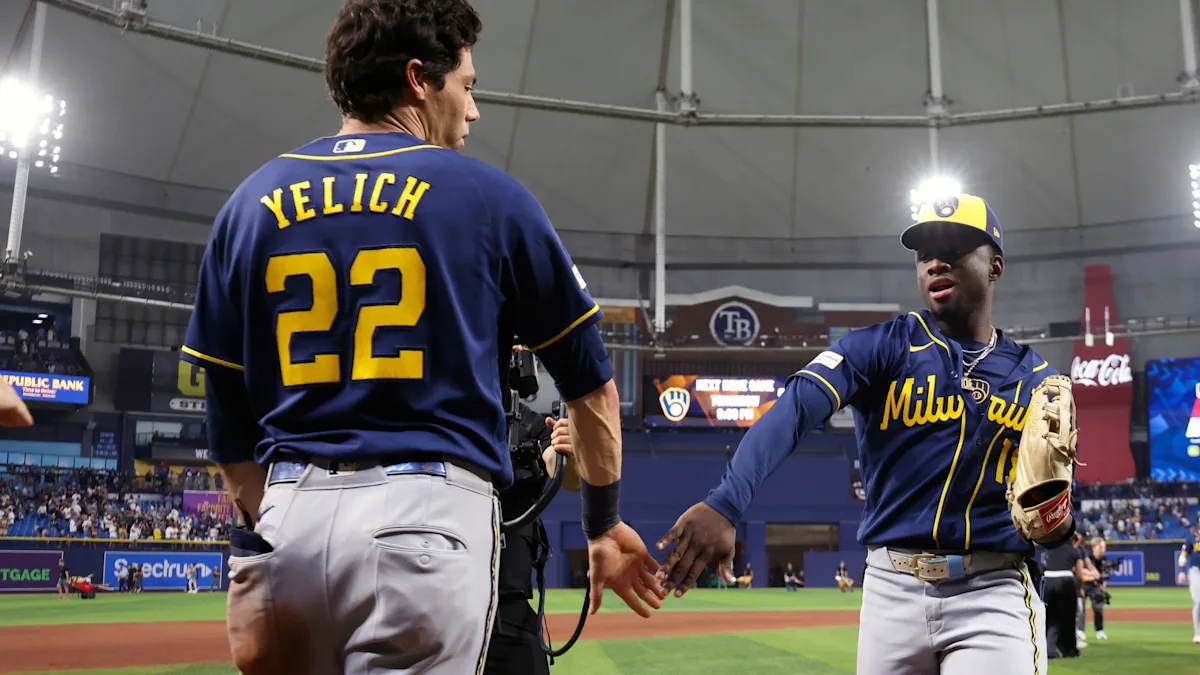
ST. PETERSBURG — The Brewers won by a mile because they're obsessed with the inches.
Nobody would describe the final outcome of Milwaukee's emphatic beatdown on Monday — a 10-1 drubbing of the Tampa Bay Rays in Game 3 of the World Series — as "close." Not since 2015 has there been a larger margin of victory in a World Series game. The Brewers' 16-to-3 hit advantage over the flailing Rays was the third-largest in Fall Classic history. Starter Robert Gasser allowed just one one hit and faced the minimum across six brilliant innings, becoming the first lefty to do that in a World Series game since Sandy Koufax in 1965. A massive gathering of Brewers fans, an estimated 30% of the crowd, was there to witness it all, their voices joyously hoarse by the end.
It was a shellacking of historic proportions.
But Milwaukee's commanding 3-0 series lead, one that places this franchise on the precipice of its first championship, was earned in the margins on a bang-bang play that folks in the Badger State will remember for a long time.
Up a pair in the top of the fifth, the Brewers put runners on first and second against Tampa Bay starter Freddy Peralta. Milwaukee catcher William Contreras, the best hitter in these playoffs, ripped a two-hopper toward third baseman Junior Caminero. In a spinning motion, Tampa's talented talisman snagged the pearl and flicked it to second baseman Ben Williamson as a full-bore Christian Yelich slid into the bag. Umpire Dan Bellino punched his fist. The Fox graphic evaporated from the screen. Multiple members of Tampa Bay's between-innings hype squad jogged onto the outfield track for some type of giveaway.
Yelich, though, clung to the bag with his left hand as he motioned adamantly toward Belino with his right.
The Brewers challenged the call. Before Bellino could finish announcing the overturn, Tampa Bay skipper Kevin Cash was already headed toward the mound to pull Peralta.
But no move, at that point, could have stopped the inevitable.
"The whole game was changed when Yeli was safe at second," Brewers manager Pat Murphy insisted afterward. "That's just a hustle play. When your leader makes that play, that says it all. The game was changed because he did a little thing that anybody can do."
Yelich, by beating the throw to second, turned a dead frame into the inning of a lifetime. The floodgates soon burst, sweeping away Tampa's next pitcher, Cam Booser. On a 2-2 count, he served a mid-zone fastball to second baseman Brice Turang, who scorched one off shortstop Taylor Walls' glove and into the outfield. Milwaukee's lead was doubled to 4-0.
As the sizable traveling contingent — a bar down the street sold out of Miller Lite before first pitch — went berserk, the Fox broadcast panned to a young Rays fan, who could be seen uttering to his companion a harsh and humbling realization: "That's the series."
Milwaukee, though, would leave no doubt. And then some.
Their next five batters all found grass, with each consequential hit eliciting louder and louder roars from the armada of traveling Wisconsinites. In total, the Brewers strung together seven consecutive two-out hits to plate eight two-out runs, a World Series record. It was an all-time heater and a fitting performance from a pridefully selfless Brewers offense that has prioritized passing the baton over hitting big flies all season long.
"Nobody wants to be the hero," hitting coach Dan Vogelbach boasted.
That might be true, but Yelich, with his mad dash to second, was the under-the-radar hero of this evening.
With the right-handed Contreras at the plate and a runner on second, Rays first baseman Ryan Vilade was shaded toward second, opting not to hold Yelich on. That allowed the Brewers' captain to take a much larger-than-average lead off first base. By the time Contreras swung, Yelich was already about 30 feet from the bag, his right foot in the air ready to break in either direction. As the ball bounced toward Caminero, Yelich landed and broke hard for second.
"You have to understand where you're at in space," Yelich explained postgame. "You're lengthening your primary [lead] in case there's a ball in the hole or some sort of play happens where you could potentially beat the throw."
It was a sublime bit of baserunning, the kind that takes years of purposeful, monotonous practice to get good at. There's also an element of internal pre-pitch preparation: "If X happens, I do Y." Yelich executed that process perfectly. Caminero, who had ample time to get the slow-footed Contreras at first, did not.
"The beauty of it is that you have guys like Yeli that demand it from the group," first-base coach Spencer Allen told Yahoo Sports about the team's attention to detail.
Jason Lane, Milwaukee's offense and strategy coordinator, explained to Yahoo Sports that he tells players to approach a secondary lead at first base and two outs with the same intent and intensity they would bring to a "contact play." That's the inside-baseball term for when a runner at third, with the infield drawn in, plans to race home on contact — no matter where the ball's hit.
"When you remind guys of that and explain it to them like that — and these guys are hunting all those little things that we preach about right turns — it can become something that happens in a playoff game," he explained.
On a team that cares deeply about the little things, Yelich, the group's most accomplished character, might care most of all. That establishes a standard, one that has helped push the Brewers to an amazing 10-1 record this postseason. But that crucial play, and its outcome, was about more than Yelich's impressive read and instincts. His footspeed from first to second clocked in at 28.5 mph, a full tick faster than his season average. That's an 81st-percentile result from a 34-year-old DH with a history of back problems.
Yelich was once a speedster before age and injuries did their thing. There exists a timeline in which the 2018 MVP evolved into a bat-first baseclogger, a plodder focused on in-box responsibilities. Instead, Yelich has done everything in his power to remain as athletic, as lithe and as quick as possible. Years of treatment, offseason sprint work, healthy habits, weight room sessions — all of it has allowed Yelich to maintain his speed despite the barrage of injuries and his status as a primary DH.
"I've got some things that have happened to me, but for the most part, I feel pretty good," he said when asked about his speed. "I feel like I can still hang with the boys out there."
"That baserunning by Yeli there, which allowed us to have that huge inning ..." outfielder Sal Frelick said. "We work on those things in spring. He's the guy that's running the meeting, saying this is important. It's his 14th season. He's been All-Star, Silver Slugger, MVP, and nobody cares about baserunning more than him. Just to see him do that, get a good secondary, run as hard as he could and beat that out — that's what allowed us to have that big inning."
"Little things like that — that's what makes our team great."
Great might be an understatement. If the Brewers finish the deal in Game 4, they would become the first team in the League Championship Series era to sweep both the championship series and World Series rounds. They would finish this month a mind-boggling 11-1, with their only defeat coming by one run in NLDS Game 3 in San Diego. There's a strong argument that we are currently witnessing the most dominant postseason team in MLB history.
The gap between these Brewers and the rest of the league is a massive chasm, yes, but it's one they chiseled one swing and one step at a time.
Topics in this story
Gathered from external sources. Rights to this text belong to whoever originally published it.