What stories of MLB postseason heroes teach us about low-cost youth sports
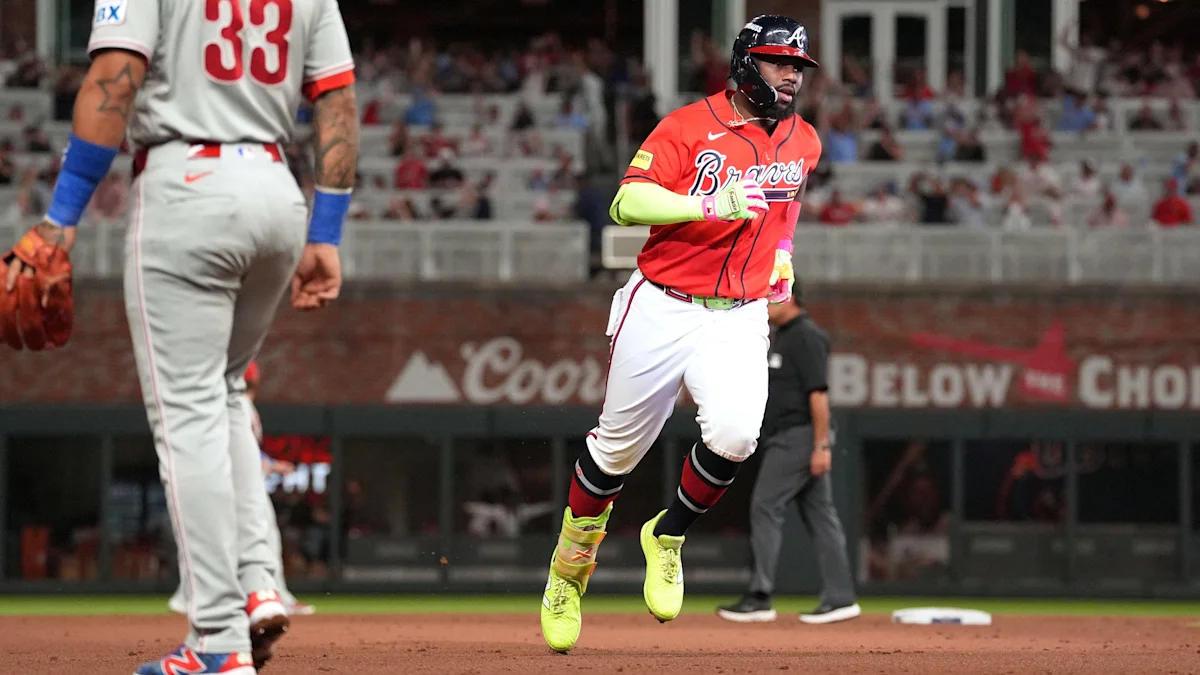
Michael Harris II (Braves) and Braden Montgomery (White Sox) are among the MLB Develops alumni shining in the playoffs.
As parents of athletes, we learn to be strategic (and realistic) about how to move our son or daughter along the line. Maybe we played sports at some level and can offer guidance.
Del Matthews went into parenting with experience in big league clubhouses. His father, Gary "Sarge" Matthews , was a standout major leaguer who played 16 years, while his brother, Gary Jr., was also an All-Star outfielder who lasted 12 in the majors.
Del, who played in college and the minor leagues, understands how sports experiences can set up your life without you "making it." He and his brothers played Little League , too.
"I fell in love with the game early," he tells USA TODAY Sports, "and, really, it was being at the ballpark with my dad and watching him interact with his teammates and watching him win and compete and just emulating what I grew up watching and the conversations that I was hearing, and acting that out with my brothers when we went to the park."
Del Matthews is now Major League Baseball's senior vice president of baseball development as part of MLB's initiatives that include cost-free events and showcases and youth academies in a growing number of U.S. cities to increase baseball and softball accessibility.
Twelve players competing in this year's postseason are a product of MLB Develops programming , which Matthews helps oversee. He has known many of them since they were 13 or 14.
"So many things in the (youth) space are tournament based, and pay-for-play , showcase based," Matthews says, "and so what we try to do is take away the pay barrier for some of these opportunities, but also give kids skill development and things that are going to help them.
"And so whether they go back and play for their high school team or their travel team, they're really equipped with the necessary skills that are going to sustain them through high school, make them better players and hopefully ready to compete at the next level."
When he says "the next level," Matthews, 49, doesn't necessarily mean being in the same room with future Hall of Famers some day, the way his dad was.
He shared perspective on what MLB teaches about trying to get as far as you can in the game, and how that journey can be worthwhile no matter how far you reach.
MLB Develops is a network of baseball and softball intersquad games, showcases and other events aimed at kids through the high school level. Matthews, under former Angels general manager Tony Reagins , has helped reshape MLB youth initiatives over the past decade with more of a development mindset.
They start with grassroots events for younger kids like Play Ball and Pitch Hit & Run . They rise through an MLB ID tour in 18 to 20 cities from eighth grade to high school. GRIT is the same as the ID tour for girls baseball.
Players are identified at ID tour events and invited to larger summer showcases such as the three-day Breakthrough Series and five-day Hank Aaron Invitational . There is also the DREAM Series in January.
There's the Trailblazer Series for girls baseball and Jennie Finch Classic for softball, as well as a Breakthrough Series and Elite Development Invitational for each.
The majority of these events are done in conjunction with USA Baseball. The women's space can be a pipeline to the women's national baseball team and softball team .
Who are the MLB Develops alumni in the 2026 postseason?
When the postseason began, program alumni included infielders Travis Bazzana (Guardians), David Hamilton (Brewers) and George Lombard (Yankees); outfielders Justin Crawford (Phillies), Michael Harris II (Braves), Brice Matthews (Astros), Braden Montgomery ( White Sox ), Chandler Simpson (Rays), Cam Smith (Astros), Taylor Trammell (Astros); DH Dominic Smith (Braves); and pitcher Carlos Rodón (Yankees).
Matthews (from Houston) and Smith (Compton, California) came out of two of the nine youth academies MLB runs in urban communities, which have provided more than 10 major league players. Other youth academies are located in New Orleans, Cincinnati, Philadelphia, Dallas, Kansas City (Missouri), Miami, and Washington, D.C.
2026 MLB playoffs open with thrilling wild-card series matchups
The academies are free and open to everyone, typically for grade school through high school kids who live in those communities. They can be a starting ground for players getting recommended for the development events. Kids go through drills and group style workouts but also come in after school for educational and vocational programming, such as SAT prep and broadcasting.
The youth academies gather every All-Star Week to compete in the Commissioner's Cup (baseball) and Jennie Finch Classic (softball), but the focus is on the everyday aspect of what a commitment to a sport can bring you and what it takes to keep advancing.
"For some kids that don't get selected, what we try to advise is, pick one or two showcases that you want to go to," Del Matthews says. "You don't have to go to every showcase. You don't have to compete in every single tournament. A lot of parents have the fear of missing out that if maybe another kid on the team was (here) that they missed their opportunity. And that is not really the case. Everybody's development arc is a little bit different and so pick one or two showcases or tournaments you can afford.
"The most important thing is getting an opportunity (on a team) where you can play . … We try to instill the message you want to be ready for the showcase when you go there and pay for it, not just pay for an evaluation. You want to make sure that you have the requisite skills that you're actually ready for it, and that you've shown growth, you've shown improvement, and that you're going to be invited back based upon your skill level and not just the monetary value that the entity is getting from it."
'You don't have to go to every tournament': What do stories of MLB Develops alumni teach us about the youth sports pipeline?
Harris, the Braves' 25-year-old starting center fielder in the wild card series , went 3-for-3 with two runs scored in the Braves' 5-3 Game 1 win over the Phillies. He hit a three-run homer in their decisive Game 3 win .
As a kid growing up in the Atlanta area, he liked to pick flowers in the outfield. In one game, his father remembered for an MLB documentary , he was distracted by the activity and wouldn't go after the ball.
He played a number of sports as a kid and his mentality changed about baseball as he got bigger, faster and stronger.
He played in MLB's Reviving Baseball in Inner Cities (RBI) program, which provides resources and support for underserved communities . He met former Braves star Marquis Grissom , who runs a baseball academy , when he was about 14.
Scouts came out to watch someone playing against Harris and noticed him.
"He actually was a two-way player and was probably a little further along as a pitcher than he was as a hitter," Del Matthews says, "but he was a standout from the jump and had a chance to play on some of our tournament teams."
Dana Brown, then the Braves' vice president of scouting, saw Harris through MLB's Hank Aaron Invitational. The Braves drafted him in the third round in 2019. He has been in the majors since 2022.
Justin Crawford had more of a pedigree as the son of a four-time major league All-Star (Carl Crawford) but Matthews says he was small and wiry and behind some of the other players when he showed up to the MLB camp. He was motivated to put in more work when he went home to Las Vegas.
"He continued to do drills and practiced some of the things that he had learned in the summer when he would go home in the offseason," Matthews says. "He would just continue to get better and by the time he became a senior, really worked himself into one of the top players in the country and ended up going in the first round in the draft ."
What do the stories of MLB Develops alumni teach all youth athletes?
We tend to regard major leaguers as specimens born with generational talent. In many cases, they are, but how do they develop their talent?
Academic and psychologist Angela Duckworth closely studied perseverance in her acclaimed book, "Grit." She argues that while talent is important to achieving success in whatever you undertake, major drivers for achievement are tenacity and repetition of effort.
She puts herself in that category, relaying how her father used to tell her as a kid, "You're no genius."
Based on her research and conversations with success stories from sports, the military, business and elsewhere, she came up with a two-part formula for achievement: talent X effort = skill and skill X effort = achievement.
In other words, grit is crucial to success. And, she writes, where there's no joy, there's no grit. Think of Harris.
"When he stopped loving the game, I'd stop pushing him," his father, Michael Sr., said in the documentary, "but he never stopped."
We often settle on what we do in sports, school and life because it's our passion.
"If you love the game, our message is, 'Hey, just keep playing, keep getting better, find an opportunity (in or out of MLB programming) where you can play summer ball, where you can get at-bats, where you can get innings, where you can develop your skills," Matthews says. "And if you work hard, put in the repetition, good things will happen. It doesn't happen overnight but with baseball the long game is important and if you can enhance your skills over weeks, months and years, you have the best opportunity to continue to get better."
If there's something that interests you besides sports, do as much of it as you can to deepen your profile. Montgomery, who went 2-for-4 in Game 1 of the White Sox's two-game wild card sweep of the Astros, was a high achiever in academics who played at Stanford and Texas A&M.
"He was a great hitter at a very young age, very polished, but more impressive off the field, just well spoken, a great student," Matthews says. "I think he got a perfect score on his ACT as a sophomore
"Everybody wants to focus on the physical development, but really the academics is what gives you the options (and) opens doors. We emphasize that while you're away playing, if you're gonna be a collegiate athlete, you have to be able to balance being an athlete, but also making sure that you get your work done."
How can kids get involved in MLB Develops programming?
Check out a youth academy or come out to get a free evaluation at an ID Tour event. They start early in the year and run through April or early May.
MLB Develops events had nearly 2,200 players competing in 2026, with some overlap. Many more kids are impacted through MLB's grassroots events.
The players for the MLB Develops free events for high schoolers are hand-selected or come recommended. Some kids, Matthews says, will blindly email, send video or have an endorsement from a coach.
The competition for spots is stiff but carries an underlying message that Duckworth, the psychologist and author, can appreciate.
"I think your skills have to take care of themselves, but if you're not selected to participate, keep trying," Matthews says. "That's really what it's about. Any sport that you play you have to continue to get better and stronger and practice your skills."
As you work toward a goal, you might end up somewhere you didn't expect.
Matthews has three sons who have played baseball, and one of them, after playing the sport in high school, developed a passion for the culinary arts.
After those early days in big league clubhouses, and later playing at Texas Southern and in the Milwaukee Brewers organization , his father went back for more secondary education and into a front office career with the White Sox and MLB.
He will tell you what you do with your love of something can benefit a person deeply.
"Everybody's not gonna play at the highest levels ," Matthews says. "Everybody's not gonna get selected to all-star teams, but if you can have a great experience around the game, if you get a chance to go to a showcase and you make friends for a lifetime, that's really what it's about. It's about going to the ballpark and not knowing what you're gonna (see) and potentially something magical happening that day or rooting for your hometown team and having memorable lifetime experiences with your family ."
Steve Borelli, aka Coach Steve, has been an editor and writer with USA TODAY since 1999. He played baseball in high school, rowed in college and spent 10 years coaching his two sons' baseball and basketball teams. He and his wife, Colleen, are now sports parents to a college and high school baseball player. For his past columns, click here .
Topics in this story
Gathered from external sources. Rights to this text belong to whoever originally published it.