Jeff Passan: Brewers-Rays World Series Won’t Head Off MLB Lockout
Passan also addressed the backlash he received to comments about the Dodgers.
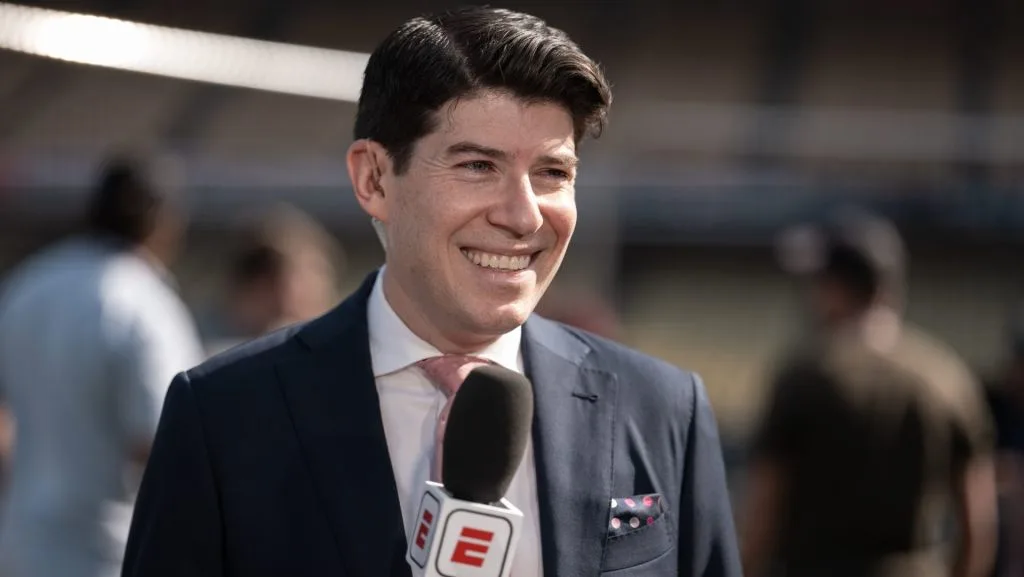
ESPN MLB insider Jeff Passan spoke to Front Office Sports about a wide range of topics, including whether a small-market World Series matchup between the Brewers and Rays could help curtail the looming lockout, backlash to previous comments he made about the Dodgers, and the momentum of his ESPN/Omaha Productions podcast, Sources Tell Jeff Passan .
This interview has been lightly edited for length and clarity.
Front Office Sports : In your estimation, does this small market World Series matchup do anything to potentially curtail or shorten the looming lockout this offseason?
JP: I wish the answer was yes, but I think part of it is because both sides are just so deeply entrenched in their positions that if the inverse of what we're going on right now is true, and this was the Dodgers and Yankees, the MLBPA wouldn't be deviating from its position either, because everyone believes what they want to believe when it comes to a salary cap and moving anyone off of their standard and set position at this point and perhaps going even further is just an impossibility, especially this early on.
So while it would be nice, I think for everybody to acknowledge the reasonable points that the other side is making, no one's prepared to do that at this point. It's what makes this so scary, I think, for baseball long-term. It's a possibility that they are going to remain in their corners and no one's going to want to come meet in the middle. And when that happens, the possibility of this lockout extending even deeper and games being lost becomes that much more realistic.
FOS: Both the Brewers and the Rays have very robust analytics departments, and they also just seem filled top to bottom with gamers. Are we seeing in real-time the melding of new-school analytics and old-school, personality-based eye test type scouting?
JP: I don't know that this is an in real-time thing because the Rays, especially, throughout the years have always leaned pretty heavily on their scouts. They have a big scouting department, and especially on the pro side. This postseason, they were running like four and five-deep scouts at multiple games. And it's not just guys who are traditional scouts. It's somebody like Brandon Hyde, who managed for the Orioles for a few years and who has a good relationship with the people in the front office there. And so they'll deploy him. Or it's a younger guy like Mike Ford, the former Yankee, who went to Princeton and wanted to get to a front office. And the Rays, essentially, just hire a few young former ballplayers, whose minds they whose minds they appreciate, and whose open mindedness they see as suitable and let them loose in roles that are yet to be defined.
So, when you have forward-thinking front offices, especially in smaller markets, they understand there can be a pretty significant return on investment if you spend a little bit extra money.
The Rays, they're not really spending it on payroll, but on infrastructure, that's an area in which they feel like they've found an advantage. And what that winds up doing is there are organizations out there that believe what you get from analytical models is enough to make good decisions. But with the Brewers and I think particularly the Rays, they feel like the more information that you can have, whether it's something that comes out of a computer or something that comes from people's eyes, there is a pretty distinct benefit to that.
FOS : In the big picture, it's really hard to criticize the Brewers' front office given what they've accomplished with the resources that they have. But I look at this Freddy Peralta trade. And for this season, they've gotten negative value back. Brandon Sproat was pretty brutal, getting pulled in the middle of at-bats for command issues. Jett Williams seems to be like number seven or eight on their middle infield depth chart, and now they're facing Peralta, albeit on a different team than the one they traded him to, in the World Series, and he's been dynamite. Does this have the potential to really bite them? The combo of not having him as their second or third starter, and having to go against him?
JP: The way Freddy Peralta is pitching right now, absolutely. But the Brewers have almost made this form of trade, getting rid of a guy on the eve of his free agency or in the year going into when he's going to be a free agent, part of their strategy.
And I think it illustrates where a lot of the frustration is among fans, especially in smaller market teams. It's not necessarily that the Dodgers and the Mets are specifically spending that much more money than everyone else.
It's the function of that, which is that when it comes to free agency, a lot of these organizations like the Brewers or even like the Rays, who have done this plenty as well, just believe they're not going to be able to afford these players and so they try and extract as much value out of them as they can. Now, could they afford them?
Yeah, I think that both the Rays and the Brewers could have larger payrolls, and especially the Rays and we would see that guarantee in a capped system and we would not necessarily see that guarantee with what the players want and is that gap at the bottom between the lower spending teams and the floor enough to make up for what they've lost at the top end?
Major League Baseball said yes. The Players Association doesn't believe that MLB's proposal is equivalent in that regard at all. When it comes to this labor dispute, there are two very different interpretations of the same set of facts and it's part of what's so frustrating, I think, for common fans that even though they want to understand this, doing so takes time and and it takes an investment in knowledge and fans, they just wanna watch their teams play—and their favorite players—and the vast majority are not going to dive into the minutiae that is labor relations.
FOS : We've been talking about the Dodgers a bit. Earlier this season, if you'll recall, there was a lot of backlash for things that you have said in the past about the Dodgers and how everybody could utilize their resources like they do. How much of this pushback, which happened amid revelations of complex financial issues with the Dodger ownerships and their other businesses, that you got on social media was valid in your opinion, and how much of it do you think was unfair and/or taken out of context?
JP: This is a subject that gets people extremely passionate, so I understand entirely that in my role, there's not a duty necessarily to be a voice for the fans, but at the very least to reflect the position of dissatisfaction, and I didn't do a good enough job of that.
There were things that I regret not looking into when it comes to what the Dodgers did and how they went out and did it, but I don't think that invalidates some of the points that I was trying to make, and clearly not making elegantly enough. Because I think that there are a lot of teams that could stand to be more like the Dodgers in the way that, with the resources they have, they go out and pursue players.
Can other teams go and splash cash around the way that the Dodgers have with signing bonuses or putting hundreds of millions of dollars a year into deferred salaries? No. But, I don't want to undersell either the idea that there are a lot of people and a lot of teams that could be spending more of the money that they have right now.
And I think the perfect illustration of this is what David Rubenstein, the new Orioles owner, said in front of an economic forum where, and I'm paraphrasing here, he said, "I saw everybody in baseball making more money than I was making in private equity. I wanted to join the party." I appreciate very much David Rubenstein's honesty because when you see an owner say the quiet part out loud, it at least suggests that the idea that these teams are doing very, very well compared to what a lot of owners will say publicly and what Major League Baseball will say, it just counteracts the perspectives publicly that they all have espoused.
FOS : That being said, do Dodgers fans have some real reason for concern between an aging roster, new MLB rules potentially coming in, all of this deferred money coming due, and all of these other financial issues that the Dodgers owners are facing outside of the team?
JP: I'll get to the deferred money first because I don't think that's quite as material as all of the other things, unless for some reason they don't have the cash to fund that deferred money. Because remember, deferrals, it pushes off into the future what is owed, but it does so by two years at best. You still need to put in a large chunk of money to then go and earn interest and eventually in that account have enough money to pay off that deferred compensation. So I think that's in a slightly different category.
Mark Walter's potential legal jeopardy, as much as the Dodgers and people at MLB have suggested that it's probably not going to affect the Dodgers, it absolutely can. If there are indictments handed down, if there are questions about cash flow, if there's efforts to untangle the enormous web that is Guggenheim and bring a little bit more opacity to the situation in baseball, then yeah, that could potentially impede the Dodgers from operating the way that they have in recent seasons.
And if the Dodgers aren't spending as much money or if the Dodgers are, say, a little bit more loath to go out there with those over the top signings like Kyle Tucker at $60 million a year was, or like getting Tanner Scott and Edwin Díaz to close in back-to-back offseasons, yeah, that combined with an aging roster could squeeze them a little bit, but we also can't forget the Dodgers have one of the five best farm systems in baseball. And while it is top heavy with hitters at this point, one thing that the Dodgers have done relatively well is maybe not develop long-term starting pitching, but develop arms that contribute at the big-league level whether it's Justin Wrobleski or Emmet Sheehan and just find those sorts of guys.
So the Dodgers I don't think anytime soon are gonna fall into a situation where they're in the doldrums, this is not going to be a rebuild waiting to happen because Freddie Freeman is getting older and going to be a free agent sooner because Teoscar Hernández is getting older or even Shohei Ohtani is getting older. They have enough there to compliment them on this beat.
FOS: Your podcast with ESPN and Omaha has a lot of momentum. It won Signal awards recently. What's it been like to really embrace this form of storytelling as another tool in your tool belt between writing and scoops and TV?
JP: An incredible, incredibly fulfilling challenge. And this sort of thing doesn't come naturally to me necessarily, so I'm learning it on the fly and trying to understand what works and what doesn't, what people want to see and hear and what they don't.
And it's been really fulfilling because it's challenging. And I love that. I don't naturally understand how something works or don't have the learned experience through doing it for as many years as I have been writing or doing TV. Learning on the fly is tough and it makes me nimble and it gives me the sorts of new skills that I need to be as well-rounded a modern journalist as I possibly can be. And I sometimes ask myself is it really necessary to do all of these things? Because you see other writers and reporters who have gone more into the multimedia space and they don't write and report quite as much as they used to. And the truth is, maybe it's not necessary, but it's sure fun.
Topics in this story
Gathered from external sources. Rights to this text belong to whoever originally published it.