The Dodgers' Growing Problem With Shohei Ohtani
In Year 3 of what is meant to be a 10-year partnership, the Los Angeles Dodgers need to decide what to do with Shohei Ohtani.
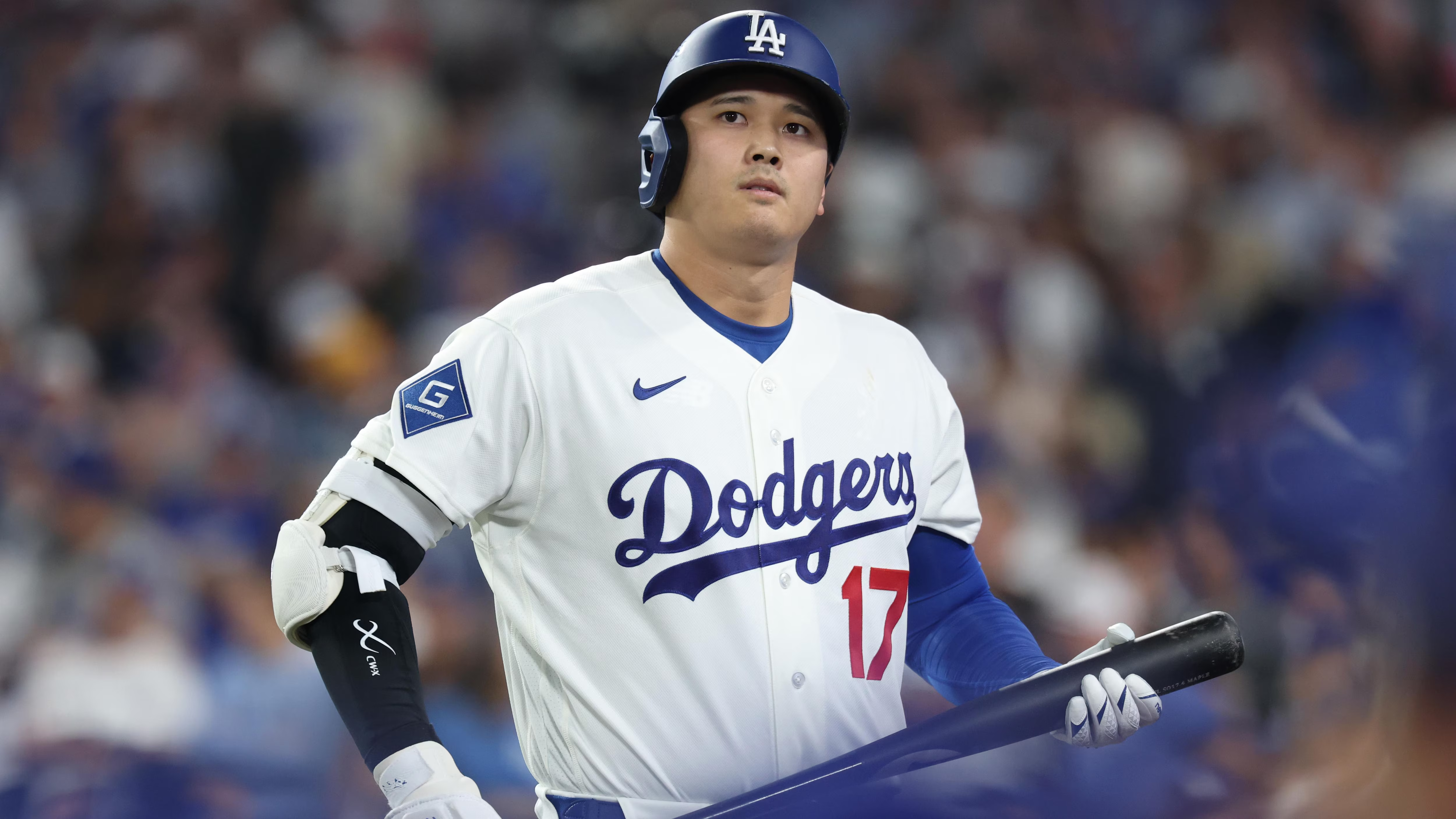
In Year 3 of what is meant to be a 10-year partnership, the Los Angeles Dodgers need to decide what to do with Shohei Ohtani.
There was nothing to it in 2024 and 2025. "Just let him cook" was the vibe coming out of Chavez Ravine, and no one could argue with the results. A 50-50 season in one year. A 55-homer season, with elite pitching on the side. A World Series championship and an MVP award for both.
It therefore borders on the brain-breaking to behold the wreckage of 2026. There are the smoldering ruins of the Dodgers after a four-game sweep by the Milwaukee Brewers in the NLCS. And there is Ohtani, who was too hurt to do much of anything in the last two months of the season.
What happens next is hard to tell. It depends on who learned what, and how strongly. Hard questions must be asked, and there won't be answers until someone blinks.
The Dodgers and Shohei Ohtani Both Own the Failures of 2026
The "Just let him cook" model worked just fine for Ohtani and the Dodgers for most of this season. He went into the All-Star break with a .953 OPS and 22 home runs as a hitter and a 1.79 ERA in 14 starts as a pitcher. He had one hand on his fifth MVP, which would have pushed him into territory previously known only to Barry Bonds.
Even then, though, there were quiet whispers of a physical breakdown that would gradually grow into a dull roar.
First, it was just his left knee . Then, it was his right biceps . The pitching stopped for good on July 3. The hitting stopped on August 18, at least based on the results. He had a .949 OPS and 30 homers on the day. After that, a .530 OPS and no homers. Even after Ohtani finally got off the long ball schneid in NLCS Game 4, he still exited the postseason with only a .630 OPS and one homer.
Dodgers manager Dave Roberts may have intentionally lit the fire that sent that homer soaring into the LA night. He had floated benching Ohtani for Game 3, and then implied during Game 4 that Ohtani had been motivated by the resulting chatter. If so, Roberts clearly understands how to get through to his famously non-communicative superstar.
However, accusations of mismanagement by Roberts and the Dodgers are backed by too much evidence. It wasn't until September 11 that the Dodgers finally placed Ohtani on the IL, where he stayed for two weeks. He still wasn't fully healthy when the playoffs began, and he never looked it during the Dodgers' briefer-than-expected stay. He struck out 14 times in 30 at-bats, at times looking like he had never swung a bat before .
According to Katie Woo of The Athletic , Ohtani said Thursday that it's "hard to tell" whether he'll need surgery for his injuries. That is notably not an outright rejection of the possibility, and that should make the Dodgers cringe.
It fuels the notion that Ohtani was too hurt to be playing all along. And with the upcoming lockout shutting down player-team communication , the last thing they need this offseason is their $700 million unicorn recovering from surgery in a black box known only to him and his equally secretive agent , Nez Balelo.
The Dodgers and Shohei Ohtani Need to Find a Happy Medium
Whatever happens with Ohtani during the offseason, now is the perfect time to discuss whether his two-way player act has finally become too much for him to bear.
He is 32 years old, after all, and he's already had two major surgeries on his right arm. Since it serves as both his landing leg when pitching and his back leg when hitting, it can't be emphasized strongly enough just how much Ohtani can't move forward with a compromised left knee.
And yet, he has already determined that there is no conversation to be had.
"Yes, definitely," Ohtani said when asked if he remained committed to pitching, according to Woo. He also added that he is "looking forward to having a better season next year."
Even if the Dodgers aren't ready to fight this, they must be ready to push back on letting Ohtani run his own show amid what should be a 26-man circus. And they just might be, if earlier quotes (presented by Woo) from Roberts and president of baseball operations Andrew Friedman are any indication:
Dave Roberts: "It's different than any player, you might argue, in any sport right now because he's a global phenomenon. Certainly it's tougher to manage, and I've got to be mindful."
Andrew Friedman: "What he's doing is unprecedented, and it takes a real toll. It's unprecedented for all of us, and we're kind of feeling our way through it together."
If the Dodgers can't convince Ohtani to stop pitching, their options for managing his workload are ultimately limited. He's already on a once-per-week schedule, with all but one of his 14 starts this year coming on six days of rest or more.
The only logical step is for the Dodgers to declare that Ohtani can't have it both ways on the same day.
He might not like it, but there's decent evidence that it would be for the best. In games where he hits but doesn't pitch, he has a career OPS of .951. In games where he does both, he has a .897 OPS. While his pitching excellence is arguably worth the modest drop-off in his offense, that argument falls apart if the risk of injury grows. After 2026, the Dodgers simply must treat that as the truth.
Somehow, some way, the Dodgers and Ohtani need to figure this out. Because barring a scenario in which Dodgers owner Mark Walter quickly sells the team and allows Ohtani to trigger an unusual opt-out clause , the two sides still have seven years left together.
They can, and should, be seven great years, but only if 2026 is treated as a warning rather than a one-off.
Stats courtesy of Baseball Reference , FanGraphs and Baseball Savant .
Topics in this story
Gathered from external sources. Rights to this text belong to whoever originally published it.