Explaining MLB Playoff Bracket 2026 Wild Card Format, Divisional Series and More
The 2026 Major League Baseball postseason gets underway Tuesday with four wild-card series.
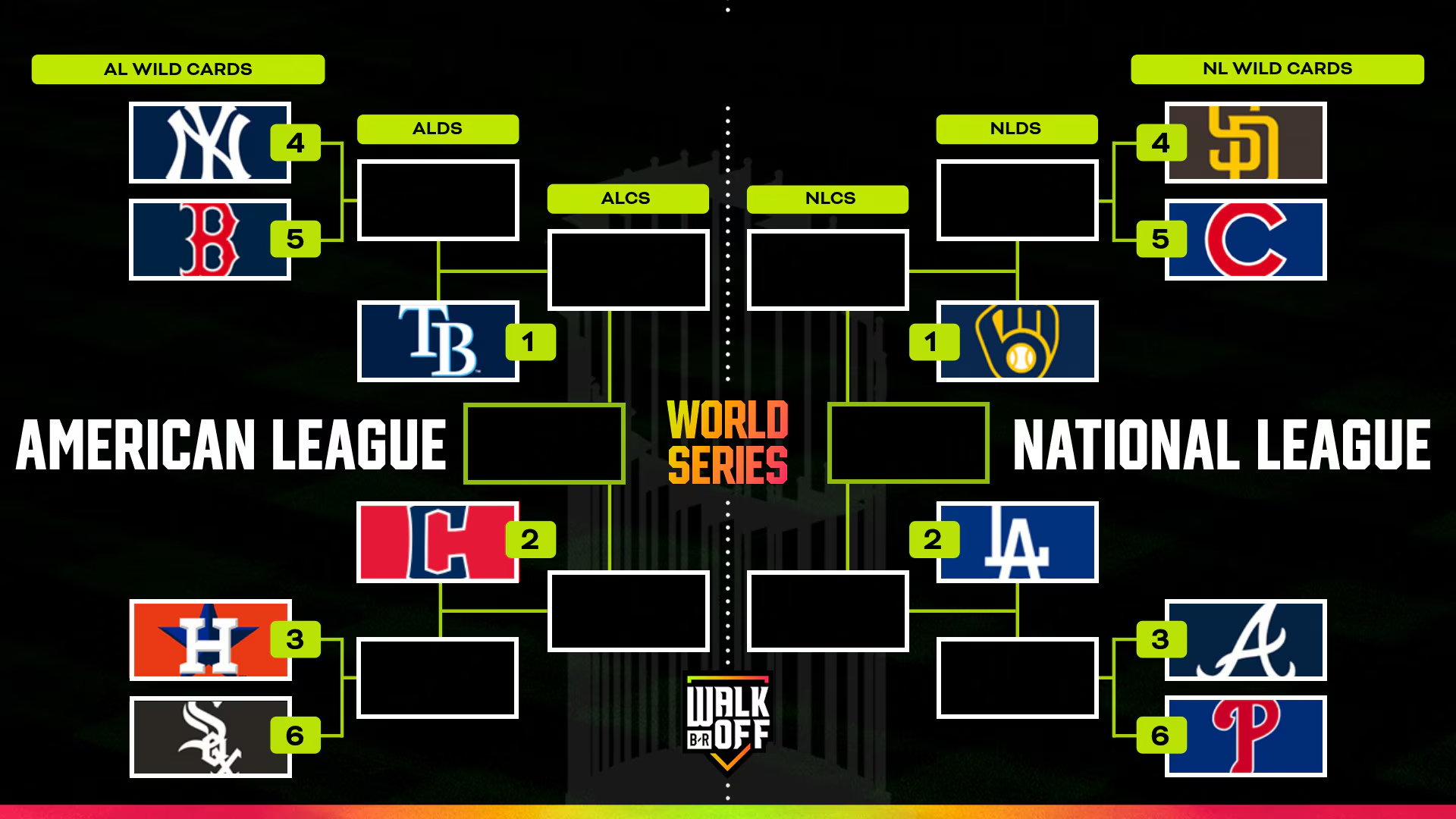
The 2026 Major League Baseball postseason gets underway Tuesday with four wild-card series.
The wild-card round produced mixed results over the last two years. In 2024, three of the four best-of-three series were over in two games. A year ago, three of the four series went the distance.
Two divisional rivalries headline the 2026 wild-card round. The New York Yankees and Boston Red Sox do battle in the American League, while the Atlanta Braves and Philadelphia Phillies square off in the National League.
History is not on the side of the wild-card teams, though, as only one wild-card participant qualified for the World Series in the last two seasons.
The Los Angeles Dodgers, Milwaukee Brewers, Tampa Bay Rays and Cleveland Guardians all get almost a week of rest before they start the postseason in the divisional round.
The wild-card round is a best-of-three format held exclusively at the home ball parks of the Nos. 3 and 4 seeds.
Atlanta faces Philadelphia in the marquee NL series. The San Diego Padres host the Chicago Cubs in the other NL matchup.
The Yankees-Red Sox series headlines the AL wild-card round. The Houston Astros host the Chicago White Sox in the other matchup.
The four wild-card winners will advance to the divisional round to play the No. 1 and No. 2 seeds in best-of-five series.
The two ALDS and NLDS winners will then meet in the best-of-seven ALCS and NLCS. The pennant winners in each league square off in the 2026 World Series.
The divisional round starts on October 3. The NLCS begins on October 11, with the ALCS starting one day later on October 12. The World Series is slated to start on October 23.
Game 3: Thursday, 2 p.m. ET, NBC (if necessary)
No. 6 Chicago White Sox at No. 3 Houston
Game 1: Tuesday, 5 p.m. ET, Peacock/NBCSN
Game 2: Wednesday, 5 p.m. ET, Peacock/NBCSN
Game 3: Thursday, 5 p.m. ET, Peacock/NBCSN (if necessary)
Game 3: Thursday, 8 p.m. ET, NBC (if necessary)
Game 1: Tuesday, 10 p.m. ET, Peacock/NBCSN
Game 2: Wednesday, 10 p.m. ET, Peacock/NBCSN
Game 3: Thursday, 10 p.m. ET, Peacock/NBCSN (if necessary)
Houston carries far more postseason experience than the Chicago White Sox, who were not expected to make the playoffs with their young core.
The Astros won the season series 5-2, but they enter the postseason with the worst staff ERA at 4.45.
Houston did hit the most home runs in the majors, led by Yordan Alvarez, and that might be the way it has to win games in the postseason.
The AL West champion can't win series with dominant pitching, like it did in previous season, so it will be fascinating to see which hurlers rise to the occasion in 2026.
The White Sox lineup had the most strikeouts of any playoff team. That's a big concern to go along with the inexperience strewn across their rotation.
However, the White Sox did go 6-2 in their last eight games and scored 54 runs in the process. There's a chance they can carry over that hot hitting into the postseason and spring an upset.
The Yankees rotation is built for the postseason.
Cam Schlittler, Max Fried and Gerrit Cole will pitch in that order against the Red Sox.
Schlittler allowed one earned run in three starts against the Red Sox in the regular season. Fried let up one run in 11.2 innings versus Boston. Cole had the worst outing of the three against Boston on June 27 with five earned runs, but there's a chance the Red Sox don't even get a chance to hit off him.
Boston can counter with Sonny Gray and Payton Tolle, but they need to be near perfect in Games 1 and 2 for the Red Sox to have a shot at Cole.
Tolle struck out 18 Yankees in two starts against them in 2026, while Gray allowed three earned runs over 13.2 innings versus the Yankees.
A low-scoring series seems to be in the cards, especially with Aaron Judge on the injured list for the Yankees.
A handful of tight, one-run games are expected given how strong all the projected starters performed in the rivalry during the regular season.
The Phillies went 2-6 in their final eight games and needed a win in Game 162 just to qualify for the postseason.
The wild-card team had to use ace Zack Wheeler on Sunday to confirm its postseason spot, so that takes him out of the first two games as a potential starter.
Cristopher Sanchez will pitch one of the first two games in Atlanta, but the rest of the rotation is a mystery because Jesus Luzardo just came off the injured list.
Atlanta will run with Chris Sale in Game 1 and then hope its makeshift rotation can get it into the NLDS. Tyler Mahle and Grant Holmes are the most likely starters behind Sale in an injury-riddled rotation.
The Braves went 4-3 in September against the Phillies, including a 2-1 record at home in a series that essentially clinched the NL East for them.
The NL East champion has the more consistent lineup, but the Phillies have the higher quality starting pitching. That might be enough for the No. 6 seed to spring an upset.
Pete Crow-Armstrong and the Chicago Cubs struggled to score for most of the final week of the regular season. They scored more than two runs in a game twice during a 2-4 week in which they were overtaken by San Diego for the No. 4 seed.
The Cubs won five of their six regular-season games with the Padres, but all of those games were played before the All-Star break.
San Diego was one of the best MLB teams in September. It washed away most of its first-half struggles and looks like a formidable force in the NL bracket.
The Padres probably have a little revenge on their minds, too, after they lost in the wild-card round at Wrigley Field a year ago.
It's hard to deny how well the Padres played down the stretch, and if that continues into the postseason, they might be able to make a deep run in the NL.
Topics in this story
Gathered from external sources. Rights to this text belong to whoever originally published it.