How the Small-Market Brewers Put the Dodgers' $500M Dynasty on Life Support
Those who would weep for the Los Angeles Dodgers right now are in the minority. They can spend $500 million on a roster all they want, but money like that doesn't buy sympathy when it's on the verge of failure.
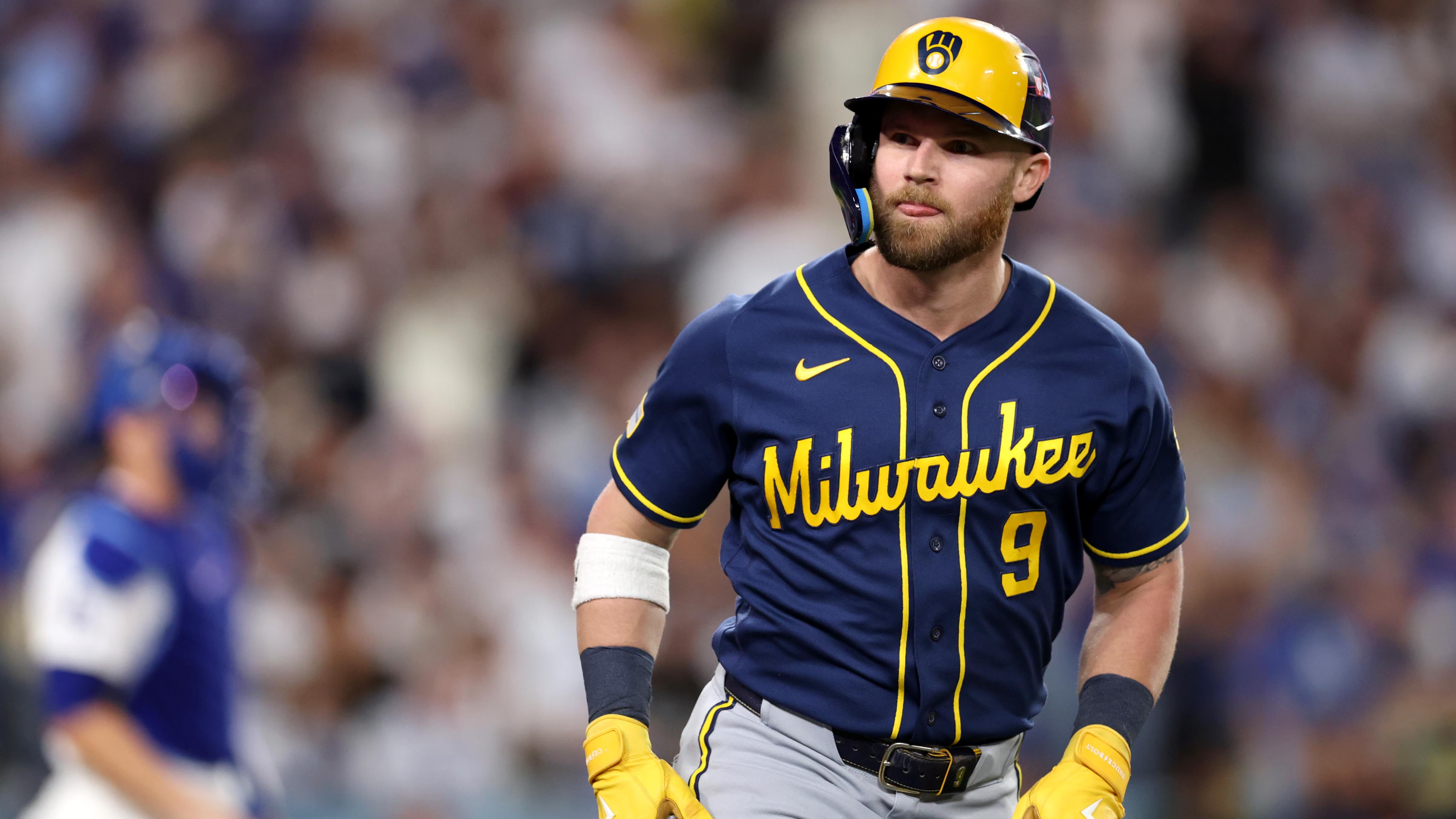
Those who would weep for the Los Angeles Dodgers right now are in the minority. They can spend $500 million on a roster all they want, but money like that doesn't buy sympathy when it's on the verge of failure.
This is a story of the National League Championship Series. Don't confuse it with the story. Despite costing a third as much as their opponent, the Milwaukee Brewers have been the better team, running up a 3-0 lead to put themselves on the verge of a sweep to the World Series.
The Brewers overwhelmed the Dodgers in the first two games, wearing out Tarik Skubal and Yoshinobu Yamamoto and allowing only one extra-base hit to Dodgers hitters. In the seventh inning of Game 3, Milwaukee made Dave Roberts pay for his lack of faith in his bullpen, getting to Blake Snell for game-breaking back-to-back home runs as the lefty was approaching 100 pitches.
It's as if the Brewers truly deserve to be crowned as the National League's best team. Go figure, after they won an MLB-best 103 regular-season games.
And so, with apologies to J.R.R. Tolkien , the Dodgers' quest for a World Series three-peat stands upon the edge of a knife. They can and should blame themselves. The rest of us can and should credit the Brewers.
When criticizing the Dodgers, you must follow a certain ritual. It involves doing an awkward dance while acknowledging that they are, in fact, a well-run franchise.
It's impossible to separate their sheer quality from the sheer might of their resources. It's also impossible to ignore questions about how team owner Mark Walter accesses those resources. Yet president of baseball operations Andrew Friedman is ultimately the architect here, and he gets high marks for using free agency, trades and player development to keep the machine humming.
The Dodgers have won the NL West 11 times in 12 seasons under Friedman. They are typically in the top five of the NL in runs scored and runs allowed. They hit a lot of home runs. They strike a lot of guys out. It's clearly a winning formula.
However, this formula has its limits, as was evident even as the Dodgers basked in the afterglow of their second straight World Series championship last October.
An offense that was getting older and less productive clearly needed to get younger and more dynamic. Fixing the problem should have been more complicated than simply signing Kyle Tucker , and even his four-year, $240 million contract smacked more of hubris than good sense. A 29-year-old player is more middle-aged than young these days, and he had spent a good chunk of the last two seasons limited by injuries.
The poor season Tucker had this year was always a possibility, and its occurrence (97 OPS+) doomed the lineup to more pain from the sub-prime seasons of 36-year-old Freddie Freeman (118 OPS+) and 33-year-old Mookie Betts (113 OPS+).
Shohei Ohtani could have saved the Dodgers, and he did for a time as he cranked 30 home runs with a .949 OPS through August 18. At some point, though, the pain in his left knee and right arm became an open secret. The Dodgers just let him keep playing through it… and playing through it… and playing through it.
The bill for that has come due. The four-time MVP didn't feel healthy even after a two-week IL stint in September, and now he looks worse than he's letting on. Ohtani's beautiful swing has devolved into bad performance art. No wonder he's hit no homers and has one RBI since August 19.
It's Ohtani's track record, reputation and aura keeping him in the lineup, and at the expense of someone who is right there to give the Dodgers' lineup what it needs. Josue De Paula is an elite prospect who posted a 1.081 OPS in a late-season cup of coffee, yet Roberts can't bring himself to get him off the bennch.
Thank goodness the Dodgers can still pitch, to the tune of a 3.55 ERA in the regular season and now a 3.39 ERA in the postseason. Yet hidden in here, too, is another story of hubris.
Between Tanner Scott in 2025 and Edwin Díaz this year, throwing big money at a free-agent reliever in hopes of a quick fix for a persistently leaky bullpen has burned the Dodgers in consecutive seasons. And while their midseason trade for Skubal had plenty of merit on its own, it was a trade the Dodgers made not because they needed to, but because they could. Upgrade the offense or the bullpen? Nah, go get the best guy. It doesn't matter that he's another starter.
All of it has the Dodgers on the brink. They may be a $500 million team, but that number doesn't imply perfection so much as complacency. The Dodgers could afford to go bigger and better. They're about to have a legacy of leaving the job half-done.
To be clear, the Dodgers have a $340.6 million payroll and $165.9 million in luxury tax penalties attached to their 2026 roster . The latter alone is more than the $143.7 million the Brewers are spending on their roster.
According to MLB commissioner Rob Manfred, this matters. It matters so much that baseball must have a salary cap so teams like the Brewers can compete with teams like the Dodgers.
Yeah, one wonders how broken his brain is right now.
Even if the Brewers can't buy talent like the Dodgers, their nearly decade-long run of excellence is finally about to prove that identifying and maximizing talent can be just as effective, even despite being significantly cheaper. Jake Bauers , whose 3.3 rWAR for this season upped his seven-year career total to 2.0, knows what's up.
"There is a right way to play the game of baseball, and if you can commit to that and get an entire team to commit to that, you can overcome a lot of things," the veteran first baseman told ESPN's Jeff Passan . "As far as payrolls and all that, you've still got to play the game. And all the talent and all the money in the world can't buy the focus that you need to win baseball games."
Offensively, the average Brewer is almost four years younger than the average Dodger. Yet that's only an advantage in the abstract. What really matters is that the Brewers' offense:
Grinds at-bats, with the lowest swing rate in MLB
Puts runners on, with the highest OBP in MLB
Moves runners over, with the fifth-most stolen bases and sacrifice bunts in MLB
Hits in the clutch, with the second-highest AVG and SLG with runners in scoring position in MLB
The San Diego Padres felt this in the NLDS, especially when Jackson Chourio stung Mason Miller in Game 2. Now it's the Dodgers' turn in the NLCS. Milwaukee's offense brought out all its tricks i n Game 2, chasing Yamamoto after 2.2 innings and erasing not one, not two, but three deficits to win 7-4. Bauers had a hand in that with a 12-pitch walk. The sequel, an 11-pitch homer off Snell in Game 3, was even better.
On the other side, the Brewers play clean defense in support of nasty pitchers. Jacob Misiorowski can throw 105 mph, yet he's just one of 11 of 18 Brewers pitchers (min. 20 IP) who topped the league average of 94.7 mph on the fastball. It helps explain how they saw the Dodgers' 3.55 ERA and raised them a 3.51 ERA.
It also explains how the Dodgers' hitters' age has become a subplot in the NLCS. Brewers pitchers have been the storyline, particularly their bullpen. Milwaukee relievers have a 1.32 ERA for the series. Their average fastball? Try 98.5 mph.
Regardless of what happens next for the Brewers, GM Matt Arnold feels like a shoo-in for Executive of the Year. Pat Murphy should likewise have a third straight NL Manager of the Year in the bag. He has played the hand Arnold has dealt him masterfully, whether we're talking through new-school bullpen management or with an old-school chewing out of a rookie for violating the team's culture .
It's perhaps overly simple to distill this NLCS down to the best team money can buy versus the best team the mind can imagine. Yet that is more or less the truth. And whether the league likes it or not, the result in play has a refreshing message for the broader fanbase of Major League Baseball.
As much as it matters, there are some things money can't buy.
Stats courtesy of Baseball Reference , FanGraphs and Baseball Savant .
Topics in this story
Gathered from external sources. Rights to this text belong to whoever originally published it.