8 MLB Owners We Hope Sell the Team After Angels, Padres Cash In
It's a good time to be in the business of selling Major League Baseball teams. Just ask the San Diego Padres and Los Angeles Angels.
It's a good time to be in the business of selling Major League Baseball teams. Just ask the San Diego Padres and Los Angeles Angels.
According to Forbes , the Padres and Angels began this year valued at $3.1 billion and $2.8 billion , respectively. They actually sold for a combined $7.9 billion, split between $3.9 billion for the Padres and $4 billion for the Angels.
Two more data points for the recent phenomenon of professional sports franchises selling for huge sums. It seems the world's uber-wealthy have found a new gold rush, which raises one question: Who's next?
Out of the 30 ownership groups in MLB right now, you might only need one hand to count how many are actually well-liked by their own fans. But from our perspective, there are eight who we wish would sell.
We'll go in ascending order of franchise values.
All franchise sale prices and current values are according to Forbes .
Calling the Reds a "storied franchise" doesn't do them justice. They are the OG in Major League Baseball, with a history that goes all the way back to 1882.
The Castellinis haven't exactly enriched this history during their stewardship of the Reds. The club is 23rd in the league in wins since 2006, with a 2-11 record in five separate playoff runs. You still have to go back to the 1995 NLDS to find the last time the Reds actually won a playoff series.
The Castellinis can't even claim credit for the lovely Great American Ball Park, which opened in 2003 under Carl Lindner. You're also not going to find a single soul who will defend this regime as a noble failure, as the Castellinis have kept the club's payrolls stuck in the bottom half of MLB over the last two decades.
It was two years ago that Phil Castellini chided fans for wanting more, snidely asking them what they would do to have the Reds "be more profitable, make more money and compete more?"
Earth to Phil: Nobody is making you and your family own the Reds. Now more than ever, selling them is the best thing you can do for the people of Cincinnati.
As far as Pirates fans are concerned, this is preaching to the choir. They have literally chanted " Sell the team! " to Nutting's face, the epitome of this particular brand of activism.
The only defense of Nutting is that the Bucs didn't start going wrong when he took over the team in 2007. The team's ills go back to the 1970s, as the 1979 World Series remains the last playoff series the Pirates have won.
Still, Nutting hasn't moved the ball in the right direction. The Bucs are 27th in MLB in wins since he secured a controlling interest in 2007. More often than not, the team is also in the bottom five of MLB in payroll.
It's a small-market team, granted, yet even the Reds have managed more success despite a similar disadvantage. Unless you want to give them credit for using the No. 1 pick in 2023 on Paul Skenes, the Pirates just never seem to have anything cooking in player development. That's the whole ballgame in smaller markets.
At best, this speaks to a lack of urgency on Nutting's part. At worst, it speaks to a lack of care. Either way, the Bucs would be better off if he got out.
Like the Reds and Pirates, the Guardians are a small-market team. Unlike those two, they're exceptionally well-run.
The Guardians have made the playoffs seven times since 2016, and are on track to make it eight times this year. We're not talking empty-calorie playoff runs either. They went to the World Series (sorry to bring it up, Cleveland fans) in 2016 and to the ALCS as recently as 2024.
All this is even though the Guardians have routinely ranked in the bottom 10 of MLB in payroll, and often even in the bottom five. So, you can say this much about CEO Paul Dolan: He's hired the right people in the front office .
Even so, days when the Guardians carried top-10 payrolls in the early 2000s are still in living memory. It makes one wonder what the team might have accomplished over the last decade if it had ownership willing to push in more chips. Alas, Guardians fans know better than to expect as much at this point.
The tricky part here is that the Guardians have already been sold… sort of. Private equity investor David Blitzer bought a minority share of the franchise in 2022. Zack Meisel of The Athletic has reported that Blitzer can become the majority owner as soon as 2027, but could also punt the decision a couple of years down the line.
Don't worry, Rockies fans. Things are moving in the right direction. As of earlier this year, 40 percent of the Rockies are owned by Greg Penner and Carrie Walton Penner, who also own the Denver Broncos.
Mind you, any mention of "Rockies fans" comes with a sort of confused tone. They're not exactly the favorite among Denver sports franchises. And if you're wondering how to square that with how the Rockies draw at least two million fans to Coors Field every year, here's a hint: It's an amazing place to spend a day.
It's certainly not recommended to go there for the baseball, and especially not these days. Since 2019, the Rockies have been dead last in MLB in wins.
How to win consistently when you're the only team that plays home games a mile above sea level is a vexing question, but that's all the more reason why the Rockies should be MLB's premier analytical powerhouse. They instead resisted keeping up with the times for years before hiring Paul DePodesta, and even his reputation as a keen baseball mind had layers of dust on it.
All this is to say that the Monforts have squandered decades' worth of time to turn the Rockies into the Denver institution they should be. The franchise and the city deserve better.
The Twins have added some new minority investors as of late last year, yet the franchise remains the property of the Pohlad family.
To give credit where it's due, the Twins won the World Series in 1987 and 1991 under Carl Pohlad. Those helped propel the franchise into "it" status in the 1990s. Or at least, that's how those of us with a soft spot for Little Big League remember it.
By contrast, the modern story of the Twins is of a franchise that is just sort of there for the most part. A strong run in the early part of this century has given way to a run since 2011, for which the Twins are 26th in MLB in wins. They were ninth in MLB in payroll in that 2011 season. This year, they opened at 23rd.
Again, small market and all that stuff applies. Yet the Twins aren't even fighting the good fight these teams need to win. They had some success under Thad Levine and Derek Falvey, and both have since left the front office.
Given all this and last year's trade deadline fire sale , the Twins feel a bit like a rudderless ship these days. Selling for billions so the team can be someone else's problem doesn't sound like a bad deal.
When Mike Ilitch died in 2017, the Tigers opened at No. 2 in payroll. They went down to 19th the following year and only just snuck back into the top 10 this season.
This alone demonstrates the difference in competitive mindsets between the late Mike Ilitch and his son, Christopher. This year's top-10 payroll doesn't totally absolve him, either. Just look at how the team handled Tarik Skubal. They low-balled the back-to-back Cy Young Award winner not once , but twice , and then traded him rather than put faith in his power to get a contention run across the finish line.
It's almost impressive how smoothly the modern Tigers walk the line between doing just enough to keep fans interested and holding back just enough to keep the same fans jaded. In this context, it's such a waste.
After all, that long rebuild that the Tigers went through in the late 2010s and early 2020s is over. They made the playoffs in 2024 and 2025, and even this year's step back has a silver lining: up-and-comers like Kevin McGonigle and Max Clark. Tigers fans should be anticipating a golden age, with many all-in years to come.
If Ilitch isn't going to make these dreams come true, it raises the question of why he's bothering. "To make money" is the obvious answer, but he can do that just as easily by selling.
It feels weird to go here. Henry is the best thing to ever happen to the Red Sox, and here's the evidence:
World Series Championships, 1919-2001: 0
World Series Championships: 2002-2026: 4
After a quarter-century in the owner's box, though, the question now is what exactly Henry still means to accomplish with the Red Sox.
This is another case of an ostensible powerhouse that doesn't act like it, as the Red Sox have gone from top-five in payroll annually between 2004 and 2020 to outside the top 10 in each of the last four years .
The Red Sox resuming contention over the last two years is a point for greater efficiency, but that's a hard sell for a fanbase that grew accustomed to winning championships over the last 14 years. The fact that the owner making the pitch is the same owner who delivered the titles is just…weird.
It would be nice if Henry explained himself, but he's been a man behind a curtain for years . It all paints a picture of an owner whose interests have diverged from those of Red Sox fans, who would be happy at this point if Henry took his billions and left.
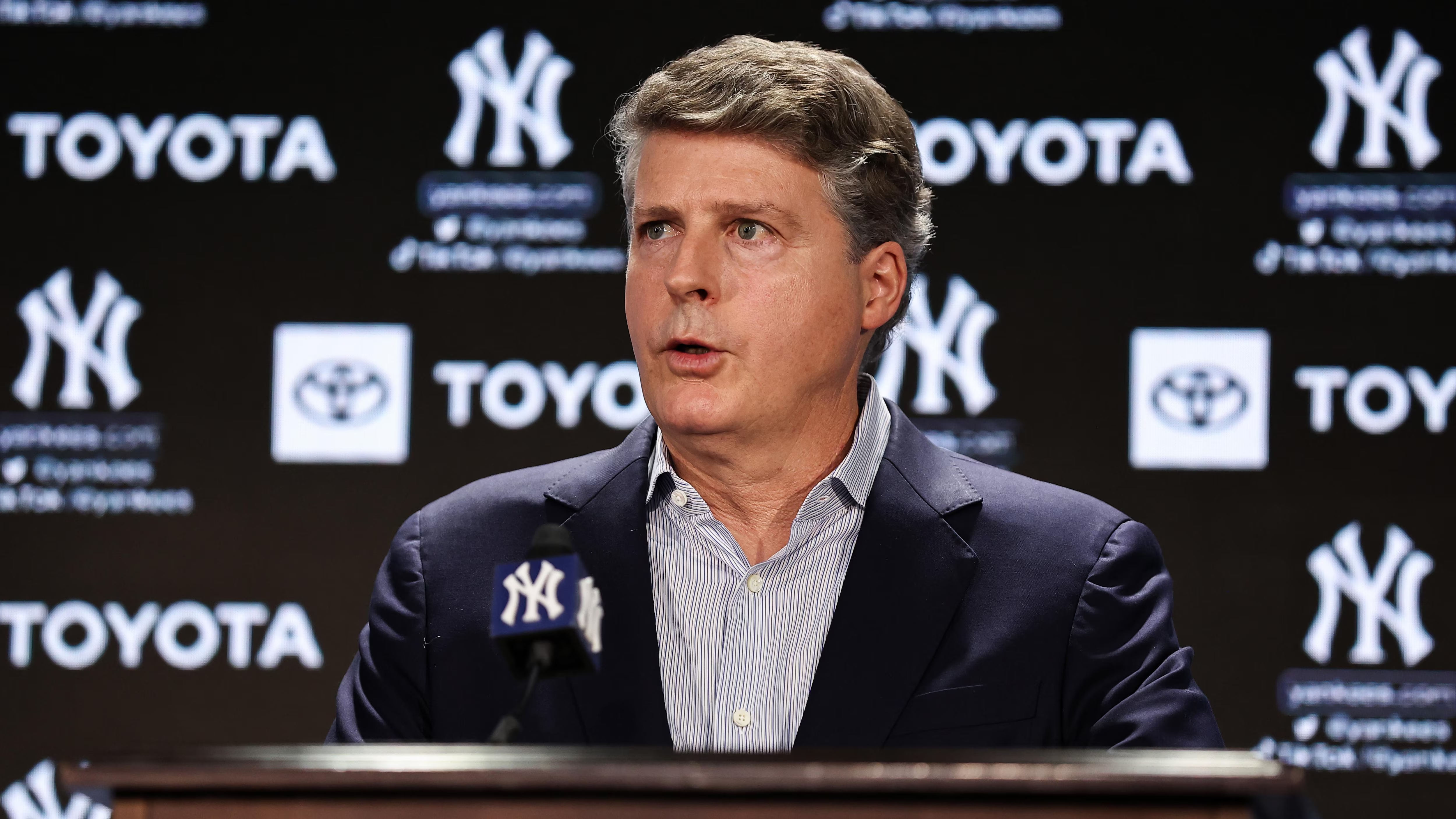
You just have to wonder if Hal Steinbrenner saw the NBA's Los Angeles Lakers sell for a record $12 billion and thought to himself, "Hmmm..."
According to Forbes , the Lakers were valued at $10 billion prior to the sale. They essentially are the Yankees of the basketball world, so perhaps a similar 20 percent premium would apply to the Yankees for a sale price of over $10 billion.
For Steinbrenner's part, it might be hard to put a price on the relief he would feel at no longer owning the Yankees. He tends to talk about running them as if it's some grand burden, specifically in the sense that he often pines for a lower payroll . As it is, it's been a long time since the Yankees were annual leaders in payroll .
A viable alternative is to find a front office head who can make better use of what Steinbrenner is comfortable spending, but why do that when you can just keep bringing back Brian Cashman? He's produced a single World Series winner in the last 25 years, but he's mastered the art of winning consistently in the regular season. Those two things are the same, right?
I'm laying on the sarcasm because it honestly is a tragedy what MLB's 27-time World Series champions have been reduced to. They should be a center of gravity, not a spot on the map. If Steinbrenner doesn't want to fix this, there's no shame in selling to someone who does.
Topics in this story
Gathered from external sources. Rights to this text belong to whoever originally published it.