Ranking Every Player in Rays vs. Brewers 2026 World Series Matchup From 52 to 1
The 2026 World Series begins on Friday night, and while the Milwaukee Brewers vs. Tampa Bay Rays matchup doesn't have the same level of name recognition we've seen the past few years in the Fall Classic, there is no shortage of star power.
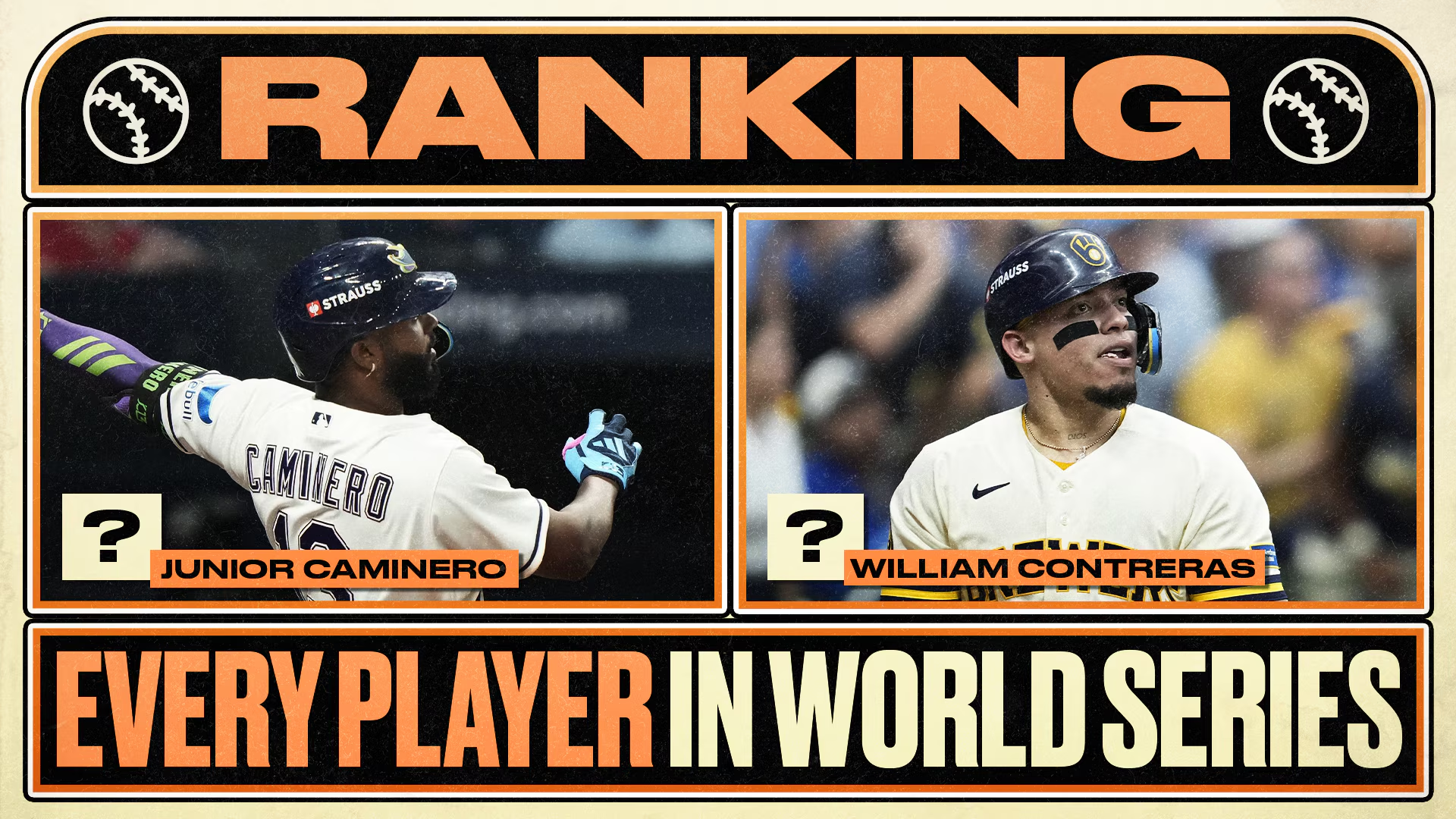
The 2026 World Series begins on Friday night, and while the Milwaukee Brewers vs. Tampa Bay Rays matchup doesn't have the same level of name recognition we've seen the past few years in the Fall Classic, there is no shortage of star power.
Milwaukee ace Jacob Misiorowski and Tampa Bay slugger Junior Caminero are the most recognizable names set to take the field, but both rosters feature electric arms and well-constructed lineups that can put runs on the board in a variety of different ways.
Ahead of the first pitch in Game 1, we've ranked all 52 players set to take the field in the 2026 World Series.
Players are ranked based on their 2026 production, importance to their team and more recent performance during the postseason. This is not meant to be a rundown of career accomplishments. It's a preview of who is most likely to make an impact on baseball's biggest stage in the coming days.
52-42 | 41-36 | 35-30 | 29-25 | 24-20 | 19-15 | 14-12 | 11-9 | 8-6 | 5 | 4 | 3 | 2 | 1
Long relievers Brody Hopkins, Kyle Harrison and Chad Patrick have yet to make an appearance this postseason, while Cole Sulser (0.2 IP, 3 ER), Shane Drohan (1.0 IP, 1 ER), Steven Matz (2.0 IP, 0 ER) and Antonio Senzatela (1.2 IP, 0 ER) have been used sparingly.
Never say never when it comes to arms being needed in the World Series—just ask Will Klein. However, no one from that group of arms is expected to log key innings in the World Series.
Cedric Mullins, Nick Fortes and Jorge Mateo have a combined seven plate appearances for the Rays in the playoffs, while Gary Sánchez walked in his lone trip to the plate. Mullins does have a home run and a steal, so he's one to keep an eye on for a potential late-inning impact.
41. OF Luis Lara, MIL 40. IF Ben Williamson, TB 39. OF Ryan Vilade, TB 38. 3B Joey Ortiz, MIL 37. DH Andrew Vaughn, MIL
Both teams utilize platoons at multiple positions.
For Milwaukee, Luis Lara, Joey Ortiz and Andrew Vaughn generally start in place of Sal Frelick (RF), David Hamilton (3B) and Christian Yelich (DH) when a left-handed starter is on the mound. The Rays don't have a lefty starter with Shane McClanahan injured, but Vaughn could see some pinch-hit opportunities against Ian Seymour or Cam Booser.
On the other side, Ben Williamson and Ryan Vilade have spelled Richie Palacios (2B) and Victor Mesa Jr. (RF) against southpaws, and that will be relevant when Robert Gasser toes the rubber for Milwaukee. Vilade had an .818 OPS and seven home runs in 170 plate appearances against lefties during the regular season.
May had a 4.38 ERA in 109 innings with the Cardinals before he was traded to the Brewers at the deadline along with reliever JoJo Romero, but he struggled to a 5.65 ERA following the trade and has allowed five earned runs in seven innings this postseason. He will be a candidate to start Game 4 along with Shane Drohan, though a couple innings in a bullpen game is more likely.
35. RHP Tyler Wells, TB 34. LHP Ian Seymour, TB
Wells was fantastic after he was acquired from the Orioles at the trade deadline, but he has allowed multiple runs in two of his four appearances this postseason and fallen down the bullpen pecking order.
Seymour has chewed up 7.1 innings over six appearances this postseason. He slots in as the second lefty behind Cam Booser, but his work will likely be limited to multi-inning bulk work.
33. OF Sal Frelick, MIL 32. DH Christian Yelich, MIL 31. 2B Richie Palacios, TB 30. 3B David Hamilton, MIL
These players represent the strong side of the platoons mentioned on the previous slide, and while Frelick (3-for-15) is having a quiet postseason, Hamilton (5-for-11, HR) and Yelich (7-for-24) have both been productive.
Palacios (8-for-22, 3 2B) has also provided a nice spark at the bottom of the Tampa Bay lineup, and he adds secondary value with his glove and his legs.
29. LHP JoJo Romero, MIL 28. RHP Kevin Kelly, TB 27. LHP Cam Booser, TB
Romero has struck out nine of the 19 batters he has faced this postseason while allowing just one earned run, and his ability to work high-leverage spots gives Milwaukee more flexibility in how they deploy fellow lefties Aaron Ashby and DL Hall.
Kevin Kelly and Cam Booser each have four holds and serve as the primary late-inning setup bridge to closer Bryan Baker, with Booser in particular having a standout postseason with 4.2 scoreless innings over six appearances.
DeLuca hit .276/.306/.432 after the All-Star break while settling in as an everyday starter, and that offensive production is a bonus on top of his strong defensive game (4 DRS, 6 OAA) in center field. The 28-year-old is 6-for-30 with a double and two steals in the playoffs.
Jax posted a 3.53 ERA, 1.18 WHIP and 116 strikeouts in 112.1 innings spanning 23 starts and 11 relief appearances, making a smooth transition into a starting role. He took the loss in Game 3 of the ALCS (4.0 IP, 5 H, 3 ER, 2 BB, 2 K), and while he is the leading candidate for a Game 4 start, he could also make an impact out of the bullpen.
24. SS Cooper Pratt, MIL 23. SS Taylor Walls, TB
Pratt (9-for-29, .655 OPS) and Walls (4-for-27, .381 OPS) both provide limited offensive impact and standout defense at a premium position. They hit a combined five home runs in 699 plate appearances during the regular season and a double in Game 4 of the NLDS by Pratt is their lone extra-base hit, but their glove work still makes them key pieces of the World Series puzzle.
Hall has high-octane stuff from the left side and has been one of Milwaukee's most reliable late-inning arms all season. He had a 1.91 ERA and 9.4 K/9 in 61.1 innings during the regular season, and has tossed 5.1 scoreless innings so far this postseason. Walks can be an issue at times, but he has been lights out.
21. OF Victor Mesa Jr., TB 20. C Liam Hicks, TB
The Rays had a top-heavy lineup for much of the first half of the season with Junior Caminero, Yandy Díaz and Jonathan Aranda doing most of the heavy lifting offensively.
The addition of Hicks at the deadline and emergence of Mesa as the primary right fielder added some much-needed length to their lineup, and while both have been relatively quiet so far this postseason, they are capable of making a significant impact.
Armed with a fastball that averages 98.8 mph and a slider that is generating a 38.0 percent whiff rate, Uribe has closer-caliber stuff serving as Milwaukee's primary setup man.
He allowed just five hits and one unearned run in his first six appearances this postseason before a shaky outing in Game 4 of the NLCS (0.1 IP, 1 H, 3 BB, 2 ER), but he has been one of the game's top setup relievers the last few years.
18. OF Chandler Simpson, TB 17. 1B Jonathan Aranda, TB
Simpson has elite contact skills and electric speed, while Aranda is one of the few consistent power threats in the Tampa Bay lineup. Both have a sub-.700 OPS in the playoffs, but they were two of the club's offensive standouts during the regular season and will be counted on to make their mark on the Fall Classic.
16. RHP Logan Henderson, MIL 15. LHP Robert Gasser, MIL
Henderson did not allow more than three earned runs in any of his 18 starts during the regular season. That has continued in the playoffs, as he was the Game 2 starter for both the NLDS (5.0 IP, 2 H, 1 ER) and NLCS (4.0 IP, 3 H, 4 R, 2 ER), taking a no-decision in both outings.
Gasser came on strong late with a 1.67 ERA in 32.1 innings over his final six starts, and he threw it well in Game 4 of the NLDS (4.0 IP, 3 H, 1 ER) and Game 3 of the NLCS (5.0 IP, 3 H, 0 ER). Who would have guessed he would be one of the team's top three starters just a few months ago?
The one-year, $13 million deal Martinez signed with the Rays in February turned out to be one of the best moves of the offseason. The 36-year-old was an All-Star for the first time, going 15-6 with a 3.10 ERA in a team-high 180 innings.
He was the winning pitcher in Game 4 of the ALCS (5.1 IP, 2 H, 1 ER), and while he doesn't strike out a ton of batters, he thrives on elite command and weak contact .
13. RHP Trevor Megill, MIL 12. RHP Bryan Baker, TB
Baker (65 G, 41/44 SV, 1.44 ERA, 9.1 K/9) and Megill (63 G, 30/33 SV, 2.63 ERA, 10.1 K/9) were two of the most dominant closers in baseball this season, and that has continued in October as they have nailed down all nine combined save chances.
The Brewers have sometimes relied on Aaron Ashby to get things across the finish line, so Baker gets the higher spot in the rankings simply due to his slightly elevated importance to his team's success.
11. OF Garrett Mitchell, MIL 10. OF Jackson Chourio, MIL 9. 2B Brice Turang, MIL
Turang (7.3), Chourio (4.9) and Mitchell (3.4) racked up a combined 15.6 WAR during the regular season, checking in as the top three on Milwaukee's WAR leaderboard among position players.
Chourio and Mitchell have each slugged two home runs in the playoffs, while Turang has a terrific .382 on-base percentage thanks to six hits and seven walks in eight games.
Outside of their contributions at the plate, which have been modest in October relative to their regular-season production, all three are also standout defenders. Turang and Chourio are Gold Glove finalists, while Mitchell (1,105 INN, 7 DRS, 7 OAA) has standout defensive metrics in center field.
8. 1B Jake Bauers, MIL 7. RHP Freddy Peralta, TB
The ALCS and NLCS MVP winners also have the unique distinction of facing off against the team they broke into the big leagues with in this World Series matchup.
Bauers (140 OPS+, 26 HR, 3.3 WAR) has authored one of the biggest breakouts in baseball, while Peralta (10 GS, 3.25 ERA, 55.1 IP) immediately turned around a disappointing season when he joined the Rays at the trade deadline.
Peralta had a 0.75 ERA in 12 innings in the ALCS, recording two wins and a hold in relief, while Bauers went 4-for-14 with a double, a home run and six RBI in the NLCS.
One of the best pure hitters in baseball, Díaz is batting .308/.341/.564 with four doubles, two home runs and four RBI this postseason out of the leadoff spot in the Tampa Bay lineup.
The 35-year-old led the AL in hits (180) during the regular season while posting a .293/.359/.446 line and 124 OPS+, and he has quietly put together a resume that ranks among the best in Tampa Bay franchise history.
Regular Season: 75 G, 4 SV, 15 HLD, 3.12 ERA, 116 K, 89.1 IP Postseason: 6 G, 2 SV, 1 HLD, 0.00 ERA, 11 K, 12.1 IP
Aaron Ashby is Milwaukee's leader in innings pitched this postseason, despite working exclusively in relief, and he has surrendered just four hits in 12.1 scoreless frames.
With one win, two saves and one hold, he has been the pitching staff's Swiss Army knife, filling a critical role akin to what Andrew Miller was for Cleveland during their 2016 World Series run.
Jacob Misiorowski is the unquestioned ace of the staff, Trevor Megill is an All-Star closer and Logan Henderson was one of the best pitchers in baseball during the second half of the season, but Ashby might be the single most important pitcher on the Brewers staff.
4. C William Contreras, Milwaukee Brewers
Regular Season: 147 G, .270/.341/.417, 46 XBH (18 HR), 94 RBI Postseason: 8 G, .367/.457/.700, 4 XBH (3 HR), 5 RBI
A three-time All-Star, two-time Silver Slugger winner and one of the best all-around catchers in baseball, William Contreras is the " straw that stirs the drink " for the Brewers.
He hits No. 3 in the Milwaukee lineup and had an .821 OPS with runners in scoring position this year, as he has proven time and again to have a knack for the big hit in the big moment. After going 5-for-14 with a double and a home run in the NLCS, he is swinging it as well as anyone for the Brewers.
His ability to control the running game (34.2% CS during regular season) will also be extremely important against a Rays team that tied for second in the majors with 164 steals.
Regular Season: 30 GS, 16-5, 2.67 ERA, 0.91 WHIP, 174 K, 172.0 IP Postseason: 3 GS, 2-0, 1.29 ERA, 0.76 WHIP, 23 K, 21.0 IP
Is there a more underrated pitcher in baseball right now than Drew Rasmussen?
The 31-year-old made his second straight All-Star team and is likely headed for a second straight top-10 finish in AL Cy Young balloting after ranking among the AL leaders in ERA (2.67, fourth), WHIP (0.91, first) and pitcher WAR (4.7, fourth).
He threw a gem against the Yankees in Game 1 of the ALDS (8.0 IP, 1 H, 0 ER, 10 K), and followed it up with a pair of quality starts in the ALCS. Nothing new for a pitcher who racked up 18 quality starts during the regular season.
For a Tampa Bay team that does a great job mixing and matching arms to get through games, he's the workhorse ace they can turn loose.
Regular Season: 162 G, .276/.360/.524, 68 XBH (42 HR), 101 RBI Postseason: 9 G, .273/.351/.455, 4 XBH (1 HR), 4 RBI
After breaking out with a 45-homer, 110-RBI season in 2025, Junior Caminero took his offensive game to another level this season, improving his walk rate and strikeout rate to log a 144 OPS+ and 5.7 WAR while again reaching the 40-homer mark.
Still only 23 years old and playing in his first postseason as an everyday player, Caminero is just scratching the surface of stardom, but no player on the Tampa Bay roster is capable of a bigger impact.
He went without a home run for the first eight games of the postseason, but went 2-for-4 with a long ball in the ALCS Game 6 clincher. That could be the perfect springboard to a huge World Series performance.
1. RHP Jacob Misiorowski, Milwaukee Brewers
Regular Season: 30 GS, 16-5, 1.80 ERA, 0.80 WHIP, 252 K, 174.2 IP Postseason: 2 GS, 0-0, 3.24 ERA, 1.56 WHIP, 11 K, 8.1 IP
Jacob Misiorowski has made two starts this postseason, and neither has been particularly dominant.
NLDS Game 1: 4.0 IP, 4 H, 2 ER, 1 BB, 6 K NLCS Game 1: 4.1 IP, 5 H, 1 ER, 3 BB, 5 K
However, he was the most dominant pitcher in baseball during the regular season, and with 11 days of rest since he last took the mound on Oct. 11 he should be fresh for his Game 1 start.
There is simply no starting pitcher who can match his high-octane stuff, and in a best-of-seven series, there is no more impactful player than the ace starter who could toe the rubber three times if the series goes the distance.
Topics in this story
Gathered from external sources. Rights to this text belong to whoever originally published it.