Home rail advantage? Padres lose possible go-ahead HR in NLDS when ball hits ceiling at Brewers' American Family Field
The Padres weren't happy with how the Brewers got the second out of the ninth inning.
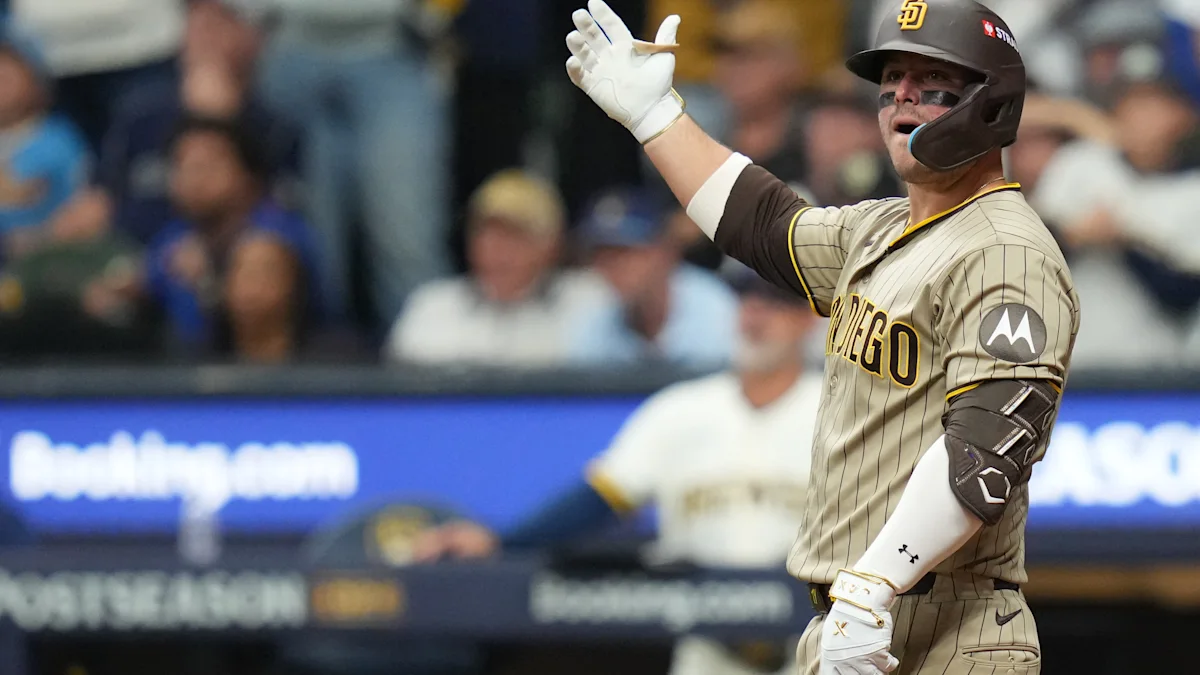
Ty France thought he had that one. The ceiling of the Milwaukee Brewers' American Family Field begged to differ.
A dramatic Game 1 of the NLDS came down to the ninth inning Saturday , with the Brewers leading 3-2 and closer Trevor Megill going for a four-out save against the San Diego Padres. With one out and a man on, France blasted a fly ball that went high and deep — but then a little too high.
The ball bounced off a railing in the roof and fell harmlessly into the glove of Brewers left fielder Jackson Chourio for the second out. France clearly believed he deserved more, and so did his team, as Padres manager Craig Stammen challenged the call on the field.
A replay review upheld the call, ruling that the ball was live and fair.
The Fox Sports broadcast speculated that the ball could be turned into a go-ahead homer, but no such provision exists in the American Family Field ground rules . There are such provisions in other parks, such as the Tampa Bay Rays' Tropicana Field , but the American Family Field rules decide only whether a ball is fair or foul:
Batted ball striking roof, roof truss or roof cable over fair territory: In Play If caught by fielder, batter is out and runners advance at own risk. Batted ball striking roof, roof truss or roof cable over foul territory: Dead Ball
Batted ball striking roof, roof truss or roof cable over fair territory: In Play
If caught by fielder, batter is out and runners advance at own risk.
Batted ball striking roof, roof truss or roof cable over foul territory: Dead Ball
That's what was being reviewed, whether the ball was fair or foul, and the replay booth decided the ball struck the roof over fair territory. France wasn't happy with the call, but winning the challenge would have merely made it a 1-1 count, not a two-run homer.
This was apparently something Stammen discussed with the umpires before the game, as he told reporters later :
"We joked about it at the umpire meeting today, about what would happen if the ball hit the roof. It was unlikely, but it happened. The rule is if they deem the ball to be fair and it comes down, you can catch it. If it hits off the roof foul, it's a foul ball. They ruled that it hit the roof fair and the outfielder caught it. "Unfortunately, it's a bad break for us. It looked like it was a possible home run. Just didn't go our way."
"We joked about it at the umpire meeting today, about what would happen if the ball hit the roof. It was unlikely, but it happened. The rule is if they deem the ball to be fair and it comes down, you can catch it. If it hits off the roof foul, it's a foul ball. They ruled that it hit the roof fair and the outfielder caught it.
"Unfortunately, it's a bad break for us. It looked like it was a possible home run. Just didn't go our way."
The real debate was whether France's fly ball would have been a homer with an open roof. MLB.com's AJ Cassavell reported that there was a postgame consensus that the ball was probably gone in an open air park. That included Brewers manager Pat Murphy, who chalked it up to intervention from late Brewers legend Bob Uecker :
"Ueck decided to put a hand on it," he said.
But that might not be so, if MLB's numbers are right. According to Statcast, France hit the ball with a 105.3-mph exit velocity and a 49-degree launch angle. Those are the numbers of a hard-hit ball hit perhaps a bit too high.
France had every reason to think he crushed that ball. Megill did, too, as he said after the game that his reaction was " Oh, crap. " However, it might be a stretch to say that the Padres were clearly robbed based on the currently available data. Consider that batters had a .038 batting average on balls with launch angles of 49 degrees this season .
That does seem to conflict with the eye test, though, as Chourio caught the ball at the warning track and the ball did seem to lose distance with the contact.
France made a case for a change to the ground rules that would have allowed him to avoid an out:
"With all the technology and data we have now ... there should be something put in place right there," France said. "That shouldn't be an out."
Of course, none of us knows this stuff for sure. That's the real frustration of the ball hitting that railing — that the game was decided by steel instead of wood and leather. Either way, it was one final piece of drama in an eventful game.
San Diego will take that disappointment into Game 2, scheduled for 4 p.m. ET Sunday in Milwaukee.
Topics in this story
Gathered from external sources. Rights to this text belong to whoever originally published it.