In the late 1800s, homesteaders planted smooth brome in what is now Grand Teton National Park for cattle feed; a restoration effort targeting 4,500 acres began in 2007
Grand Teton National Park is actively restoring historic hayfields to native sagebrush-steppe habitats, enhancing wildlife populations and biodiversity. Learn about their ongoing efforts and the impact on ecosystems.
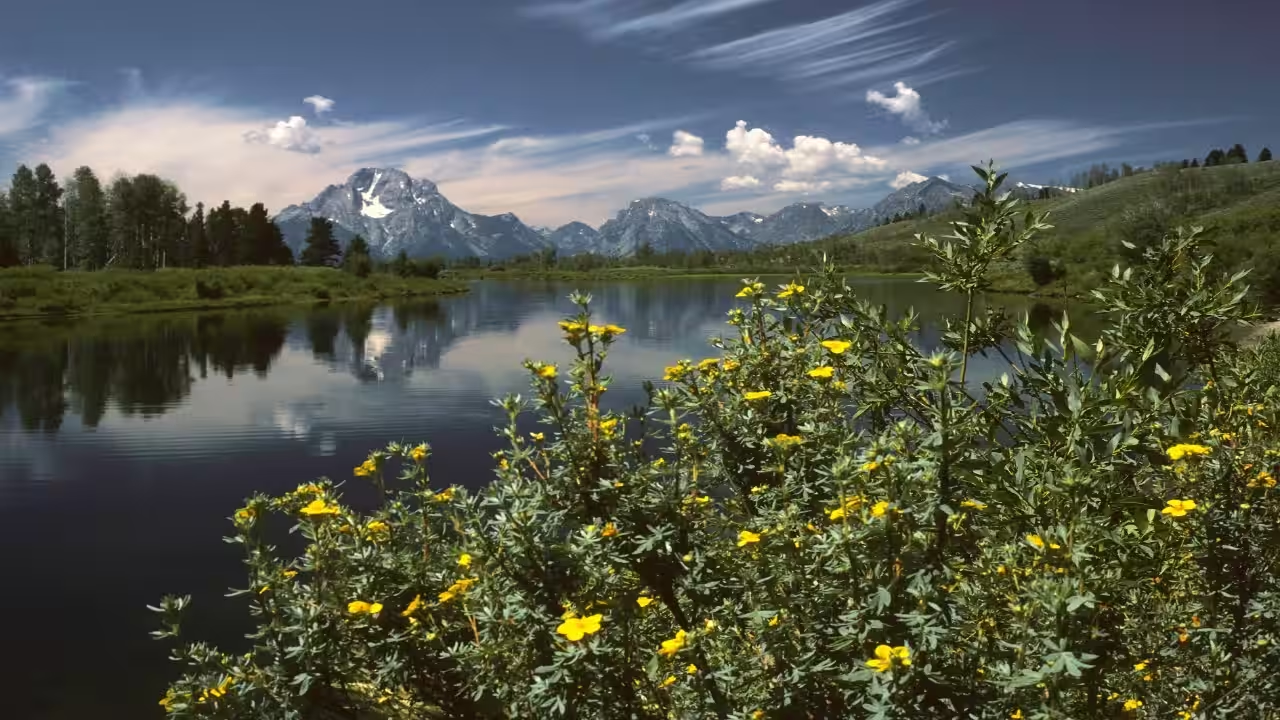
In the late 1800s, in what is now Grand Teton National Park, homesteaders converted native sagebrush grasslands into hayfields to feed their livestock year-round. A non-native perennial grass called the smooth brome was planted; it grew in the region’s short, cool seasons. Eventually, the agricultural field covered roughly 4,500 acres and became known as the Kelly Hayfields.Cultivation gradually faded when Grand Teton National Park expanded in 1950 to include Mormon Row. The National Park Service acquired more land during the 1960s, but pasture grasses persisted. The non-native vegetation continued to grow without irrigation but yielded less seasonal food compared to native sagebrush-grassland communities after the growing season had passed. In 2007, the National Park Service ratified a long-term effort to restore approximately 4,500 acres of former hayfields to native sagebrush-steppe habitat. The programme’s objective was to reestablish plant communities that provided food and shelter for wildlife. In June 2021, the Park staff expanded their restoration effort onto another 110 acres across two southern zones of the Park.How Grand Teton is restoring former hayfieldsThe 2021 project spanned 90 acres within the South Slough unit, located west of Mormon Row, alongside 20 acres in the McBride unit, situated south of Jackson Hole Airport. The South Slough project contributes to the Antelope Flats sagebrush restoration outlined in the Park’s 2007 Elk and Bison Management Plan, whereas the McBride project is solely focused on restoring sage grouse habitat.The process involves removing the non-native pasture grass as Park staff utilise herbicide through tractors, utility terrain vehicles, and backpack sprayers. The treatment eradicates the existing vegetation, leaving the ground bare, and once the grass is removed, the area is seeded with a mixture of native grasses, shrubs, and forbs, or flowering herbaceous plants.Restoration requires more than just clearing a field, and the absence of an effective strategy prompted Park biologists to analyse possible methods. During the 1990s, they carried out a series of small, controlled experiments to replace the persistent pasture grasses, and plans were formalised in 2007 with the Grand Teton National Park Foundation’s support. As per the National Park Service, reports indicate 1,320 acres were in various stages of restoration in 2021, with advanced sites supporting sagebrush, wildflowers, and established native plants.Restored landscapes show signs of wildlife useAccording to the National Park Service, sage grouse changed their behaviour from avoiding the former hayfields to utilising the restored landscape, while Park field observations confirmed elk, bison, and pronghorn followed suit.Moreover, the return of native flowering plants and the establishment of more diverse plant communities were particularly important because these sagebrush-steppe ecosystems provide essential food and habitat for native species year-round. However, the accounts do not quantify increases in wildlife populations, so observations show use of the area, not a specific rise in animal numbers.As part of a larger conservation effort in the landscape, the Kelly Hayfields project leverages its strategic location between the Snake River and the Gros Ventre Mountains. It does so by connecting newly restored habitats directly to existing sagebrush-steppe zones like those protected in Antelope Flats. The foundation’s other project includes restoration at Kelly Warm Springs and Ditch Creek, aligned with initiatives to stabilise and enhance the Mormon Row Historic District. To facilitate this project, the Grand Teton National Park Foundation contributed more than $120,000 to the Kelly Hayfields project, backed by private donors, the Teton Conservation District, and the National Fish and Wildlife Foundation.You use AI every day. Now get your AI Quotient. Take the AIQ test.
Topics in this story
Gathered from external sources. Rights to this text belong to whoever originally published it.