Can a volcano trigger the end of humanity? What would happen if Yellowstone supervolcano erupted now?
What if Yellowstone suddenly went from bubbling geysers and spectacular landscapes to the site of one of the largest volcanic eruptions in human history?
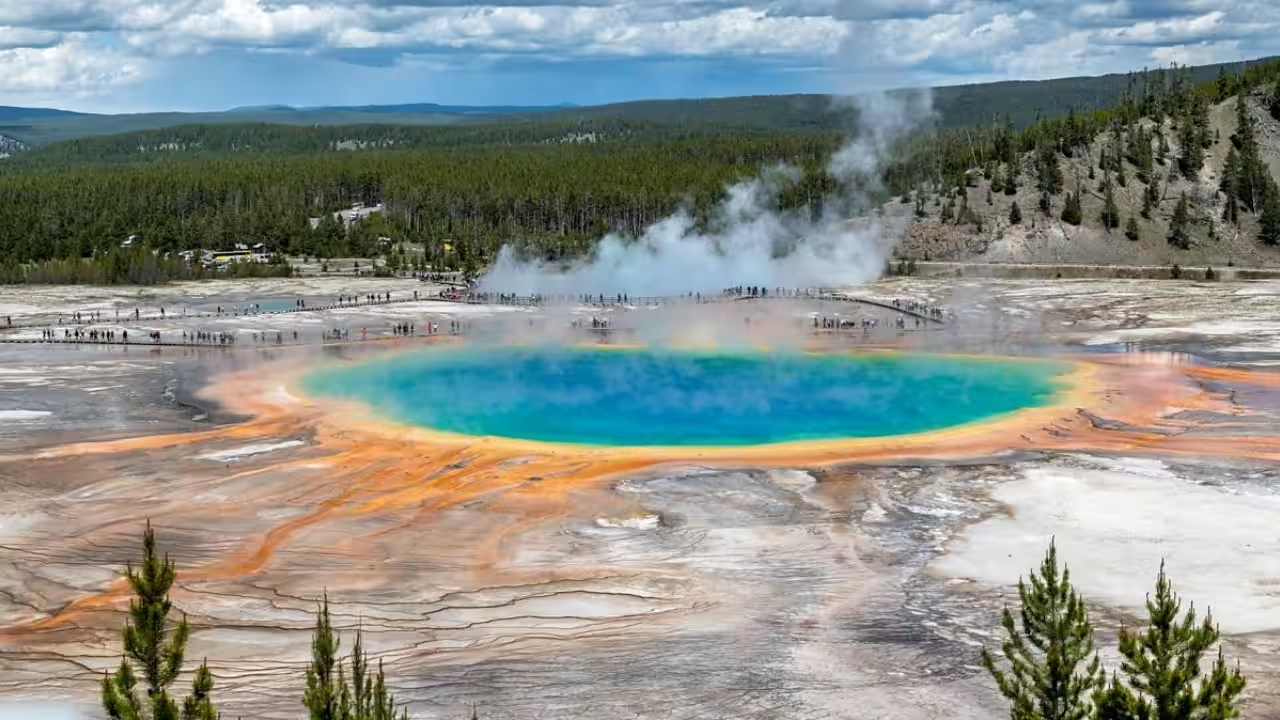
What if Yellowstone suddenly went from bubbling geysers and spectacular landscapes to the site of one of the largest volcanic eruptions in human history?Yellowstone National Park in the United States of America may be famous for its geysers and wild beauty, but for some scientists and disaster thinkers, it’s also the setting for one of the biggest “what if?” scenarios out there. Imagine if, right now, Yellowstone’s calm was shattered by a massive supervolcano eruption. What would it really do to the park, the US, and the world? The short version: it would be a disaster on a scale most of us can barely picture.Before we divulge, it’s important to establish first that this is a hypothetical worst-case scenario, not a warning that Yellowstone is about to erupt.A recent report published by Phys.org, based on analysis by disaster researchers Ilan Kelman and Matthew Blackett for The Conversation, imagines what might happen if Yellowstone experienced a full-scale supereruption today. The scenario draws on volcanic research and previous disasters to create a possible “T-minus” timeline.In reality, the Yellowstone Volcano Observatory currently reports NORMAL volcanic alert status and a GREEN aviation colour code. Its September 2026 update recorded 61 located earthquakes in August, with the largest measuring magnitude 2.0, while ground deformation remained at background levels.So, what would happen if the nightmare scenario actually unfolded?Two months before: Yellowstone starts sending unusual signalsIf Yellowstone actually started ramping up toward eruption, we’d probably first get a warning sign a couple of months out. The scene: scientists start picking up swarms of earthquakes beneath the park. Not so weird, as Yellowstone has thousands of minor quakes every year, but these are different. They get stronger, clustered together, growing shallower. The ground starts bulging. Volcanic gases creep upward. Maybe geysers act odd, or new hot springs appear. Suddenly, emergency planners are looping in, updating evacuation blueprints, while volcanologists scramble to pin down what’s happening.Importantly, the US Geological Survey says that an earthquake swarm, ground deformation, or changing gas emissions individually do not mean an eruption is coming. Scientists would become much more concerned if several unusual signals appeared together and intensified rapidly.Two weeks before: evacuation beginsIf, a couple of weeks from doomsday, everything keeps escalating with stronger, shallower earthquakes, the land rising faster, officials would probably pull the plug for everyone living, working, or vacationing in the Yellowstone region. Imagine evacuating everyone within a 100-kilometer radius: almost 200,000 lives upended, plus thousands of tourists. Airspace is cordoned off as jets avoid the threat of ash.This would be a massive logistical challenge. Evacuations would involve finding shelter, food, water, electricity, transport, and medical care for large populations, while neighbouring regions and countries dealt with their own preparations.Eruption day: the first explosionsEruption day itself might not look like a Hollywood explosion — at least, not at first. Instead, the first violence could come when rising magma meets the park’s pressurized groundwater systems. Water rapidly turns into steam, blasting open the earth with steam, rocks, and mud. This is just the opening act. Soon after, as pressure drops, molten rock (magma) loaded with gas explodes upward and turns into fine ash and pumice. The ash cloud would shoot up: maybe 30 to 50 kilometers into the sky. That’s so high it dwarfs commercial air traffic altitudes.Within hours: pyroclastic flows and ashNow, a supereruption wouldn’t just be a local problem. Within hours, fast-moving pyroclastic flows (impossibly hot, suffocating clouds of rock, ash, and toxic gases) could sweep across huge swathes near Yellowstone, destroying everything in their path. Per the USGS, these flows would be concentrated mostly in Wyoming, Montana, and Idaho — all the areas closest to the supervolcano’s heart. Meanwhile, the eruption’s ash plume would catch high-altitude winds and start spreading.Three days later: ash becomes a national crisisA few days later, the ash blanket becomes a national crisis. A USGS model estimates that a supereruption shooting out 330 cubic kilometers of material would zip a deep, sometimes meter-thick, layer of ash across the Northern Rockies and pile up in cities like Billings, Salt Lake City, and Boise. Farther out (the Midwest, the coasts) would still get hit with centimeters or millimeters of ash, enough to foul up cars, clog engines, knock out power lines, and contaminate drinking water. Planes would be grounded across entire states, maybe more.Weeks later: food, transport and infrastructure come under pressureWeeks into the crisis, the country would start stumbling over new obstacles. Roads, runways, and rail routes would be choked by ash. No flights, no trucks, no trains running on time. Farmers would scramble to save crops that wither under the relentless, gritty blanket. Cattle would need clean water. Supply chains would struggle to move food, fuel, and medical supplies, while shortages could spread well beyond the areas directly covered by ash.Months later: the eruption fades, but the crisis doesn'tMonths on, the eruption itself winds down, but the chaos is far from over. Fine ash doesn’t stay put; winds pick it up, creating choking, dirty haze that makes it tough to breathe, especially for anyone with asthma or lung problems. Rain would transform ash deposits into gluey sludge, blocking storm drains and flooding streets. Even international trade starts feeling the pinch as America, a wheat and corn superpower, finds much of its harvest destroyed.Years later: global coolingBut probably the longest-lasting ripple comes from what the eruption would do to the world’s climate. The sulfur dioxide the volcano releases climbs high into the atmosphere, where it turns into sulfate aerosols. This stuff reflects sunlight, which means cooler temperatures around the globe. Not an “instant ice age,” but a real global chill: maybe about 1.5°C on average, according to some models. That doesn’t sound like much until you realize some areas (or farming seasons) might get whacked a lot harder, leading to worldwide food shortages and sharp price spikes. The planet would take years, or maybe decades, to fully bounce back.Would this end humanity?Honestly, no. The Yellowstone supereruption is a civilization-scale disaster, but it’s not a doomsday device. The USGS is clear: the odds of another huge caldera-forming blast in the next few millennia are vanishingly small, and Yellowstone isn’t on some fixed eruption schedule. If the volcano erupts again any time soon, a slower-moving lava flow is actually the more likely scenario, and that would be a challenge, but nothing approaching global catastrophe.The bottom line? While Hollywood loves the “supervolcano apocalypse,” what’s most probable (and what science shows) is less catastrophic. Yellowstone remains calm for now, and if that changes, we’ll have some warning. The site will stay under a microscope, and for good reason, but for now, the geysers and hot springs are a lot more dangerous to tourists snapping selfies than to humanity as a whole.Get the latest movie news, reviews, and celebrity updates. Download the TOI App.
Topics in this story
Gathered from external sources. Rights to this text belong to whoever originally published it.