In 2023, a PhD student helped build a 387-square-foot house in Indonesia using 1.7 cubic metres of waste from used baby diapers
Rest of World News: Used nappies are among the less obvious materials that could end up in a building. In Indonesia, however, a team of engineers explored exactly that po.
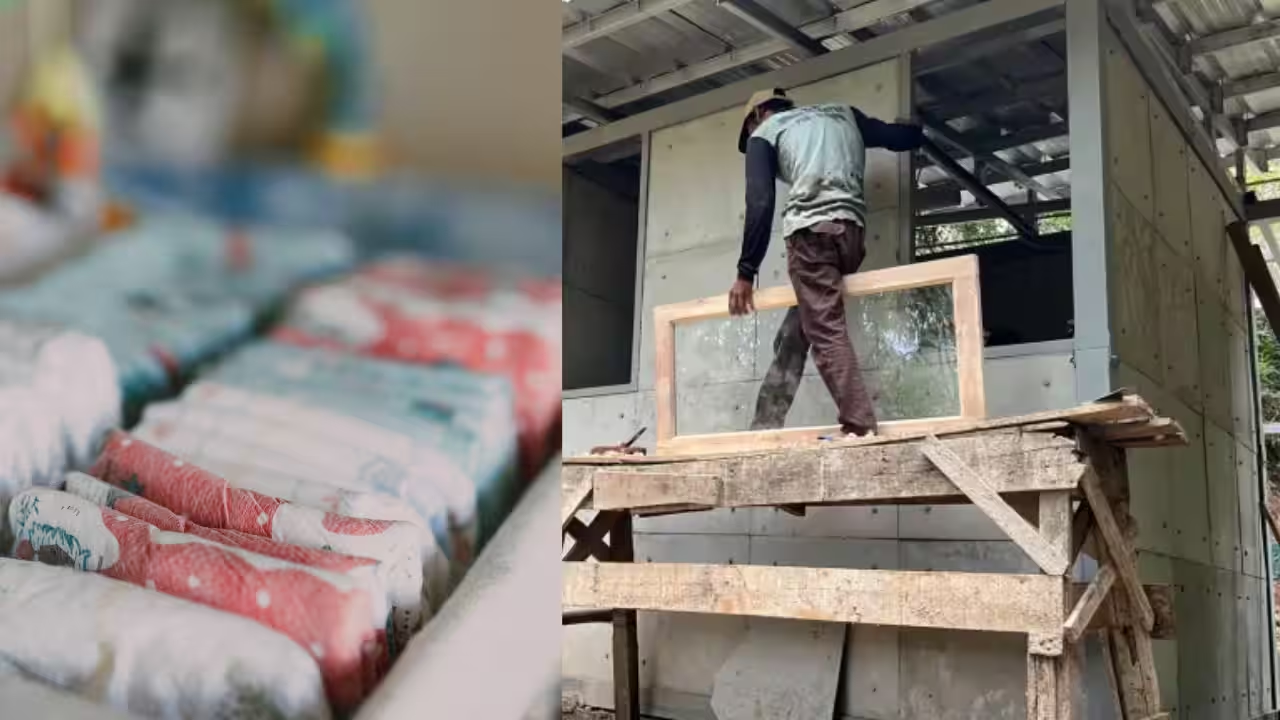
Used nappies are among the less obvious materials that could end up in a building. In Indonesia, however, a team of engineers explored exactly that possibility while looking for ways to reduce both construction material use and the growing volume of disposable waste. They collected used nappies, cleaned and sterilised them, then shredded the material and added it to concrete and mortar mixtures. The nappies were not used as a replacement for concrete itself. Instead, they supplied part of the material normally provided by sand. After testing different mixtures for strength, the researchers applied the findings to a small house measuring about 387 square feet. The finished structure contained processed nappy waste in its concrete and mortar, offering a real-world test of whether a product designed for a few hours of use could become part of a building intended to last for years.How Indonesian engineer turned used nappies into building materialDisposable nappies contain more than layers of fabric and plastic. Among their components are superabsorbent polymers, materials designed to take in liquid and retain it as a gel. Those properties make nappies useful for their intended purpose, but they also make them difficult to deal with once they become waste.The Indonesian research team focused on this mixture of materials rather than trying to turn an entire discarded nappy directly into a construction product. Used nappies were collected, cleaned and sterilised before being shredded. The processed material was then incorporated into different concrete and mortar mixtures.The experiment was not about replacing concrete with nappies. The nappies became a partial substitute for sand, one of the large-volume ingredients used in construction.In the study published in Scientific Reports, titled ‘Application of non-degradable waste as building material for low-cost housing’, researchers tested several mixtures containing different amounts of shredded nappy material. Each was subjected to strength testing to determine how far the conventional sand content could be reduced without taking the material outside the requirements for different parts of a house.How much nappy waste could be used depended on the structureThe results were not the same throughout the building. Materials used in structural elements such as beams and columns had to retain considerably more of their conventional ingredients because these components carry the weight of the building.According to the study, for non-load-bearing walls, the researchers calculated that as much as 40% of the sand could be replaced with processed disposable nappies. For concrete intended for columns and beams in a single-storey house, the figure was lower, at about 27%.There was a trade-off. As more nappy material was introduced, compressive strength fell. That meant the material could not simply be added in large quantities wherever convenient. The proportion had to be matched to the structural demands of each component.The researchers therefore designed the prototype around those limits rather than treating the recycled material as a universal replacement.The nappy waste experiment reached building scaleThe experiment eventually moved beyond individual samples. The team constructed a small, roughly 387-square-foot house intended to represent low-cost housing in Indonesia.Across the concrete and mortar used in the finished structure, about 8% of the sand was replaced with shredded disposable nappies. In total, the process diverted around 1.7 cubic metres of nappy waste from disposal and incorporated it into the building.It was a relatively modest house, but its scale was important. Laboratory mixtures can behave differently from a material used across an actual building, where walls, structural members and other components have to work together.The project also provided a practical demonstration of the limits identified during testing. The researchers did not attempt to maximise the amount of nappy material at every stage. The aim was to use enough of it to reduce conventional material requirements while retaining the necessary strength.Indonesia’s housing shortage created a new material challengeThe experiment was closely tied to the pressures facing Indonesian cities. Rapid urbanisation has increased demand for housing, while construction materials can make up a substantial part of the cost of building a home.According to Fortune, a civil engineer at the University of Kitakyushu Siswanti Zuraida and the researchers were working from projections that placed roughly 70% of Indonesia's population in urban areas by 2025. At the same time, the country was facing an estimated housing shortfall growing by around 300,000 homes each year.That combination creates a difficult material problem. More homes require more concrete, sand, bricks and other construction products, while the waste stream from a growing urban population also expands.Disposable nappies form part of that waste stream. Their widespread use means that the quantities involved are substantial, and their plastic and polymer components make conventional disposal particularly persistent.For the engineers, using some of that waste in housing offered a way of connecting the two problems.The experiment could reduce waste without eliminating itThere is an important qualification to the experiment. Putting shredded nappies into concrete does not make the nappies biodegradable, nor does it remove all of the environmental impacts associated with them.The processed material remains inside a construction product. In effect, part of the waste has been transferred into another use rather than returned to its original components.That can still have value where it reduces the amount of waste entering landfill and lowers demand for virgin sand. But it is better understood as a form of waste reuse than as a complete solution to the environmental problems associated with disposable nappies.There is also the question of what happens much later, when a building reaches the end of its life. A material that has been embedded in concrete is not necessarily easy to recover and recycle again.The research team was aware of those limitations. The prototype was an early demonstration rather than a finished commercial construction system.Concrete brings its own environmental costThere is a second issue running through the project: the environmental footprint of concrete itself. Concrete is used on an enormous scale around the world, requiring large quantities of raw materials. Cement production is also associated with substantial greenhouse gas emissions. Replacing a little sand with waste material does not change the basic fact that the building still relies heavily on concrete.This is why some sustainable-building specialists have treated the Indonesian experiment cautiously. From that perspective, the strongest argument for the nappy mixture is waste management rather than a dramatic reduction in the environmental impact of concrete.Sand itself is another concern. Construction consumes huge amounts of it, and extracting suitable sand can place pressure on riverbeds, coastlines and other environments. Finding substitute materials is therefore an active area of construction research.Researchers have previously investigated materials such as crushed waste concrete, industrial by-products and other discarded materials as partial replacements in concrete mixtures.Disposable nappies simply bring a particularly unusual material into that wider search.Discarded nappies were becoming an unexpected building materialThe Indonesian house was not the first attempt to give discarded nappies another use.In Wales, more than 100,000 used nappies were incorporated into a road-paving pilot project. The idea was similarly based on recovering useful material from products that would otherwise have been sent to landfill.Such experiments point to a broader challenge with disposable hygiene products. They are manufactured to be durable, absorbent and convenient, but those same characteristics make them troublesome once their short useful life ends.Recycling them is considerably more complicated than recycling materials such as paper, glass or some forms of packaging. Organic waste, plastics, absorbent polymers and other components can be mixed together in a single product.Catch the latest World News and Live updates. Download the TOI app.
Topics in this story
Gathered from external sources. Rights to this text belong to whoever originally published it.