In 1930, St Kilda’s last residents evacuated the Scottish islands; within 18 months, its house mice vanished while larger field mice moved into abandoned homes
Rest of World News: In 1930, the evacuation of human residents from Scotland’s St Kilda islands led to the extinction of the St Kilda house mouse while the field mouse thrived in the abandoned habitats. This article explores the ecological impact of human departure and the fate of two mouse populations.
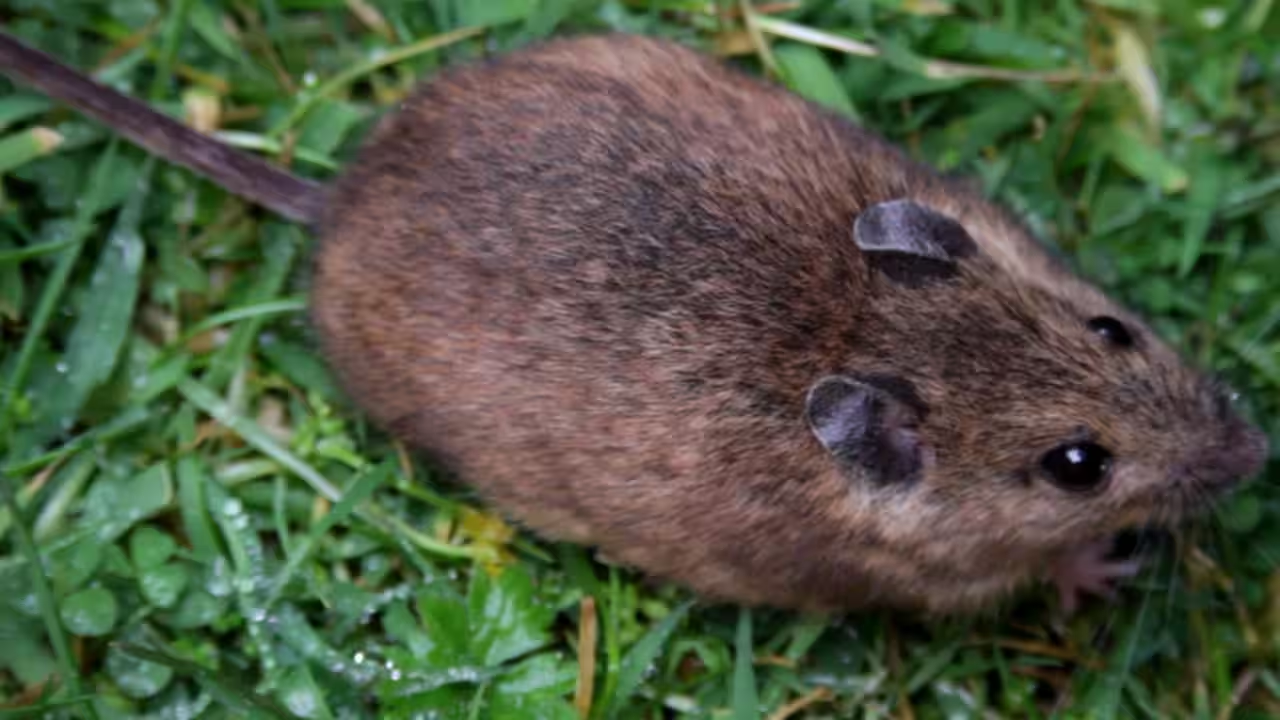
The last residents of St Kilda left the remote Scottish archipelago in 1930, bringing an end to a human community that had survived on the islands for generations. The departure’s impact went far beyond the social history of the isolated settlement. Within around 18 months, the St Kilda house mouse, a population that was closely associated with human habitation, became extinct. On the other hand, the islands’ already-established field mice expanded into abandoned buildings that were previously occupied almost exclusively by house mice.About 66 kilometres west of Benbecula in Scotland’s Outer Hebrides lies St Kilda. Its largest island, Hirta, was the centre of the permanent settlement, and by the beginning of 1930, only 36 people remained there, according to the National Records of Scotland. They lived in 10 households, while six of the island’s 16 rented cottages were already empty. Sheep rearing, fishing and the harvesting of seabird resources, which were considered traditional livelihoods, had become increasingly difficult to sustain. In addition to this, sometimes bad weather would interrupt deliveries of food and mail.The evacuation that followed was therefore not a part of a response to an ecological experiment. Instead, after a particularly difficult winter in 1929–30, the remaining residents decided that staying on the island was no longer viable. Archived records suggest that the residents requested evacuation, and that on 29 August 1930 the remaining community left for the Scottish mainland. This departure unintentionally impacted the conditions under which two different mouse populations had lived alongside one another.With the departure of humans, house mice lost their human-made habitatSt Kilda had two distinctive mouse populations. One was the St Kilda house mouse, Mus musculus muralis, a form of mouse associated with the island’s human settlement, and the other was the St Kilda field mouse, Apodemus sylvaticus hirtensis, a subspecies of wood mouse that survived in the island’s natural environment. Despite being island forms, both populations’ relationships with human habitation were different. According to the National Trust for Scotland, the St Kilda house mouse became extinct after the 1930 evacuation, while the field mouse remains common on Hirta and is also found on Dun.Conditions created by a permanent human population had greatly benefited the house mice. The houses provided shelter, while food stored by the humans offered a dependable resource for them. On the other hand, field mice were already established on the island but were less closely associated with human buildings. Therefore, when people disappeared from the island, the change was not that a new species suddenly arrived. Instead, the balance between the two populations changed drastically because one species lost the environment they were habituated to.In the summer of 1931, T.H. Harrisson and J.A. Moy-Thomas visited St Kilda and reported in January 1932’s Nature publication that the house mouse had become extremely rare. They found it in only two of the recently vacated households where perishable food supplies had been left behind during the final 1930 evacuation. The 1931 visit indicated that some house mice were still surviving less than a year after the evacuation, especially in places where food remained. Published in the Journal of Zoology in 1969, a later assessment by R.J. Berry and B.J.K. Tricker concluded that the St Kilda house mouse became extinct within 18 months of the human population leaving in 1930.An early explanation for the extinction suggested that mice could no longer obtain enough food after the islanders left; but Berry and Tricker argued that competition with the field mouse was a more likely explanation. They suggested that the mere absence of humans was not sufficient to explain their extinction, as house mice can survive on uninhabited islands. The human departure, instead, stripped the house mice off their structural advantage, thus triggering a lethal survival competition that the wild field mice eventually won.The mouse population that was already established on St KildaThe disappearance of the human population in 1930 changed the field mouse’s relationship with the village buildings. The researchers suggested that the disappearance allowed the field mouse to enter a habitat that had previously been dominated by the house mouse.Apodemus sylvaticus hirtensis is a distinct St Kilda subspecies of the wood mouse and is larger than mainland forms. In a 1969 study of Apodemus sylvaticus populations across the Hebrides and Shetland, Berry argued that most of the island forms were unlikely remnants of prehistoric populations and were more probably introduced by humans. He suggested that Vikings or their descendants were the most likely agents.This is, however, a historical evolutionary interpretation rather than a documented record of exactly when the St Kilda population arrived. Today, the field mouse remains part of St Kilda’s ecosystem. As per the National Trust for Scotland, it is still common in Hirta and is also present on Dun, where it reportedly feeds on snails, insects, moss and seeds.Catch the latest World News and Live updates. Download the TOI app.
Topics in this story
Gathered from external sources. Rights to this text belong to whoever originally published it.