Islandmagee: Bronze Age whale fossil found at Portmuck Harbour
A 10-year-old boy was out looking for fossils along the shore in Islandmagee when he spotted the back of the skull.
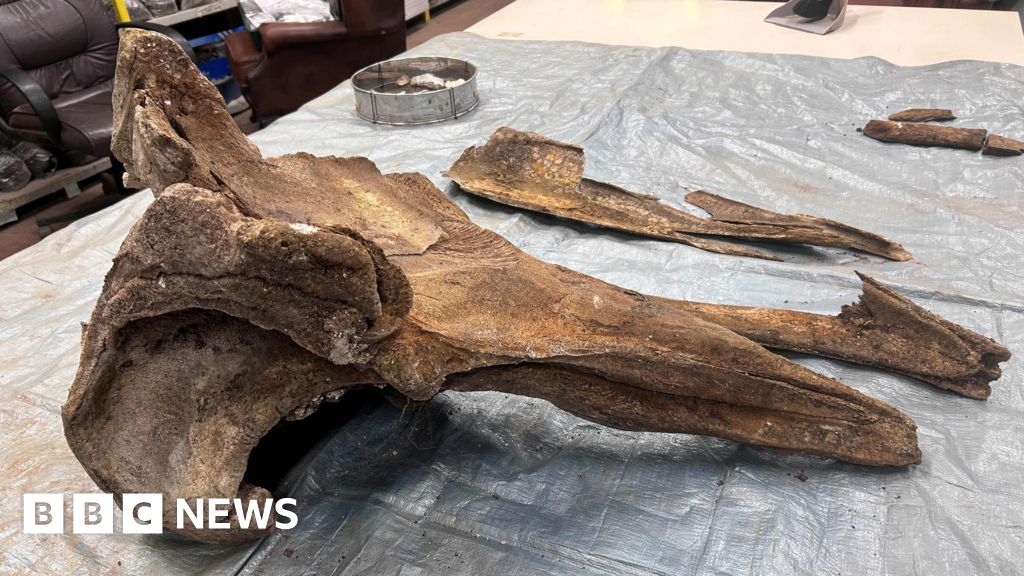
The head of a whale, believed to date back to the Bronze Age, has been discovered buried on a beach in Islandmagee.
A 10-year-old boy was out looking for fossils along the shore when he spotted the back of the skull protruding from a bank of earth - but could the fossil be the remnants of a prehistoric Sunday roast?
The find has been described as a totally unique, with geologists and marine specialists trying to establish the fossil's story and the Natural History Museum in London helping to identify it.
It was found on the same beach where Ireland's only dinosaur bones were discovered in the late 19th Century and the 1980s.
Ten-year-old George was out on a walk at Portmuck Harbour with his parents when he spotted something unusual.
"It was just the weird patterns on it," he told BBC News NI.
"The bits that stuck out, it just didn't look like a rock. I thought it was a bone, but I just wasn't too sure. So I asked my dad and he said it was definitely a fossil."
This fossilised hunk of whale bone has lain hidden in the earth on Portmuck Beach for possibly millennia.
Only the back of the head was visible to George, invisible for centuries was the beak, which was about a foot long when excavated.
Katy McMonagle, one of the archaeologists who dug the whale head out, said the fossil was difficult to move and very heavy.
She said it was now in a warehouse in Belfast and there could be a week of cleaning work involved.
"There will be painstaking work in cleaning the fossil and preparing it for a marine specialist who will be able to find out more about the creature."
The process of discovering exactly how old it is may take some time, but flint tools, excavated with the fossil, suggest it could have been buried in Islandmagee as many as 3,000 years ago.
"Yeah, that's really hard to imagine. To think about what it looked like, what it was, what it sounded like. We have a bit of an idea, but we're not 100% sure yet.
"It's been so cool, it shows you what you can find and then to see what happens after you find something - what the experts do with it, how they figure it out, how they do that."
There are secrets and stories held within the remains of this majestic creature.
Geologist Ian Enlander works with the Irish Whale and Dolphin Group.
When he got the call to go down to the beach and see the fossil before it was moved he said he was very excited.
"I think it is going to turn out to be unique, a once in a lifetime thing."
Enlander took images of a well preserved part of the whale's ear, which may also be useful for carbon dating, and sent photographs to the Natural History Museum in London.
"The keeper of Mammalian Zoology there was very gracious and kind enough to get back to me the following day. They confirmed that it is a beaked whale, and the likelihood is that it's a species called Cuvier's beaked whale.
"So to put that into some sort of context, all the beaked whales are deep water, offshore species, by and large. If they do come inshore, it's usually because they're ill or already dead."
Enlander said finding "a buried skull, without any other bone present" presented a problem in trying to discern what happened.
"I've seen beaked whales in the Azores. I've seen them at the Bay of Biscay. I've never seen them around Ireland. They've never been recorded in this area. So how did it get here?"
Enlander added that the fossil "could be 3000 years old".
"It looks as if it has been handled, perhaps deliberately buried. I suppose the great wish would be that the archaeologists examine the skull and find evidence of butcher marks, that Bronze Age people have been there, trying to decapitate it and utilising the rest of the body perhaps as Sunday roast.
"And then for whatever reason, preserving the skull."
With the Natural History Museum now involved it's hoped this find will be of huge value.
For George, it's been quite the experience, and he has some advice for other budding archaeologists.
"Just keep your eyes open and see, you might find something good as well. Be curious. You never know what might happen."
Rare dinosaur bones 'belong to different species'
First dinosaur bone from Antarctica found in a drawer
Was this the heaviest ever animal on Earth?
Topics in this story
Gathered from external sources. Rights to this text belong to whoever originally published it.