In 2001, Boston Harbor scientists released red dye to test how treated wastewater dispersed from the new outfall into Massachusetts Bay
US News: Discover how Boston Harbor scientists used red dye to ensure safe wastewater outfall to Massachusetts Bay, leading to a cleaner and healthier marine ecosystem.
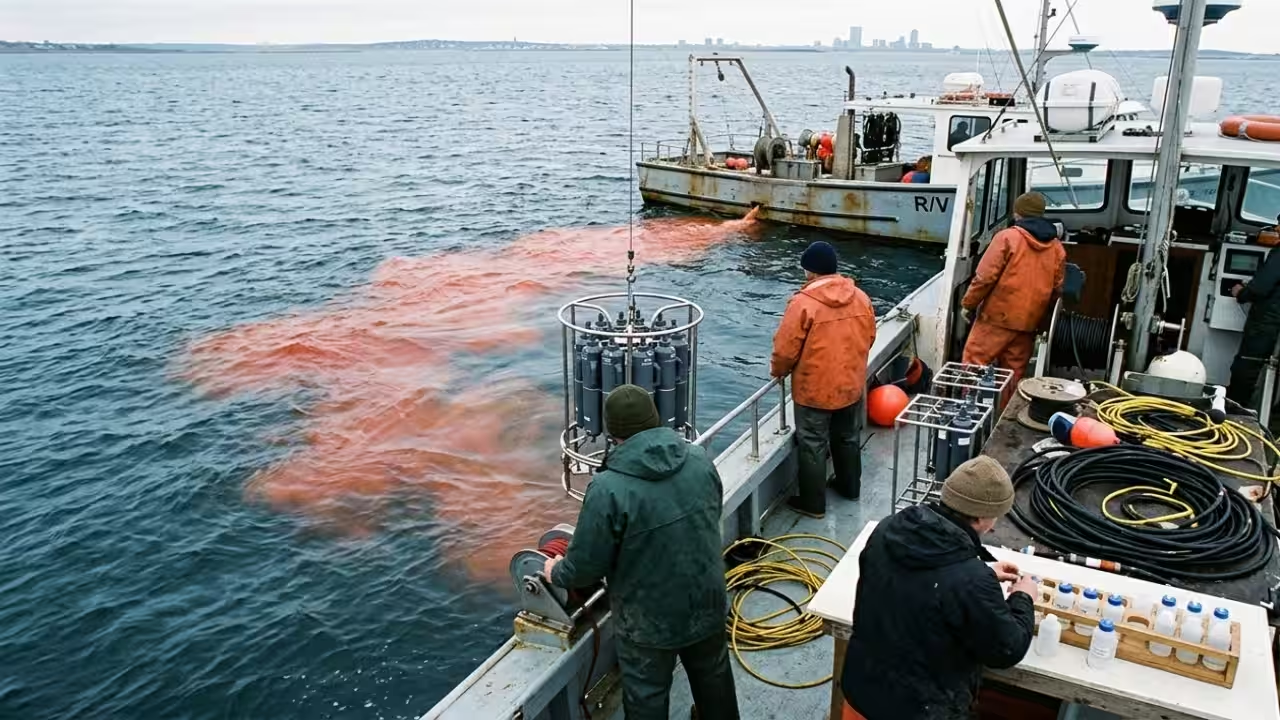
For most of the 20th century, Boston Harbour had a bad reputation. Decades of inadequately treated sewage from the Deer Island facility flowed directly into the harbor's shallow waters, stifling marine life and obstructing beaches, making it a national symbol of urban pollution that even made an appearance in a presidential campaign. Cleaning up the treatment plant involved more than just improving it. It involved figuring out a safer place to send the cleaned water and presenting compelling evidence that the new approach would work.In the lead up to September 2000, the MWRA was planning to stop dumping into Boston Harbour entirely and route treated effluent down a brand new outfall tunnel into Massachusetts Bay. Engineers needed to examine what would happen to that water when it exited the pipe. The simplest and most reliable solution available was dye.Follow the colour nine miles of tunnelThe treated wastewater traveled through a 9.5-mile rock tunnel beneath Massachusetts Bay before reaching 55 diffuser risers spread across the final 1.25 miles of the system, allowing the effluent to mix gradually with surrounding seawater. Hydraulic calculations had demonstrated on paper this plan would dilute the wastewater by a considerable margin before it could affect marine life or public beaches.Scientists chose a fluorescent chemical called Rhodamine WT, which has been used to trace water for years since it glows brilliantly under certain lights and is safe to people and wildlife at the concentrations involved. Researchers were able to track the plume as it passed through the diffuser system and out into open water by adding it to the effluent stream and sampling the water at various distances and depths to measure how quickly the vivid colour faded. The quicker the fading, the more potent the dilution. The measurements helped scientists evaluate the dilution and mixing performance of the new outfall after it began operating.Why a coloured plume meant so muchThis testing was massive. The project needed a federal discharge permit, and MWRA had to do field testing and show that the outfall would meet the dilution rates that earlier scale model experiments had predicted before the project could advance to full-scale operation with confidence. However, one test on a calm day would not tell the whole story. So researchers used acoustic tracking and current profiling equipment, together with dye tracing, to get a complete picture of how the plume moved and mixed with surrounding seawater under various tidal and weather circumstances.The results supported the decision to move the discharge away from the shallow waters of Boston Harbor and into deeper waters with stronger mixing and dilution. The real-world findings were remarkably in line with projections from physical-scale models developed years earlier, showing the large investment in the tunnel and diffuser system was paying off just as the engineers had hoped.A bright chapter in harbour renewalThe reversal in Boston Harbour since the outfall went on line in September 2000 is already well documented: cleaner beaches, healthier shellfish beds, and a marine ecology that continues to recover from decades of neglect. Since then, MWRA says monitoring has indicated a continuously cleaner harbour and a healthy Massachusetts Bay, as well as clean bills of health for nearby Cape Cod Bay and the Stellwagen Bank National Marine Sanctuary, a feeding area for endangered right whales.That recovery would not have been possible with the same scientific certainty without the quieter, less dramatic effort that preceded it, a plume of benign red dye vanishing into the Atlantic as engineers on research ships tracked its every trace. The plume-tracking work became part of the monitoring program that followed the outfall’s opening and helped document changes in Boston Harbor and Massachusetts Bay.Catch the latest World News and Live updates. Download the TOI app.
Topics in this story
Gathered from external sources. Rights to this text belong to whoever originally published it.