After years as a washerwoman, Madam C.J. Walker arrived in Denver with $1.50 in 1905; she built a hair-care company that grew to 5,000 sales agents
Discover the inspiring journey of Madam C.J. Walker, who rose from a laundress to a pioneering entrepreneur in hair care, creating jobs for thousands and transforming the beauty industry.
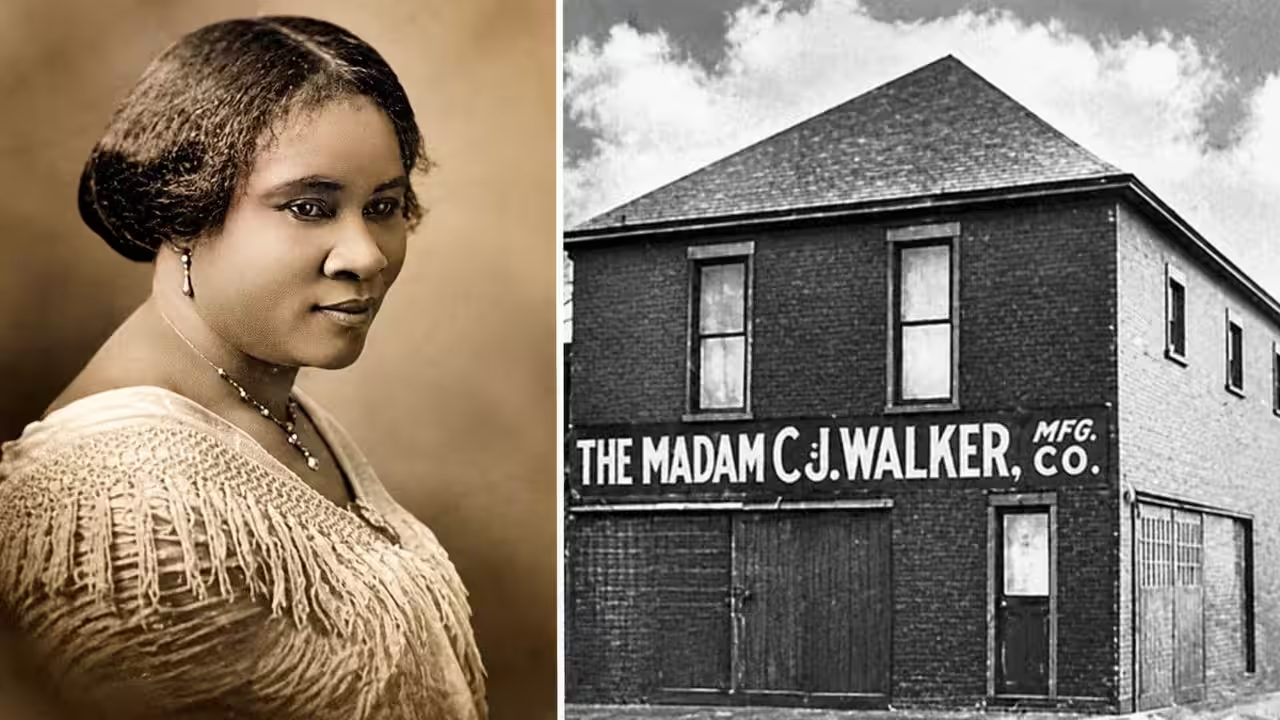
In 1905, after years of work as a laundress to support herself and her daughter, Madam C.J. Walker set out for Denver, Colorado, with $1.50 in her pocket. What happened next was a business story that made her one of the most successful African American women of her era. She developed a line of hair-care products and sold them through a network of about 5,000 sales agents and stockholders.According to the National Park Service, Sarah Breedlove, born in Delta, Louisiana, in 1867, struggled with poverty and hardships early in life. Her parents, Minerva and Owen Breedlove, had formerly been enslaved and later worked as sharecroppers. She was orphaned as a child living in St. Louis, Missouri. Breedlove was a single mother and supported her child as a washerwoman. In her thirties, she began experiencing recurring loss of hair, which motivated her to experiment with commercial hair care formulas and create her own product.From laundry work to a business opportunity in DenverWalker's concern about hair care stemmed in part from her own experience. Widely available hair care products were inadequate or damaging, and many women suffered from scalp conditions and hair loss in the early 90s. Walker tested various solutions and eventually created one of her own that cleared up the scalp problem. She worked as a sales agent for Annie Turnbo Malone, a successful African American beauty entrepreneur, and learned the retailing side of hair care products by observing the Poro company.She moved to Denver in 1905, earning money as a cook and taking in laundry to sustain her small family. She gave the remainder of her time to making and selling hair care products door to door. Her early product line included Madam Walker's Wonderful Hair Grower, a vegetable-based shampoo that gained her a following in Denver’s Black community. Walker married newspaper salesman Charles Joseph Walker in 1906 and took the name Madam C.J. Walker. Her husband worked in advertising, promotion campaigns, and mail-order business with newspaper advertising and demonstrations, playing a vital role in marketing her products to customers outside her neighbourhood.Training women and expanding a nationwide sales networkWalker knew that growth would mean more than selling products. She would require a distribution network that could bring her products to consumers all across the country. She began by listing women as sales representatives, Walker agents, to demonstrate the products, perform treatments, and teach others how to follow her hair care regimen. The business also created the opportunity for women to start their own small beauty businesses out of their homes. Walker trained the women in product application and sales techniques, as well as operating a small business and keeping inventory and accounts. Many of the recruits were former teachers and women who previously would have had few employment options.In 1908, Walker relocated to Pittsburgh, Pennsylvania, and created Lelia College, named after her daughter. The college trained women in beauty techniques and hairstyles, providing a handy workforce for expanding business. A more significant expansion happened in 1910 when the beauty magnate moved her operations to Indianapolis, Indiana. She opened a factory, beauty salon, and training school. Indiana had several freight lines radiating out of it and quickly proved attractive for manufacturing and selling her product to a national customer base. The National Park Service also noted that the network grew to 5,000 agents by 1910 and that the firm earned roughly $7,000 per week.A business legacy that extended beyond hair careWalker's influence and ambition did not stop there. In 1913, she opened a New York branch in Harlem, where a beauty salon and training school were set up to cater to the increasing number of clients. She moved to New York permanently in 1916, having already transferred the running of a manufacturing plant in Indiana to trusted employees. Her profits also supported educational charities and causes. She used her business to advance African Americans and encouraged the women who worked for her to take part in community service. Her annual conventions provided other businesswomen the opportunity to share experiences, discover new ideas, and build contacts.Research published in OAH Magazine of History also looks at Walker's business and J.C. Penney, a retailer, showing how each shared a different way of carrying out a business through sales, manufacturing, and customer interaction. Walker died in 1919 at the age of 51 and was succeeded by her daughter, Lelia Walker. She held her position until her death in 1931. Finally, in 1927, the Indianapolis headquarters became the Walker Building, a manufacturing business and cultural centre that represented C.J. Walker's ascent from a washerwoman with $1.50 to a national businesswoman.You use AI every day. Now get your AI Quotient. Take the AIQ test.
Topics in this story
Gathered from external sources. Rights to this text belong to whoever originally published it.