Drumcree dispute: NI Secretary says 'no agreement' reached
Sir Chris Bryant spoke of his disappointment that the parties failed to reach agreement after more than two hours of talks at Hillsborough Castle
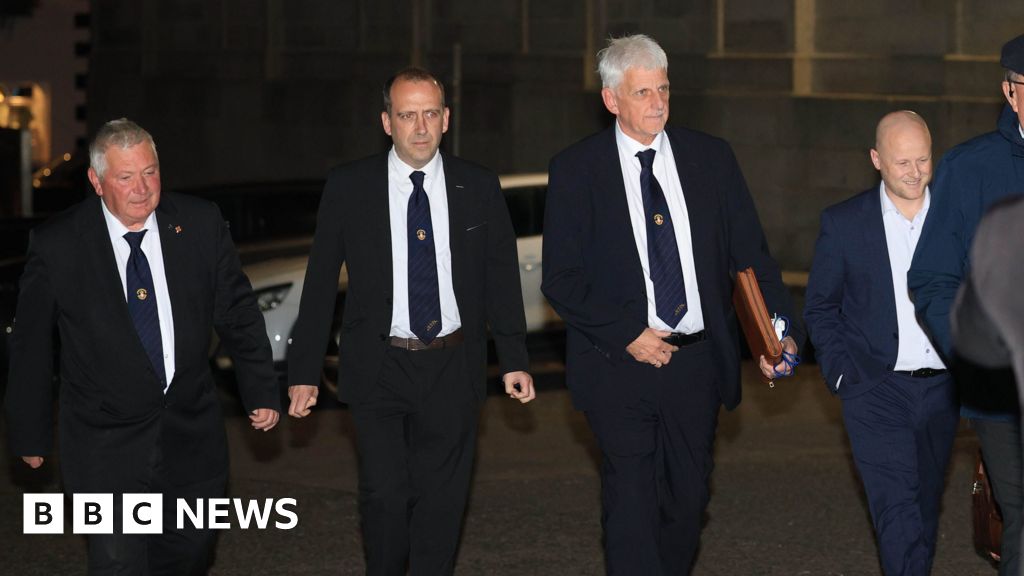
Agreement has not been reached on a resolution to the Drumcree parade dispute, Northern Ireland Secretary Sir Chris Bryant has said.
Members of Portadown Orange Order and the Garvaghy Road Residents' Coalition (GRRC) met Sir Chris at Hillsborough Castle for further talks on the Drumcree parading dispute on Thursday night.
Speaking afterwards Bryant told reporters: "I think this is the end of these conversations. We haven't come to a settled agreement, and it's a shame, but my door remains open."
On Tuesday, lawyers for the GRRC issued a fresh legal bid to try to prevent the march from going ahead. It was due to be heard on Friday but has been postponed until Monday.
Regarding the fresh legal bid by GRRC "we'll have to see how that plays out".
He added that "the law, in the end, is the law" and he would "urge everybody to cooperate with the police".
The chairman of the Garvaghy Road Residents Coalition said there had been no "meeting of minds" during Thursday's Drumcree parade talks and added that the current process is "done".
Breandán Mac Cionnaith was speaking after more than two hours of talks hosted by the Secretary of State at Hillsborough Castle.
Members of the Orange Order also held a separate meeting with Sir Chris Bryant and said their position on the march had not changed.
On Sunday, an Orange Order parade from Drumcree church did not take place due to a large protest on the mainly-nationalist Garvaghy Road .
Protesters have remained on the Garvaghy Road, although in much smaller numbers, and the Orange Order has maintained a presence at Drumcree Church, about a mile away.
The Orange Order delegation included Portadown district master Nigel Dawson and loyalist activist Jamie Bryson, who has been acting as their legal adviser. GRRC chairman Breandán Mac Cionnaith also attended.
Earlier, on Thursday evening, Mac Cionnaith said "the British government know what our position is," as the residents' group arrived at the castle gates.
"The Orange Order know what our position is," he added.
"I'm here to represent my community. That's all I have to say."
The Orange Order delegation made no comment to reporters as the group walked through the gates of the castle grounds.
Both the Orange Order and the GRRC were given a document during separate meetings with Secretary of State Sir Chris Bryant on Wednesday.
Earlier, Dawson said they were shown a discussion document in relation to the Drumcree dispute, but stressed it was "not a proposal".
The chairman of the residents' coalition said his group would agree to it, if the Orange Order did.
Dawson said on Thursday that the document shown to him "was very much an opening document and I read the document and there was nothing in it that moved the situation forward at all".
"And the document has now been removed from the table," he added.
Sir Chris has been involved in discussions with the Orange Order and Garvaghy Road residents since Monday.
It is understood that both parties on Wednesday signed a confidentiality agreement after being presented with a document from the government.
On Thursday, The Nolan Show revealed details of what was in the document that was presented to both sides in the dispute.
BBC News NI understands that it said the Orange Order had the legal right to walk along the Garvaghy Road; that the residents would accept that legal entitlement and publicly accept that it was wrong to block the Orange Order from walking down the Garvaghy Road - but in return the Orange Order would choose not to walk down the road.
Democratic Unionist Party (DUP) leader Gavin Robinson would not discuss the details of the proposal but told the Nolan Show that he supported the Orange Order's "determination and their dignity in the face of hostility and lawbreaking".
What is the Garvaghy Road dispute all about?
O'Neill returns to Garvaghy Road as police investigate Sunday's 'unlawful protest'
Drumcree negotiations are 'nowhere near dead' - NI secretary
Police Service of Northern Ireland (PSNI) Chief Constable Jon Boutcher discussed the dispute at a public meeting of the Policing Board in Belfast on Thursday where he said the policing operation over the dispute has cost about £3m so far.
He described the situation as "challenging" - but said that despite "very significant tensions" there had been no violence.
The consequences of police forcing an Orange Order march down the Garvaghy Road "could be catastrophic" for Northern Ireland, Boutcher added.
During the meeting, it also emerged that the Policing Board has launched a code-of-conduct investigation into one of its members, Sinn Féin's Deirdre Hargey.
She was pictured taking part in an unlawful protest against the march on the Garvaghy Road on Sunday.
Sinn Féin First Minister Michelle O'Neill has been accused by the DUP of breaking the law by taking part in protest on Sunday.
In response, O'Neill said that if she was investigated then "so be it - that's the chief constable's job".
The Sinn Féin deputy leader returned to the Garvaghy Road on Wednesday to give further support to protesters.
Earlier on Thursday crowds gathered on the Garvaghy Road, including former Sinn Féin president Gerry Adams.
There were also performances by bands, including folk music group the Mary Wallopers.
The Orange Order, the most prominent of the loyal orders associated with Protestants in Northern Ireland, holds thousands of parades every year and the vast majority pass off without incident.
However, many Catholics see the marches as sectarian and object to them passing through, or close to, mainly Catholic or nationalist areas.
The Garvaghy Road had been part of the Drumcree parade route but by the mid 1990s nationalist residents protested against it.
Drumcree was one of Northern Ireland's most serious parading disputes, when stand-offs over attempts by the Orange Order to march along the Garvaghy Road were accompanied by riots, roadblocks and killings.
When the Orange Order was prevented by police from walking down the route in July 1995, there was a tense stand-off. It was the same for the next three years.
In 1998, the newly-established Parades Commission ruled that the Orange Order should not march down the road - a decision that was upheld for the past 28 years.
The row re-emerged last month after a court case in which a ruling by the Parades Commission was overturned, and a fresh application to parade was lodged.
Last Friday, the commission decided that the march could go ahead with restrictions in place.
However, that decision was challenged in several Belfast courts on Saturday, before finally being given the go-ahead just hours before it was due to take place .
Parading, policing and power sharing collide amid Drumcree dispute
Police block Orange Order from controversial parade route
Orange Order march row goes to heart of ongoing divisions in Northern Ireland
Topics in this story
Gathered from external sources. Rights to this text belong to whoever originally published it.