In 2014, researchers spread cocoa pod husks around near-dead cacao trees in Nigeria; two years later, pod production reportedly rose 64% and 68% at two sites
A groundbreaking study reveals that cocoa pod husks can significantly rejuvenate dying cacao trees, boosting pod production by 64% and 68% at two Nigerian sites.
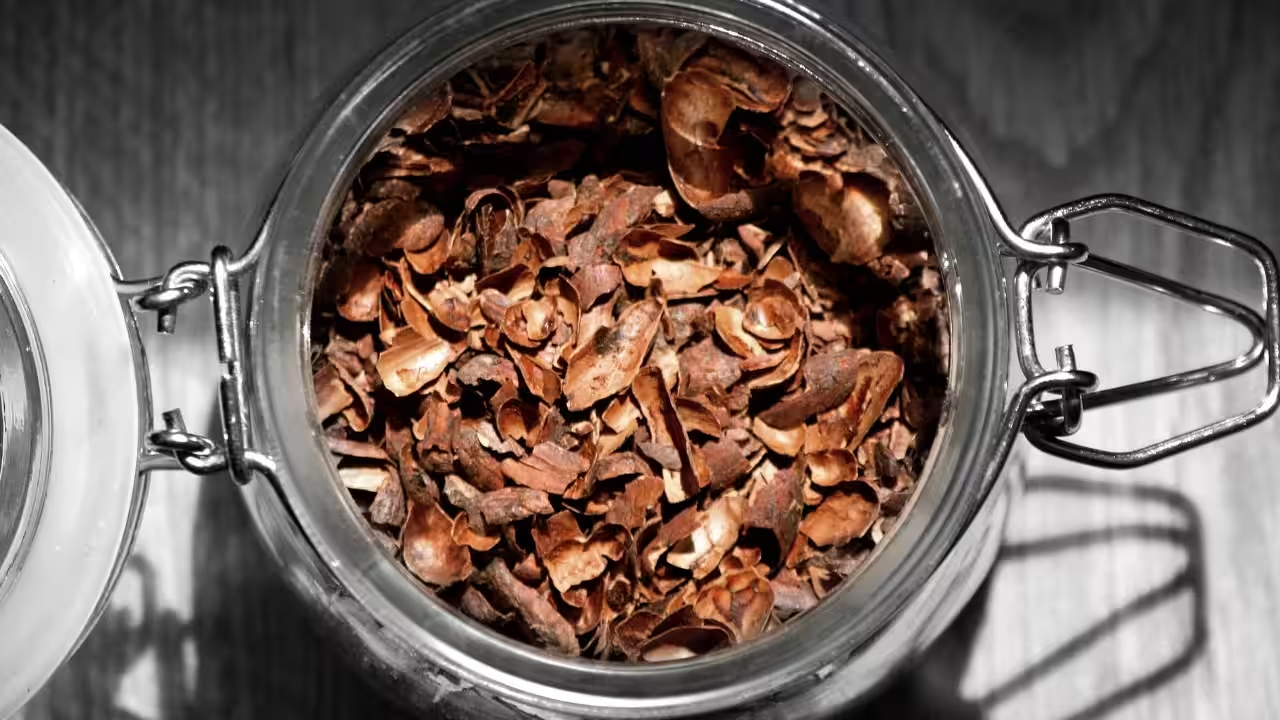
Cocoa farms in south-western Nigeria produce large volumes of pod husks, the outer shells left once the beans are removed. Although most of these farms treat these husks as waste, it is important to know that these wastes are nutrient-rich and can be added as an effective soil additive to aging plantations. Indeed, the researchers at the Cocoa Research Institute of Nigeria have carried out experiments on their use. In one of their experiments, the researchers wanted to explore the effects of adding husks to dying trees. They asked if these husks would rejuvenate the dying trees to start producing again. The figures from this experiment have now been simplified into a percentage increase in the number of pods. As the paper shows, the figures are more complicated and the experiment involved more than husks alone.The May 2014 to December 2017 husk trial at Ibadan and OwenaThe trial is described in Rehabilitation of Old and Moribund Cacao Soil Using Organic Amendments in Ibadan and Owena of South West Nigeria, published on 25 March 2020 in the Journal of Scientific Research and Reports. This experiment occurred between May 2014 and December 2017 on two farms, situated in Ibadan in Oyo State and Owena in Ondo State. Uninfested fresh pods were first oven-dried before grinding them to 4 mm sieve size. These were then spread around the trees during the rainy-season months of April/May and August/September. According to the paper, the experiment used a randomized complete block design with four treatments and four replications, with amendments applied to eight cacao trees per plot.After two years, the abstract of the paper reports higher pod production: at Ibadan, cocoa pod husk alone gave the largest increase, 64% above the control, while at Owena the three amended treatments raised yields by 68%, 64% and 63%, respectively. These figures come from a trial that also tested husk blended with neem leaf powder, so they need careful interpretation. Husk was used individually in an amount of 0.5 kg per tree. Two other treatments mixed husk with neem leaf powder in ratios of 90:10 and 80:20, respectively. Unprotected trees were used as controls. The whole paper is available on the website of the Cocoa Research Institute of Nigeria.Pod counts of 64 and 68 per tree and why the percentage claim needs careIt can be observed from the abstract that even after two years, only husk has recorded the maximum percentage pod gain against the control at 64% at Ibadan and at Owena, husk has a value of 68%, whereas the neem blends are 64 and 63%. In the results section, it looks like the comparison is of pods only. According to the results section of the paper in the Journal of Scientific Research and Reports, pod counts on husk-treated trees rose from 40 to 64 at Ibadan and from 47 to 68 at Owena. That is an increase of about 60% and 45%, respectively, which does not match the 64% and 68% reported in the abstract. The abstract appears to compare treated trees with the control, while these counts compare pod numbers before and after treatment.The results section appears to compare 2012 and 2013, even though the trial ran from May 2014 to December 2017. In the study, changes in soil composition have been reported by the authors. The pH of soil has increased from 6.50 to 6.89 at Ibadan and from 6.41 to 6.82 at Owena, while more nitrogen has been released eight months after application. Authors have credited part of the increase in pods to weeding and pruning.The Ondo and Osun compost trial and its 72.4% bean yield gainIntegrated Soil Fertility Management for Smallholder Cocoa Farms: Using Combination of Cocoa Pod Husk Based Compost and Mineral Fertilizers, published on 21 March 2020 in the International Journal of Plant and Soil Science, takes a different route. The husks were cut and composted together with chicken droppings and Chromolaena odorata leaf mulch in a ratio of 2:1 and applied at 4 kg/tree in four villages in Ondo and Osun States. The experiment was laid out using five treatments with three replications, 10 trees/treatment/block. The abstract shows increases in dry bean yields of 72.4% and 36.4% over the control for compost mixed with NPK fertilizer and compost or NPK fertilizer alone respectively. From the same study, Table 7 shows site-wise increases of 60.0 to 75.0% for the compost and NPK mixture and 30.0 to 41.7% for compost alone, so the 72.4% reported in the abstract does not match any single site figure in the table.Black pod risk, unused husks and the nutrients lost with each harvestThe same paper adds that husks left on the farm could host and transmit Phytophthora inoculum that causes black pod. The paper says that all of the farmers interviewed did not use their farm-produced husks (100%) and no farmer had used any fertilizer before the experiment. Compost with NPK reduced black pod damage, with percentage loss levels of 9.9 to 13.4% compared to 32.2 to 35.5% in the control. The paper further refers to previous research, which shows that harvesting 1000 kilograms of dry beans leads to the loss of 20 kilograms of nitrogen, 4 kilograms of phosphorus and 10 kilograms of potassium from the soil, explaining the importance of nutrient replacement.The above-mentioned trial of husks relieved the disease concern through the use of fresh and uncontaminated pods, which were dried and milled prior to application, even though the trial did not evaluate black pod disease. Both studies indicate that husks may be beneficial to exhausted plantations, depending on how they are handled and farm surroundings. Neither study provides a straightforward, conclusive measure of the effect of husks alone: the first trial’s figures raise unresolved questions and the second tested composted husk mixed with other materials.You use AI every day. Now get your AI Quotient. Take the AIQ test.
Topics in this story
Gathered from external sources. Rights to this text belong to whoever originally published it.