Around 1941, Canadian gunner Alfred Sutton recorded a voice message for his wife and sons on aluminium discs; decades later, renovators found them hidden inside the family home’s wall
Discover the fascinating story of Alfred Sutton, a Canadian soldier's voice recordings found hidden in a wall, revealing heartfelt messages to his wife and sons during WWII.
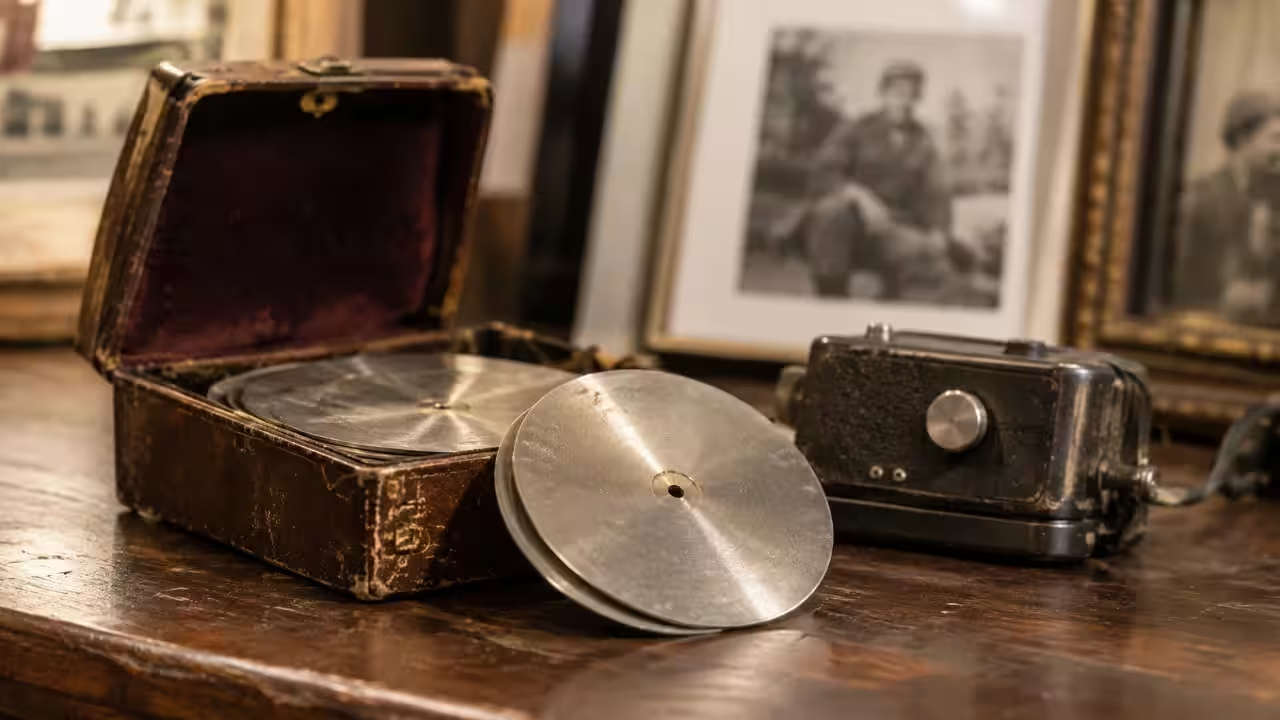
A kitchen renovation in the late 1990s exposed a sealed envelope behind a wall, hiding two aluminium discs. The discovery then waited on a machine that could play the recording. The message recorded on two aluminium discs overseas remained sequestered for decades inside a house in Napanee, Ontario. The recordings belonged to a Canadian soldier, Alfred Richard Thomas Sutton, who served with the Royal Canadian Artillery.According to the Lennox and Addington County Museum and Archives, the two records were received as a donation after a couple brought them in for examination. They had discovered the discs in the late 1990s while renovating their kitchen. Inside a sealed envelope behind the wall were the recordings and several wooden gramophone needles. The couple kept the material for more than 20 years before a friend found a player that could play it.Heather Wilson, the museum’s archivist, recorded the discovery in an account published on 6 November 2024. The records turned out to be wartime voice letters, a method used by soldiers to send recorded messages to relatives at home. Sutton’s recordings were addressed to his wife, Constance, and their sons in Strathcona, Ontario.A voice preserved from the Second World WarThe recordings remained unplayed until early 2024, when a friend of the couple found a record player. After that, they took the two discs to Lennox and Addington County Museum and Archives, where the recordings were played for the first time. The first disc was difficult to discern because of the poor audio. The second disc, however, contained a clearer message. It started with Sutton greeting his wife: “Hello, sweetheart… This is Saturday afternoon, September the 27th.” This allowed the archivist to identify its intended recipient and establish an approximate recording date. On the disc, he asked about her and the children, mentioned receiving a parcel and sent his affection to the family. He also spoke about returning to Canada.The disc did not reveal the year when it was recorded. Wilson used the details in the message and the available historical information to place it in 1941. Based on the historical information, Sutton was stationed in Aldershot, England, when he made the recording. By Wilson’s understanding, this likely explains why very few voice letters survived. Her research had documented similar references to such recordings in the United States and the United Kingdom, alongside a small number of Canadian mentions. The museum had no other example in its collection.Sutton’s military service and familyAccording to the Lennox and Addington County Museum and Archives, Sutton was born in Leeds, England, in 1906. He moved to Canada with his family in 1913 and worked as a labourer in Strathcona by the age of 15. Later, he found employment at the local paper mill.In 1939, he married Constance Pringle, and together they had two sons. Subsequently, Sutton enlisted for military service and joined the 14th Field Regiment before being sent to England. Based on his recordings, a brief account of his life overseas was revealed.In the end, Sutton survived the war and returned to Canada. He and Constance lived in the same house where the records were later discovered. By the time of his death, their sons had moved away, one to Saskatoon and the other to Colorado.Sutton died at Lennox and Addington County General Hospital on 12 June 1967, at the age of 61. The circumstances in which the two discs came to be concealed in the first place remained unknown. The couple who found them eventually donated the recordings to the county archives, where they could be played and preserved.You use AI every day. Now get your AI Quotient. Take the AIQ test.
Topics in this story
Gathered from external sources. Rights to this text belong to whoever originally published it.