In 2007, Texas sank the retired 473-foot Texas Clipper off South Padre Island; it now brings in over $1 million from anglers and up to $2 million from divers
US News: Discover how the Texas Clipper, sunk in 2007 off South Padre Island, became a lucrative artificial reef, generating millions for local economy and boosting marine biodiversity.
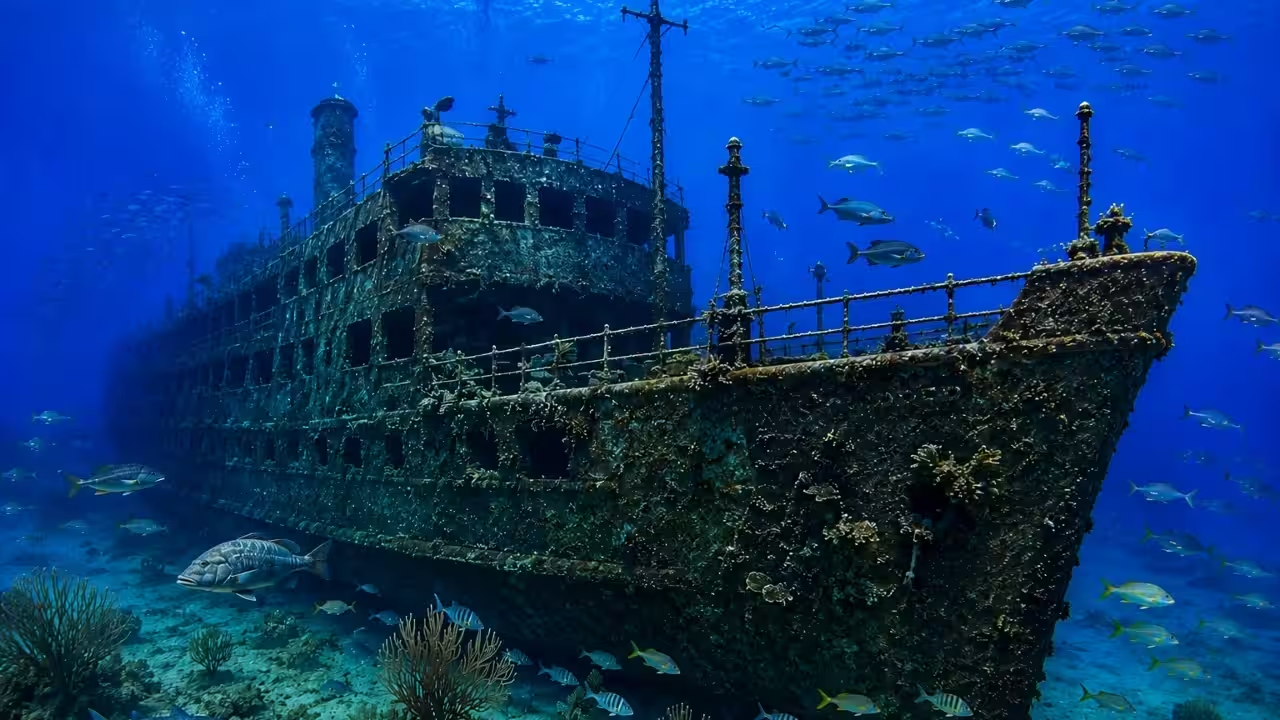
In November 2007, Texas transformed the retired 473-foot USTS Texas Clipper from a former passenger liner and maritime training ship into an artificial reef in the Gulf of Mexico. The vessel was deployed about 17 miles off South Padre Island, where its steel hull and multiple decks provided hard surfaces for marine organisms and shelter for fish after it was sunk. Nearly two decades later, the Texas Parks and Wildlife Department (TPWD) says that the Texas Clipper reef generatesmore than $1 million from anglers and approximately $1.4 million to $2 million from divers.Transformation from a wartime transport to a Texas training shipThe vessel’s history began long before it reached the Gulf seafloor. Built by Bethlehem Steel in Maryland, it was commissioned by the US Navy in December 1944 as USS Queens (APA-103). During the Second World War, the ship carried troops and supplies in the Pacific and transported wounded Marines from combat areas. Following the war, the vessel was converted for civilian passenger service and renamed SS Ecambion, operating on Mediterranean routes.The ship’s next major chapter began in 1965, when it became the USTS Texas Clipper, a training vessel used by Texas A&M University at Galveston. Until 1996, it remained in that role, giving maritime students and cadets practical experience at sea. TPWD describes the ship’s eventual reefing as its fourth and permanent life, after its military, passenger and training careers.When the ageing training vessel was no longer required, the Texas officials opted for an alternative instead of simply scrapping it. Immediately following its 1996 retirement, the Texas Artificial Reef Program pursued the vessel as a potential offshore reef; however, converting a large ship into a marine habitat required extensive preparation. According to TPWD, the vessel was transferred to the state on 4 October 2006, after nearly a decade of negotiations with the US Maritime Administration.Subsequently, the ship was towed from the reserve fleet in Beaumont to a shipyard in Brownsville, where it underwent extensive environmental preparation. The aim was to ensure that the structure would be suitable for deliberate placement in the marine environment.Preparing a 473-foot ship for the seafloorBefore deployment, crews removed materials that could contaminate the Gulf. TPWD says the preparation included about 7,000 gallons of hydrocarbons, 1,680 cubic yards of asbestos, 393,270 pounds of PCB-containing materials, 1,410 cubic yards of debris and 330,450 gallons of wastewater. Additionally, workers altered the ship’s structure. Large openings were cut into the hulls so that seawater could circulate through the vessel and marine organisms and fish could use its interior spaces. Following these heavy shipyard modifications, a massive final cleanup sweep was executed to purge 1,410 cubic yards of loose operational and industrial debris from the ship prior to its tow.In November 2007, the Texas Clipper was deployed as an artificial reef, coming to rest approximately 17 miles off South Padre Island. Instead of disappearing into the Gulf as scrap, the vessel became a permanent hard structure in an offshore environment where natural reef habitat was comparatively limited.The ship became an economic and ecological assetOnce established underwater, the Texas Clipper became part of the marine environment rather than just an inert object on the seafloor. Sponges, corals, barnacles, and other marine organisms colonised the artificial-reef structures, while diverse fish populations utilised the shelter created by the ship’s hull and superstructure. Biological monitoring at the site has documented a thriving ecosystem, cementing the vessel's status as one of the state's most ecologically successful deep-water habitats.The state agency has reported that the sunken vessel now generates more than $1 million for the local economy from anglers and approximately $1.4 million to $2 million from divers. These figures reflect estimated recreational economic activity associated with the site, instead of the money earned directly by the ship or reef.Furthermore, the Clipper has an unusual distinction within Texas’ artificial-reef programme. The agency identifies the vessel as the largest ship intentionally sunk under this programme. Its size gives marine organisms an unusually extensive and complex structure to colonise, while its location makes it accessible to recreational visitors travelling from the South Padre Island region.Catch the latest World News and Live updates. Download the TOI app.
Topics in this story
Gathered from external sources. Rights to this text belong to whoever originally published it.