Massive flash flood hits Nepal-China border, hundreds missing and many feared dead
A huge flash flood has swept through villages in Nepal. Police say at least eight people have been killed but there are fears the toll will rise. Follow for news updates.
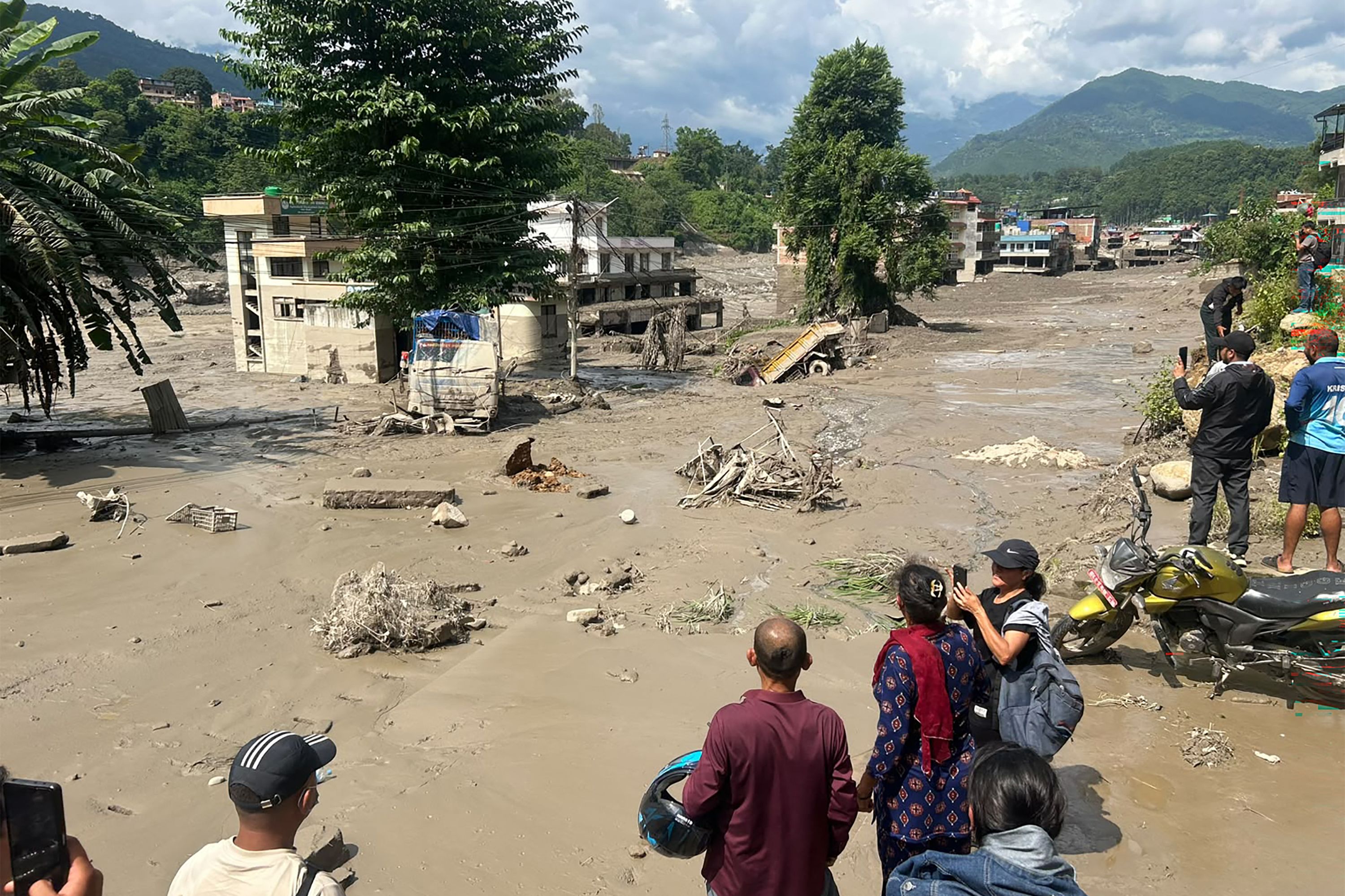
• Villages devastated: A huge flash flood has swept through villages in Nepal. Police say at least eight people have been killed but there are fears the toll will rise. Nepal’s tourism board says at least 400 travelers, including foreign nationals, are missing.
• Tibet hit: Tibet has also been impacted, with Chinese state media warning of “major casualties.” A mudslide also hit China’s Gyirong port, where Chinese leader Xi Jinping urged “all-out” search efforts.
• Rescue operation: Helicopters are searching the area but waters in some parts are too high for them to land. The cause of the flood is not yet clear but deadly floods last year were traced to the draining of a glacial lake.
The flash flood which has devastated settlements in northern Nepal was caused by an earthquake triggering a large landslide which blocked the Bhote Koshi river, according to Nepal’s foreign minister Shishir Khanal.
“An earthquake occurred at 8:37 a.m. today, and due to it, a large landslide occurred, blocking the river, which appears to have caused the flood,” Khanal said during a meeting at the House of Representatives.
The United States Geological Survey, which records earthquakes worldwide, registered a 4.4-magnitude earthquake in the region at the same time as the one referenced by Khanal.
A deadly flash flood in Nepal has caused widespread damage to multiple settlements in the north of the country, killing several people.
Elsewhere, Tibet, an autonomous region of China, has also been impacted, with Chinese state media warning of “major casualties.” It is feared the death toll will likely rise, with search and rescue efforts currently underway.
Catch up on the latest developments here:
Hundreds missing: Nearly 400 travelers, including hundreds of foreign nationals , have been reported missing following the massive flash flood in Nepal, the country’s tourism board has reported, citing an initial assessment. This includes foreign nationals from India, Australia, The Netherlands, South Africa, the UK and Malaysia.
Helicopters struggling: Rescue helicopters cannot land in the affected areas of Syapru Besi and Timure in northern Nepal until the waters recede, the country’s army spokesperson Raja Ram Basnet said, according to Reuters.
Police and military join rescue: Nepal’s Prime Minister Balendra Shah said police and military are joining the rescue teams, Reuters reported. “People along the river are advised to exercise extra caution and remain alert,” he said.
China’s Xi responds: Xi Jinping has ordered an all-out search and rescue effort to find those who are missing after a mudslide in Nepal caused “major casualties” in Tibet’s Gyirong county, according to China’s state news agency Xinhua. Relief teams in Tibet will receive supplies including tents, heating stoves, clothing and bedding, China’s state broadcaster said.
CNN’s Issy Ronald and Simone McCarthy contributed reporting.
Rescue operations are underway after a huge flash flood swept through villages in Nepal and Tibet earlier today, with fears mounting the death toll will rise.
Known as the “rooftop of the world,” the Himalayan region is prone to flash floods and landslides, with experts clear that extreme weather is becoming more frequent and intense as the human-caused climate crisis escalates.
Here are some of the biggest natural disasters in the region in recent years:
August 2025: A surge of flood water tore through a mountainous Himalayan village in northern India, leaving several people dead and dozens missing. Rescue efforts were also hampered by mudslides.
September 2024: Days of heavy monsoon rains in Nepal triggered widespread flooding and landslides across the nation, killing around 200 people and causing widespread destruction.
October 2023: More than 100 people went missing in India’s northeast after heavy rain caused a glacial lake to burst, leading to flash floods which ripped through the Himalayan state of Sikkim.
October 2021: Rains and heavy flooding killed at least 150 people in India and Nepal, causing landslides to occur, bridges and houses to collapse, and rivers to burst their banks.
September 2014: Massive flooding hit parts of the Pakistan-administered Kashmir region and across the plains of Punjab province, wreaking devastation and disaster. The flooding killed more than 400 people across India and Pakistan, and displaced tens of thousands more.
The flash flood that hit northern Nepal on Wednesday was likely caused by an avalanche from a glacier, according to an expert at the International Centre for Integrated Mountain Development (ICIMOD) in Kathmandu.
The Lhende Khola River, a tributary of the Bhote Koshi River, witnessed maximum flooding Wednesday, Saswata Sanyal, a disaster risk reduction specialist at the climate research group told the Associated Press.
The flood on the Lhende Khola was “triggered by an ice rock avalanche from a glacier on the Nepal side that blocked the river and released a sudden surge downstream,” Sanyal told the AP.
The Bhote Koshi river flows from China into Nepal, often through deep gorges, and ultimately, into the Ganges in India.
Last year flooding on the river killed nine people, with 24 missing, according to Reuters.
Nepal’s Rasuwa municipality rises from the Himalayan foothills up to the border with China, where peaks higher than 7,000 meters dominate the skyline. Scattered villages of mud brick or stone buildings dot the ridges and hills along with terraces planted with maize and barely.
Mountain passes or particularly dangerous spots along its winding roads are marked by Buddhist shrines and strings of prayer flags. It takes around 5-6 hours by jeep to reach the Nepali capital Kathmandu from the border with China.
The region is home to around 50,000 people. In the north, Langtang National Park is a popular destination for trekkers, and Gosaikunda, a sacred alpine lake more than 4,300 meters up, is a major pilgrimage site for Hindus. The region is also home to several hydropower projects that tap into its fast-flowing rivers.
The Bhote Koshi river flows from China into Nepal, often through deep gorges, and is popular with white-water rafters. It flows through Nepal and ultimately, into the Ganges in India.
Rasuwa was devastated by the 7.8-magnitude earthquake that hit Nepal in 2015, killing more than 9,000 people, including hundreds in Langtang National Park who were buried after a landslide wiped a one-popular trekking village off the map.
Timure – located on the Trishuli river and one of the settlements feared hard-hit by the flooding – is the last settlement on the road to China. A string of buildings lining the road before the huge, imposing gate that marks China. It is typically clustered with lines of lorries, waiting to cross into China to pick up cargoes of clothes, electronics and household items.
China has mobilized multiple agencies to respond to the disaster in Tibet, with Chinese state media citing top leadership as guiding the response just several hours after it occurred – a sign suggesting the potential severity of impact.
Chinese leader Xi Jinping was quoted by state news agency Xinhua around 3:30 p.m. Beijing local time as calling for search and rescue efforts, resettlement of affected people and attention to “secondary disasters.” Xi is typically cited issuing such statements during natural disasters and other incidents, but those statements may not come until after the initial moment of response.
State media also noted China’s Premier Li Qiang had issued instructions to central agencies, while Vice Premier Zhang Guoqing was dispatched to Tibet to guide rescue efforts in the region, Xinhua said.
Disaster relief and emergency response agencies were allocating 30,000 items of central disaster-relief supplies, including tents, heating stoves, clothing and bedding, folding beds and moisture-proof mats, to support relief efforts in Tibet, according to China’s state broadcaster CCTV.
China’s Ministry of Emergency Management and the state-backed China Energy Engineering Corporation, which operates in the region, deployed emergency responders under a joint response mechanism.
An initial team of 200 geological, engineering and emergency response personnel equipped with reconnaissance drones, 3D laser scanners, life detectors and rescue equipment were mobilized, CCTV said.
Rescue helicopters cannot land in the affected areas of Syapru Besi and Timure in northern Nepal until the waters recede, the country’s army spokesperson Raja Ram Basnet said, according to Reuters.
Separately, Nepal’s army posted a video on X of one helicopter hovering just above a muddy outcrop beside the raging floodwater, indicating that search and rescue efforts are underway in the mountainous Rasuwa region in northern Nepal. Other pictures show service members carrying the injured on stretchers into a helicopter and an off-road vehicle.
Nepal’s Prime Minister Balendra Shah said police and military are joining the rescue teams, according to Reuters.
“Instructions have been given … to move the people living in the lower areas to safer places,” he said. “People along the river are advised to exercise extra caution and remain alert.”
Nearly 400 travelers, including hundreds of foreign nationals, have been reported missing following the massive flash flood in Nepal, the country’s tourism board reported Wednesday, citing an initial assessment.
“A preliminary agency-wise record received from tourism and travel companies has identified 384 travellers, including 291 foreign nationals and 93 Nepali nationals, who were reported missing from the affected areas,” Nepal’s tourism board posted in a statement on X.
The nationalities of those listed as missing include travelers from India, Australia, The Netherlands, South Africa, the United Kingdom and Malaysia.
China’s leader Xi Jinping has ordered all-out search and rescue efforts to find those who are missing after a mudslide in Nepal caused “major casualties” in Tibet’s Gyirong county, China’s state news agency Xinhua reported.
The mudslide occurred at approximately 10:30 a.m. local time (4:45 p.m. ET), cutting off the region’s roads, communications and power, Xinhua said.
Pictures from the scene of the deadly flooding hint at the scale of the disaster.
A violent flash flood in Nepal has caused widespread damage to multiple settlements in the north of the country.
At least eight people have been confirmed dead, according to Reuters, but the extreme force of the floodwaters means it is likely that toll will rise significantly.
Videos posted on social media show a torrential flood flowing through a Nepalese town, bursting the banks of a river, and causing multi-storey buildings to collapse into the water.
Topics in this story
Gathered from external sources. Rights to this text belong to whoever originally published it.