In the 1940s, a Wampanoag couple opened a restaurant overlooking Martha’s Vineyard’s Gay Head Cliffs; their descendants are now raising $8 million to buy back and restore the 3.5-acre property
US News: A Native-led nonprofit organisation has launched an $8 million campaign to acquire and restore a historic property on Martha’s Vineyard that has deep .
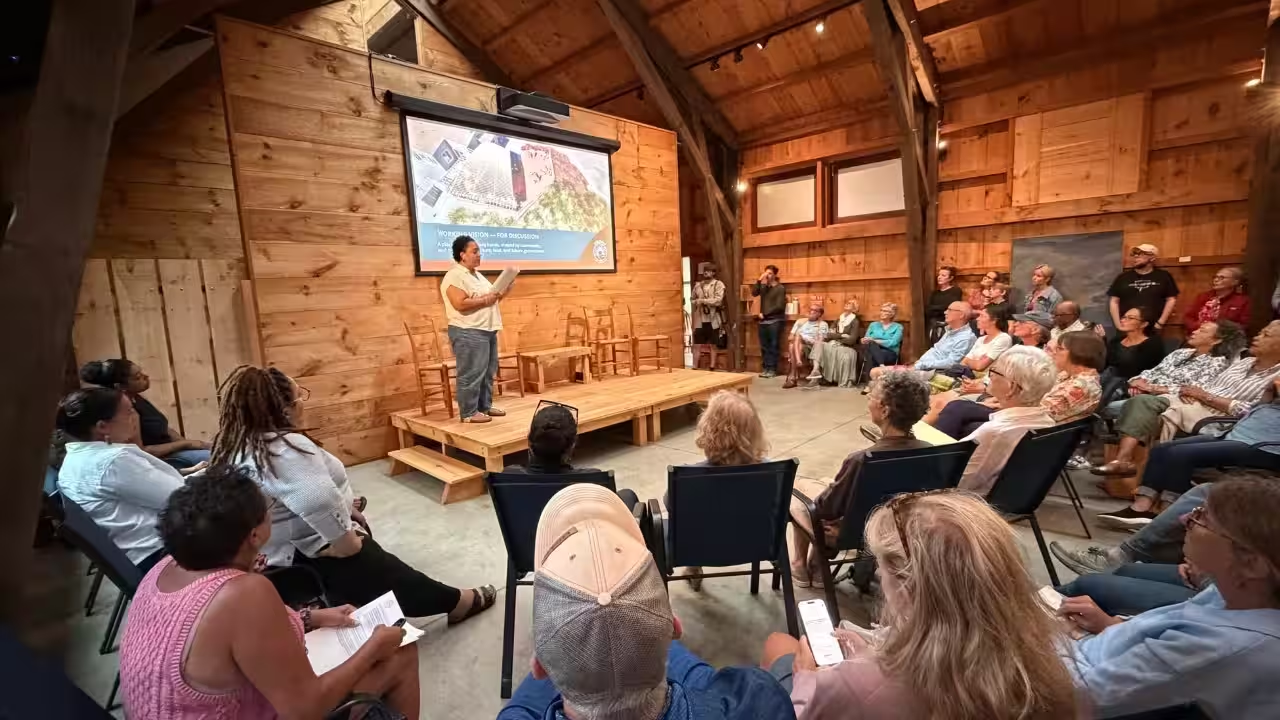
A Native-led nonprofit organisation has launched an $8 million campaign to acquire and restore a historic property on Martha’s Vineyard that has deep ties to the Wampanoag community. A former Aquinnah Shop sat on the 3.5-acre property overlooking Martha’s Vineyard’s Gay Head Cliffs. The site also had a restaurant, which was started in the 1940s by Wampanoag couple Napoleon and Nanette Madison. But it is empty now.The Aquinnah Land Initiative (ALI) has launched the campaign to purchase this property from the Native Land Conservancy, which paid $2 million when it bought it in 2023, TBN reported.A family restaurant with deep community tiesFor many Wampanoag families, the Aquinnah Shop is more than a restaurant. They worked there, ate there and gathered at the property. It was a place where they built connections, even as ownership of nearby land changed over the years.ALI intends to rehabilitate the former restaurant. For ALI board member Amira Madison, the campaign is closely connected to her family. She is also a descendant of the restaurant’s founders. Several other members of the organisation’s board are also their descendants. So, for them, reclaiming the cliffside also means bringing their ancestral land back home. The challenges they face are not financial alone. There are administrative and environmental challenges, given that the property sits along the island’s fragile cliffs.“Everything happens in time, and everything happens for a reason. If we’re not doing this, who else is going to step up in the community to take on something like this and this responsibility?” Madison told the outlet.ALI is not really a tribal government entity; however, all of its board members are citizens of the Wampanoag Tribe of Gay Head (Aquinnah). Many of its members are also direct descendants of Napoleon and Nanette Madison, the couple who built the original shack, which later became the restaurant.“There are a few of us on the board who are the great-grandchildren of Napoleon and Nanette. All of us have been impacted in terms of either working for the Aquinnah Shop, eating there every day, or connecting with most of the community there,” Madison said.Efforts to reclaim the cliff side As soon as the property went up for sale, they acted quickly. Initially, they explored options for buying the land through a private backer, but then circumstances changed, and they decided to form a nonprofit organisation.“We had to spot-create a 501(c)(3) land conservation organisation, which is not what we initially set out to do. I think we’ve come to accept that this is the path that we’re on, that I think the Creator has put us on, which is land back,” Madison said.But then the Native Land Conservancy, another nonprofit led by citizens of the Mashpee Wampanoag Tribe, acquired the property to preserve it under Wampanoag stewardship. This step gave ALI the time to bring together the funding, said Paula Peters, the conservancy’s communications director.“We think this is a great way to get this done, and we’re excited to support it,” Peters told the outlet. According to Madison, another Native-led group helped them move quickly and focus on protecting the land and its cultural importance.The project secured a $717,500 state grant through Massachusetts’s Municipal Vulnerability Preparedness programme. The state said the grant would support the acquisition of 3.5 acres at 27 Aquinnah Circle, including the former restaurant, with the goal of returning the property to Aquinnah Wampanoag ownership.The $8 million campaign will help ALI buy the property, restore the closed restaurant and maintain the cliffside site over the long term. The restored space will serve as a community gathering point, a cultural education site or a business operated by a tribal citizen, depending on what the board and community decide as fundraising continues. The nonprofit hopes to use the project as a foundation for future efforts to return land to Native stewardship. They have not yet decided how those efforts will work. They could involve land being donated, purchased or transferred through settlements or conservation easements.“This will be an incredible space of knowledge and education and an opportunity to really do something huge for our Wampanoag people. We’re okay with the time it’s taking. We feel okay about that,” Madison added.Catch the latest World News and Live updates. Download the TOI app.
Topics in this story
Gathered from external sources. Rights to this text belong to whoever originally published it.