A Pompeii victim cast in plaster beside a child was long thought to be a mother protecting her child; DNA revealed the adult was male and not biologically related to the child
Recent DNA analysis has overturned long-held beliefs about a famous Pompeii victim cast, revealing the adult figure with a child is a male and not related, challenging historical narratives of gender and family in ancient times.
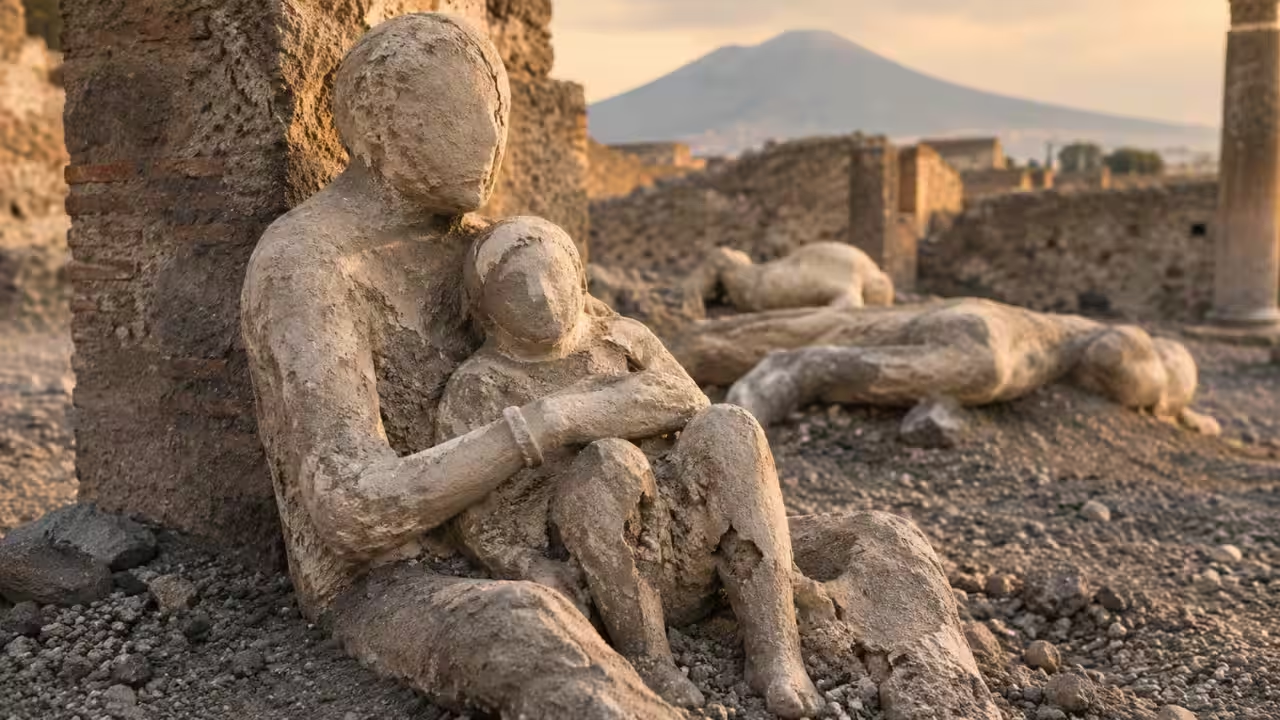
First impressions can often feel convincing even when they are wrong, and Pompeii shows how far a wrong one can travel. For decades, a plaster cast of a victim of the eruption was told as a simple story. It showed an adult wearing a golden bracelet and a child on the lap, and it was read for years as a mother protecting her child. A Harvard Medical School report from November 2024 explained how DNA altered that narrative. The adult was genetically male and was not biologically related to the child.A story built on a bracelet and a pose In 79 CE, when Mount Vesuvius erupted, Pompeii was buried under the ash along with those unfortunate people who were unable to escape. The bodies decayed over a period of time, leaving hollow spots in the hardened ashes. During the 1800s, workers used plaster to fill up the hollow spaces, and the outlines of the victims emerged. Jewellery and clothing became important clues. Jewellery suggested a woman, and a child on the lap suggested a mother. For years, these ideas were repeated, but they were based on appearances only. The adult and the child became a much-told picture of the eruption, and the mother-and-child reading remained a favourite.How scientists tested the old storyThe research came from an international team led by scientists at Harvard Medical School, the University of Florence, and the Max Planck Institute for Evolutionary Anthropology. In 2015, the researchers worked with the Archaeological Park of Pompeii to collect DNA while 86 casts were being restored. Samples were taken from 14 of those casts, and the remains of five people yielded enough genome-wide data to analyse. The findings were published in Current Biology in 2024. The authors explained that they generated genome-wide ancient DNA and strontium isotope data from skeletal material inside the casts. The paper studied sex, family ties, ancestry and movement.What the DNA showedFor the famous pair, the answer was clear. The person with the bracelet was an adult male, and the child was not biologically related to him. So the theory about the mother and her child was incorrect, and the bracelet had misled people for decades. The researchers also pointed out that, in the same house, three out of four people believed to be a family were not genetically related to each other, at least to the third degree. The DNA of the fourth individual could not be studied. Another pair of people in a position that looked like an embrace turned out to include at least one genetic male. Two of the three common explanations, that the pair were sisters or that they were a mother and daughter, were ultimately ruled out. While the third assumption, that they were lovers, wasn't.Why the news story needs care tooThe researchers warned against swapping one story for another, which might feel tempting. David Reich, a co-senior author of the study, said the results could make people careful about inventing tales on gender and family in past societies using today's expectations. DNA can reveal biological sex and family, but it cannot reveal how a person saw themselves or what bonds they shared with other people. The authors also noted that some of the remains had been moved and some casts were likely creatively restored a long time ago, so even the positions might be unreliable. The DNA also showed that the five people mostly traced their roots to people who had moved from the eastern Mediterranean. Reich said it showed how diverse the Roman Empire was at that time. Co-senior author Alissa Mittnik said the work shows why genetic analysis should be combined with archaeology and history. A bracelet, a pose or a first glance might feel like proof, but it needs to be supported by evidence.You use AI every day. Now get your AI Quotient. Take the AIQ test.
Topics in this story
Gathered from external sources. Rights to this text belong to whoever originally published it.