In 2020, Taal’s eruption buried a Batangas home in ash; 15 days later, an eight-year-old dog named Idol was found alive beneath a wooden bed
In a miraculous rescue, Idol, an eight-year-old dog, was found alive 15 days after the Taal Volcano erupted, buried beneath volcanic ash in Batangas. The heartwarming story highlights the resilience of pets during natural disasters. Read more about Idol's survival and the impact of the Taal eruption.
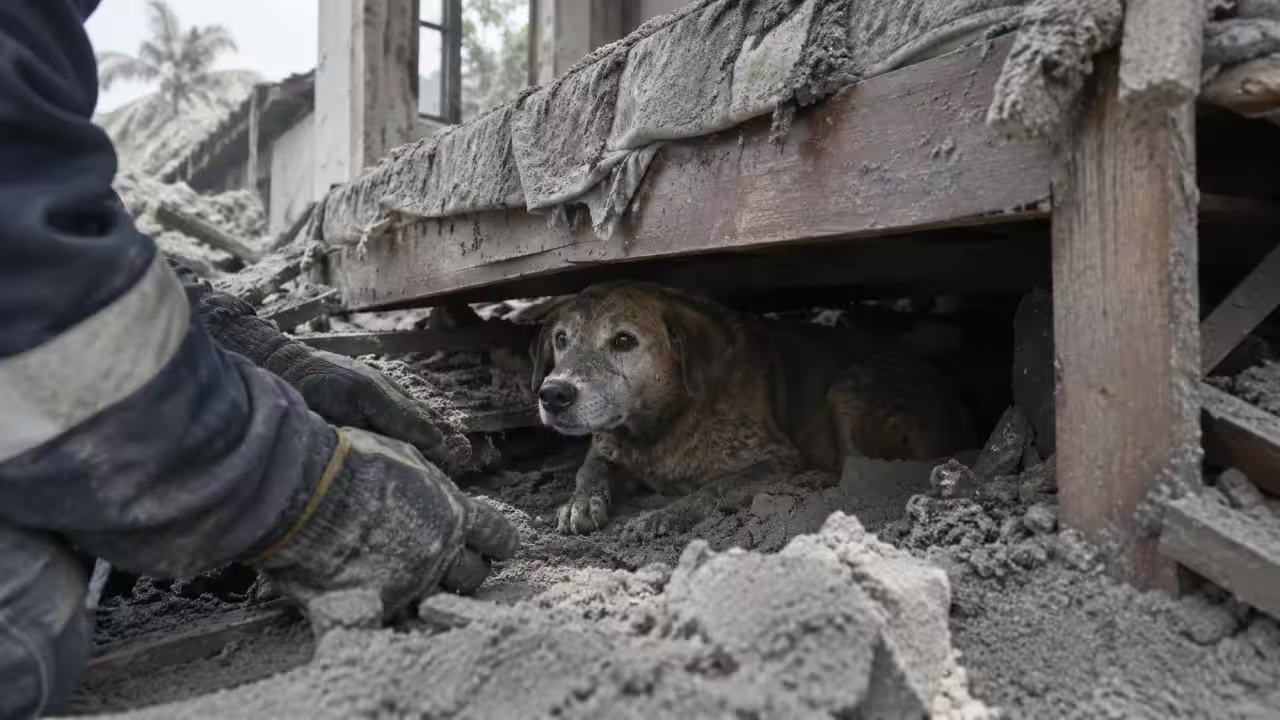
An eight-year-old dog was found alive beneath a wooden bed covered in volcanic ash 15 days after the Taal Volcano erupted in the Philippines. According to GMA News Online, the owners, Jay-R Balba and his brother Germie, discovered him at their home in San Nicolas, Batangas, after local officials permitted them to return. The rescue reunited Idol with his owners after more than two weeks in the damaged home, and the family took him and the other pets to Germie’s house, where they planned to stay.A search beneath the bed led to Idol’s rescueThe dog, named Idol, was barely able to move when the brothers rescued him and reportedly had been without food and water and appeared almost skin and bones. After he was freed, Idol drank several bowls of water and slowly regained his appetite, the same outlet reported. His survival came after the eruption forced the family to evacuate their home without taking their pets. Jay-R later recalled the wooden bed in his father’s room as Idol’s favourite resting place and decided to check the spot after local officials allowed residents to visit their homes.Other pets were also reunited with their owners after photos of them circulated on social media once some areas had been declared outside the danger zone. Animal welfare groups and pet rescue organisations were searching towns across Batangas for animals left behind as residents fled the eruption. Idol’s survival was remarkable given the circumstances in which animals were left without access to food, water, or care.Idol’s ordeal was part of a wider disaster Two studies published after the disaster, in IOP Conference Series and Scientific Reports, examined how Taal’s activity developed and how its effects spread across the surrounding environment. In a research study titled “Evolution, Causes and Influence Factors of Taal Volcanic Activities”, published in 2022, satellite imagery was used to compare conditions before and after the eruption. The findings provide context for the ash that covered homes and vegetation after the volcanic eruption.As per the 2022 study, the volcanic unrest was traced back to March 2019, when elevated seismic activity showed slight inflation and the amount of carbon dioxide flux increased. Seismic swarms happened in December, and a sequence of phreatic and phreatomagmatic activity was detected on the day of the eruption, followed by a rising alert level and evacuation measures. Taal was located near a convergent boundary between the Eurasian and Philippine Sea tectonic plates, where subduction contributed to volcanic activity.Based on the Sentinel-2 satellite images from before and after the eruption, the researchers were able to determine that the volcano island and nearby land had turned grey after the event, which indicated widespread volcanic deposits and a loss of visible plant cover. By April 2020, much of the vegetation outside the island had recovered, and in September, the island itself remained largely grey, with sparse vegetation.A second study, “Hazardous base surges of Taal’s 2020 eruption”, published in Scientific Reports in 2021, examined a more immediate physical danger. A. M. F. Lagmay and co-authors used field observations, satellite and drone imagery, LiDAR data and terrain models to analyse base surges. These were fast-moving, turbulent mixtures of hot gas and particles produced during explosive eruptions when magma interacted with water.The study found that the surges travelled at 50–60 metres per second near the crater rim, then slowed before reaching coastal communities. Researchers estimated that the deposits covered 6.2 square kilometres of Taal Volcano Island and had a total volume of about 19 million cubic metres. At the coast, deposits averaged 0.9 metres thick. The flows extended approximately 600 metres offshore near Calauit village. The research also documented severe losses among animals, with more than 1,000 livestock killed in the south-eastern part of the island. In Calauit, on the island, 480 families evacuated hours before it was overwhelmed, but there was insufficient time to move hundreds of cattle, horses, carabaos and goats, along with more than 1,000 pigs and poultry.You use AI every day. Now get your AI Quotient. Take the AIQ test.
Topics in this story
Gathered from external sources. Rights to this text belong to whoever originally published it.