In 2026, a homeless former clothing reseller pulled discarded office chairs from a Nashville dumpster, made a $17,000 profit and later built a six-figure resale business
Explore the inspiring story of a former clothing reseller who transformed his life by dumpster diving for discarded office chairs, turning a $17,000 profit and growing his business to six figures by 2026.
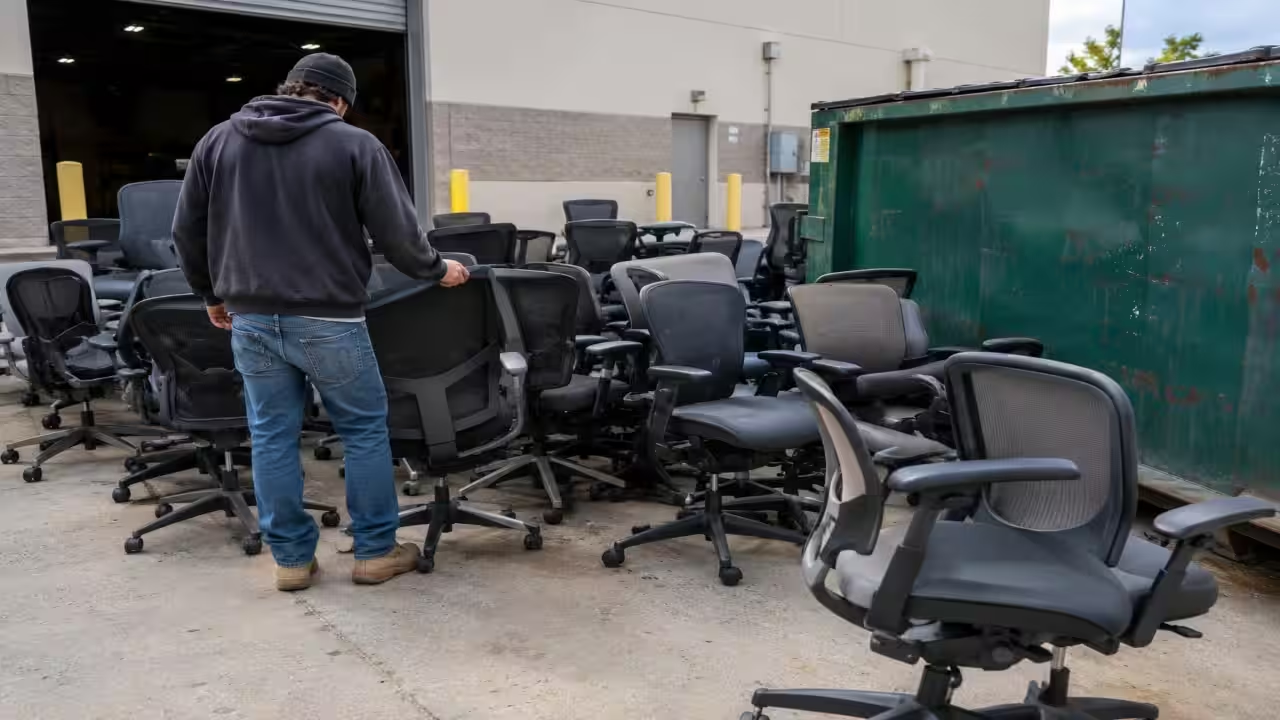
What looks useless to one person can be an inventory to another. After realising that discarded items could still hold significant value, a former apparel reseller in Nashville turned this idea into a business. Office furniture was his breakthrough: after seeing a large number of unwanted chairs, he realised that goods companies discard can be resold instead of wasted. The 190 Steelcase chairs from that haul brought in roughly $17,000. His finances improved after that discovery, and by 2026 his larger dumpster-resale business was generating six figures.The chairs changed his businessBefore that, Carter Stevens was a vintage clothing reseller in Nashville. That business taught him how to price used stuff, how to find buyers, and that the worth of an item depends on who is looking for it, not on whether the original owner still wants it. When that business dried up, his financial circumstances deteriorated, and he ultimately became homeless. Dumpster diving began as a way to find items to sell rather than as a conventional business model.The office chairs made the difference. Stevens salvaged 190 Steelcase office chairs from a warehouse in Nashville. They were not broken, and the Steelcase name carried recognisable value in the secondhand market. He brought them back, then cleaned and listed them for sale. Over around six weeks, the haul netted nearly $17,000 in profit, while his wider eBay sales brought in about $30,000 in revenue. He built on that model, and by 2026 his larger resale business was generating six figures.From dumpster finds to a resale businessStevens began to recover more than just furniture. He looked around Nashville for clothes, electronics, and home items, some of which he could resell online instead of tossing. But finding the goods was only part of the work. Bulky products need to be carried, photographed, stored, cleaned when needed and matched with customers. For someone dealing with dumpsters instead of a normal wholesaler, shipping and storage can be as crucial as the resale price.He had a model for that approach in the office-chair haul. He could recognise things with recognisable labels, determine their secondhand value and reach beyond the people immediately around him via online marketplaces. His later income did not come from one lucky find. The six-figure figure reflects the growth of the business into a larger resale operation.That distinction matters because a $17,000 profit from a single haul is extraordinary. It does not mean every discarded office chair is valuable or that dumpster diving automatically becomes a viable income source. The business can work when resale value exceeds the costs and risks of recovering the goods.The resale economy behind the storyStevens' experience fits the logic of the circular economy: an item one owner discards can still serve another buyer. Reuse can extend a product's life and postpone a replacement purchase. A 2025 review of studies on secondhand clothing and the circular economy concluded that resale can prolong product use and support circular consumption, but the environmental effect is contingent upon the fate of the original product and what new purchase the used item substitutes. The same approach can apply beyond apparel to furniture and electronics.That does not mean that all types of resale are automatically viable. Transport, storage and packing, and customer behaviour influence the outcome. But a chair, television or piece of clothes that is still serviceable usually takes a different route to disposal than just throwing it away. For Stevens, the idea for a circular economy became a business opportunity, not a formal sustainability effort.The spending problem was part of the storyThis is a change from his past financial struggles. He experienced a cycle of heavy spending without much financial security, followed by a period in which discarded goods became a source of income rather than spending. A longitudinal study in Psychiatry Research linked compulsive shopping to a lower quality of life and higher financial costs among people followed from adolescence to midlife.Another five-year follow-up study of individuals diagnosed with compulsive shopping disorder indicated that some participants had a drop in shopping and spending symptoms over time, but triggers such as boredom, negative feelings and pressure could lead to the behaviour returning. Those studies did not examine Stevens and cannot explain his particular situation. They do suggest why shifting the direction of money, from buying undesired items to discovering value in unwanted things, can make such a huge difference in a personal financial story.What the dumpster experiment really showsThe notable part of Stevens' story is that he saw a recurring market where others saw disposability. The proof of concept was the 190 office chairs. His history in garment resale gave him insight into how secondhand markets worked, and the $17,000 profit on one haul made the case for continuing the quest. By 2026 the model had become a six-figure earner. For Stevens, the dumpster was not the end of a product's life but the start of a second market.You use AI every day. Now get your AI Quotient. Take the AIQ test.
Topics in this story
Gathered from external sources. Rights to this text belong to whoever originally published it.