After years of retail work, Sam Walton used $5,000 in savings and a $20,000 loan from his father-in-law to buy an Arkansas store in 1945; by its fifth year, it was recording annual sales of $250,000
Discover the inspiring journey of Sam Walton, who turned a failing retail store in Arkansas into the foundation for Walmart, revolutionizing discount retailing with innovative strategies and a commitment to customer value.
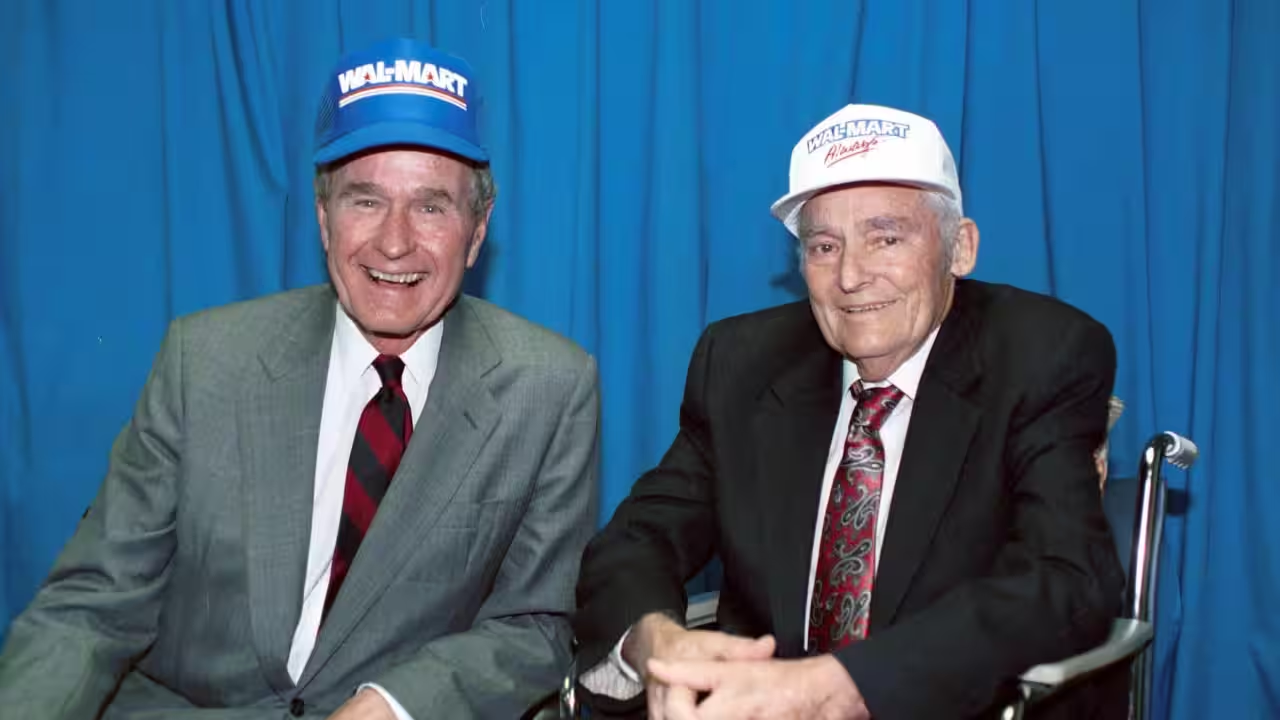
A young retailer looking to start their first independent venture might have hoped for a better starting point. The shop on offer in Newport was losing money, and Sam Walton had little experience running an independent venture. Still, he took a chance on it anyway.American Business History recorded that on 1 September 1945, Walton bought the shop for $25,000. He used up $5,000 from his savings, and the rest, $20,000, he borrowed from his father-in-law, L.S. Robson. Fast forward to five years later, the languishing shop would see annual sales of $250,000 in a town of 7,000 people, the American Business History noted. Behind this boon were simple methods that Walton used: buy cheaply and sell at lower prices.Learning the ropes and a costly leaseWalton had worked as a management trainee at J.C. Penney in Des Moines before serving in the US military during the Second World War. At Penney’s he learnt the ins and outs of retailing and spent his lunch hours studying rival stores. Even during his military service, he continued reading about the trade and visited shops. When he returned to civilian life in 1945, he wanted a store of his own. Butler Brothers, the wholesaler who operated the Ben Franklin franchise system, offered him the Newport store.According to Harvard Business School, the purchase was riskier than Walton understood. He agreed to pay rent equivalent to 5% of sales, a figure exceptionally high for a variety store. The lease also lacked a renewal clause. Although Walton was inexperienced in running any kind of business, he did keep an eye on competitors, a skill he soon leveraged. The Sterling Store across the street was better managed, with more sales. Walton frequented the Sterling Store and checked its prices and displays. Butler Brothers provided him with training and an accounting system, while the rival shop showed what his store needed to improve.Breaking the supplier rulesWalton looked for merchandise beyond the suppliers approved by Butler Brothers. The franchise had mandated operators to buy at least 80% of their goods through the wholesaler. Walton, in a manner of speaking, went against the norm and sourced cheaper goods elsewhere, including shirts and underwear from Tennessee. He also used a New York broker who offered lower prices than Butler Brothers and reduced the selling prices. His decision to discount goods and make money through volumes of sales became a principle of Walmart. For instance, Walton sold four pairs of panties for a dollar while his competitors charged three for a dollar.Walton’s principle worked, and the store’s sales increased from $72,000 before Walton took over to $105,000 in his first year, then $140,000 the following year, to $175,000 in the third year, the Harvard Business School noted. Walton subsequently repaid Robson’s loan within two and a half years. By the fifth year, annual sales had reached $250,000, with a profit of between $30,000 and $40,000.Losing the lease and launching Walmart However, the business’s success did not secure its premises. When the lease expired, the landlord P.K. Holmes refused to renew the lease. He wanted to buy the store for his son. Because the agreement gave Walton no right to renew, he left Newport. Holmes purchased his inventory and fixtures for $50,000, according to Harvard Business School. He remained undaunted by loss, and said: “I’ve never been one to dwell on reverses, and I didn’t do so then”. According to American Business History, Walton then moved to Bentonville, Arkansas, and bought a dime store, which he reopened as Walton’s Five and Dime in July 1950, a precursor to Walmart. He remained a Ben Franklin franchisee but introduced self-service, with tills near the exit instead of clerks and registers throughout the shop. Sales rose exponentially from $32,000 to $95,000, American Business History noted. He then opened more stores in Arkansas and Missouri, with borrowed money to expand and oscillate frequently between locations.According to Harvard Business School, when Walton shifted to large-discount retailing near Rogers, Arkansas, he opened Walmart alongside Walton’s Five and Dime. Harvard Business School recorded that by 1969, Walmart had opened its 18th store in Newport, nineteen years after he had left.You use AI every day. Now get your AI Quotient. Take the AIQ test.
Topics in this story
Gathered from external sources. Rights to this text belong to whoever originally published it.