An Australian woman whose home was destroyed in a 2024 bushfire is rebuilding it with more than 350 earth-filled car tyres, glass bottles and aluminium cans
When a bushfire swept through Pomonal in western Victoria in 2024, Dee-Ann Kelly lost her home along with much of what she owned.
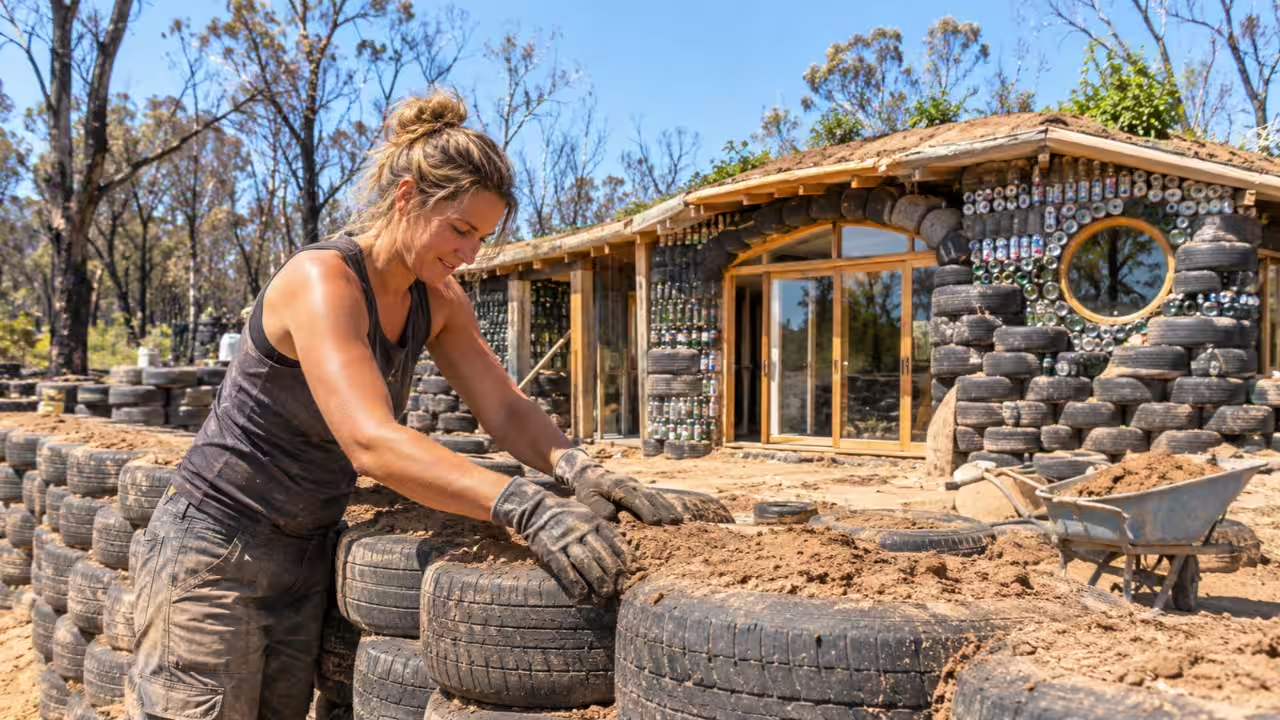
When a bushfire swept through Pomonal in western Victoria in 2024, Dee-Ann Kelly lost her home along with much of what she owned. Two years later, she is rebuilding on the property, but the materials taking shape around her are far removed from those used in a conventional house. Her new home is being constructed with hundreds of discarded car tyres filled with earth, alongside glass bottles and aluminium cans. The unusual design, known as an Earthship, uses recycled materials and thick layers of earth to create an energy-efficient structure intended to offer greater protection against bushfires.How a Pomonal bushfire survivor turned rebuilding into a community effortAs reported by the ABC News, the February 2024 bushfire that struck Pomonal began after a dry lightning strike and spread rapidly through the area. By the time the fire had passed, 45 homes in the western Victorian town had been destroyed. Kelly managed to escape with her pets and a small number of belongings as the fire approached. The loss left her facing the task of starting again, but the support of people around her became part of the rebuilding process. Rather than opting for a standard construction project, she decided to create an Earthship, bringing together volunteers and people with experience in sustainable building.The work is being carried out under the supervision of a registered builder, with around 35 people travelling from different places to contribute. For Kelly, the construction has also become an opportunity to bring people together after the devastation caused by the fire. She described the first day of work as an especially memorable experience, with volunteers explaining what had brought them to the project. The community involvement, she said, had given the rebuilding effort a wider purpose beyond putting another house on the property.How discarded tyres are becoming part of the wallsReportedly, the structure is being built using more than 350 old car tyres, each packed tightly with earth to form sections of the walls. The tyres are being put to use as building components rather than being sent into the waste stream, where discarded tyres create an ongoing disposal challenge. Glass bottles and aluminium cans are also being incorporated into the construction. These materials become part of the wall system, while earth-based finishes are used to cover and complete the surfaces.The approach is associated with Earthship construction, a building method that makes use of reclaimed materials and natural resources. Martin Freney, who has designed and constructed around a dozen Earthship homes, is involved in the project. He explained that the method can reduce the need for conventional building products, including bricks, steel and timber.The construction also involves materials collected directly from the property. Volunteer Chevaun Buchecker, who travelled from South Australia to participate, helped prepare a natural wall finish using clay and sand sourced largely from the site. Straw is added to the mixture before it is used for plastering inside the house.Why the design is intended to offer bushfire protectionFire resilience is one of the main considerations behind Kelly's choice of building design. Earthships use substantial quantities of earth around their structures, creating a thick barrier between the living spaces and the outside environment. Freney said this construction method could make the buildings highly resistant to bushfires. The earth surrounding the structure acts as a protective layer, limiting the exposure of the house to external flames. The design is also intended to withstand other environmental conditions.The home is being built at ground level, although its finished appearance will be closer to that of an earth-covered or underground dwelling. Soil will be placed around and over much of the building, leaving the required openings and living areas exposed. However, the use of earth-packed tyres and recycled materials should not be taken as a guarantee that a building will survive every bushfire. Its performance depends on the complete design, construction standards and the conditions surrounding the property.Millions of discarded tyres find a new purpose in unconventional Earthship homesThe project also draws attention to the volume of discarded tyres generated in Australia each year. Millions are disposed of across the country, creating a challenge for waste management and recycling programmes. Using hundreds of them in a house offers an alternative application for material that would otherwise require disposal or processing. Freney said the approach also reduces demand for certain manufactured construction materials, since reclaimed items take the place of products that would ordinarily need to be produced and transported.The thick earth surrounding an Earthship has another purpose. It helps regulate indoor temperatures by providing insulation, reducing the need for conventional heating and cooling. The buildings are also designed to use energy and water efficiently, potentially lowering running costs over time.Despite its unconventional materials, the Pomonal house is not necessarily a cheaper construction project. Freney estimated that it would cost roughly the same as a conventional home, with the building expected to take about three months to complete.Volunteers help bring the Earthship togetherThe construction has attracted people from outside the local area, including volunteers who wanted to gain practical experience with alternative building techniques. Their involvement has extended from filling tyres and preparing wall materials to applying natural finishes.Buchecker said the people involved had arrived for different reasons, but the relationships formed during the work had become an important part of the experience. She travelled from South Australia specifically to take part in the build.The site has also developed its own informal features during construction, including a dog-shaped sculpture made from mud. Meanwhile, the roof has been attached as the building progresses towards completion.For Kelly, the project is closely connected to the future of Pomonal, a community where bushfire risk remains a part of life. She hopes the house will demonstrate that rebuilding in a fire-prone area can involve different construction choices, rather than simply reproducing the homes that existed before the disaster. She has said, "I'm wanting to create confidence in this community that you can live in a bushfire zone, you can build here and you can survive a bushfire.”You use AI every day. Now get your AI Quotient. Take the AIQ test.
Topics in this story
Gathered from external sources. Rights to this text belong to whoever originally published it.