By 2022, British communities had adopted more than 7,000 phone boxes for £1 each and turned them into libraries, book exchanges and defibrillator stations
Rest of World News: Discover how British communities are giving a new lease of life to obsolete phone boxes by converting them into libraries, cafés, and lifesaving defibrillators, reviving a piece of history.
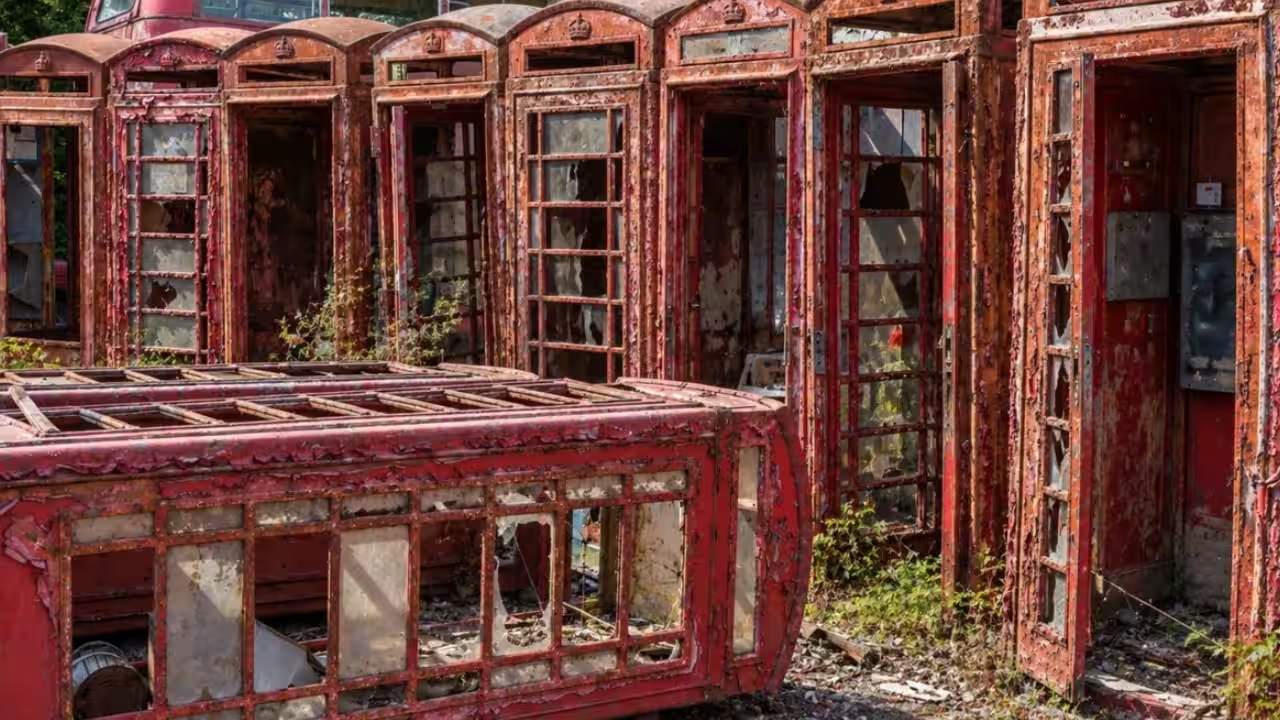
Britain’s famous telephone boxes were an essential part of everyday life for much of the 20th century. These boxes offered a way to make a call from anywhere, including the street corner, village green or railway station at a time when most people did not carry a mobile phone in their pockets. However, the rapid spread of mobile phones soon eroded the telephone boxes’ original purpose. By the 2020s, thousands of the boxes were rarely used.Instead of simply removing them, British communities have adopted more than 7,000 phone boxes since 2008 for £1 each through BT’s Adopt a Kiosk scheme, according to The Guardian in April 2022. The former telephone boxes were turned into miniature libraries and art galleries. Meanwhile, others were repurposed to house publicly accessible defibrillators.How a £1 initiative gave redundant telephone booths a second lifeIn 2008, to take over redundant red telephone boxes instead of having them removed, BT launched Adopt a Kiosk. The scheme allowed recognised public bodies like town, parish and community councils, including registered charities, to acquire qualifying kiosks for £1. Under these terms, the internal telecommunications machinery is completely decommissioned and uninstalled prior to the community taking physical possession of the shell for repurposing. This innovative idea soon produced some small community facilities. BT reported that two former red boxes were acquired by Appleton Parish Council in Cheshire and were converted into different public amenities. One box became a book exchange, while the other was fitted out to house a defibrillator.Other adopted kiosks soon found other functions as well. Communities reportedly found uses that allowed the structures to remain a part of their local landscape despite losing their original telecommunications function. By 2021, records reported that more than 6,600 phone boxes had already been adopted through the scheme, with The Guardian saying that by 2022, the said figure had passed 7,000, thus making the £1 scheme a nationwide reuse programme instead of a collection of isolated village projects. As enclosed kiosks were well suited to provide a recognisable, publicly accessible location for emergency calls, defibrillators became one of the most practical conversions.Under this scheme, not all phone boxes were transformedJust because there was a decline in ordinary use, it did not necessarily mean that every remaining payphone was obsolete. Ofcom’s evidence showed that public call boxes continued to play a role in regions where people lacked a working mobile phone or where mobile coverage was poor. At the time of The Guardian’s report in 2022, around 5 million calls were still being made from British phone boxes each year. Ofcom’s data suggests that between May 2019 and May 2020, approximately 150,000 calls were made to emergency services. This included about 25,000 calls to Childline and 20,000 to Samaritans.The regulator introduced stronger guidelines in June 2022, preventing BT and KCOM from removing certain boxes when they were still needed in the communities. A box could qualify for protection if, among other conditions, it was in a region without coverage from all four mobile networks, had recorded at least 52 calls over the past 12 months, was in an area with a high frequency of accidents or suicides, or if there was any other evidence that it was reasonably needed, such as use for helplines or local emergency services.A British landmark became a part of community infrastructureThe famous red kiosks had become a part of the country’s visual landscape long before mobile phones appeared. Government guidance on former telephone kiosks notes that the red designs included the K2, introduced following Giles Gilbert Scott’s 1924 design, and the later K6, of which around 60,000 were installed. The 2008 scheme allowed the phone boxes to retain their recognisable red legacy while its interior was given an entirely different function.Looking ahead to subsequent project expansions, BT’s 2023 report said that more than 7,200 phone boxes had been adopted by communities across the UK since 2008, while around 20,000 working payphones remained, including about 3,000 in traditional red kiosks. This legacy infrastructure network now continues to serve as an enduring, adaptive model for local civic engagement and architectural preservation.Catch the latest World News and Live updates. Download the TOI app.
Topics in this story
Gathered from external sources. Rights to this text belong to whoever originally published it.