In 1889, Switzerland opened the Pilatusbahn after Eduard Locher designed a new rack system that helped trains climb Mount Pilatus at gradients of up to 48%
In 1889, Switzerland opened the Pilatusbahn, a mountain railway designed to climb Mount Pilatus using an unusual rack-and-cogwheel system.
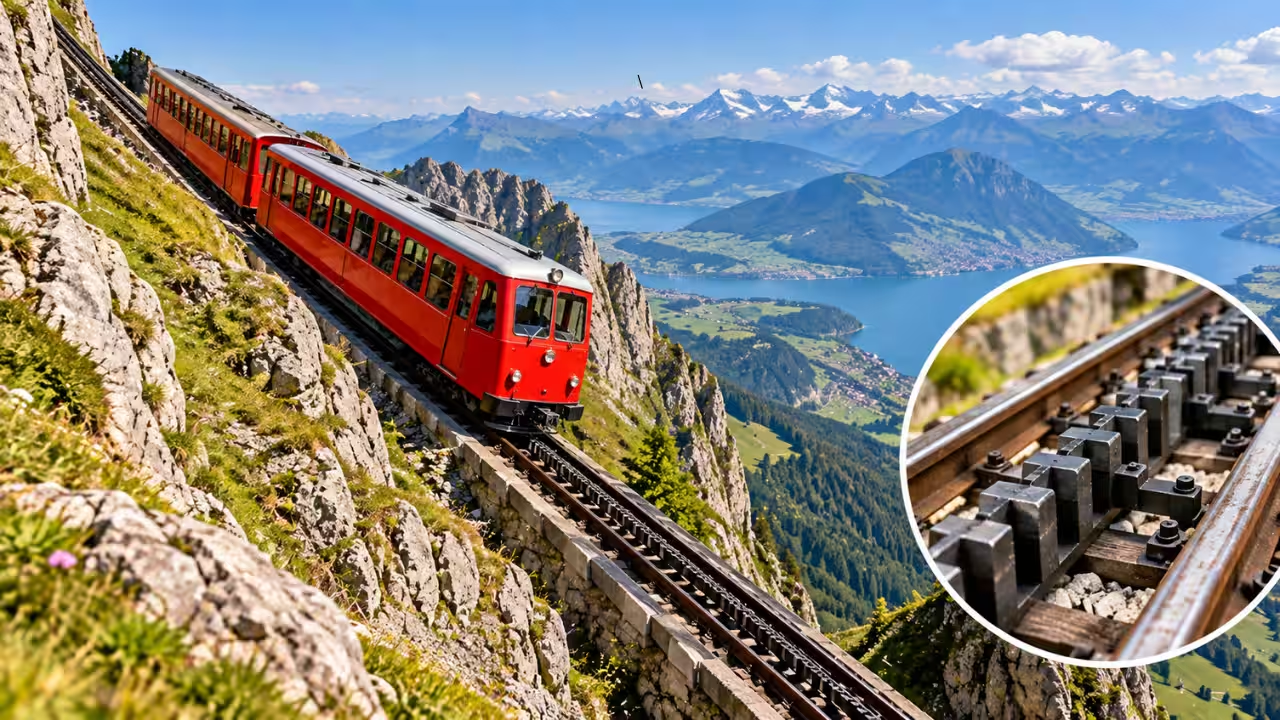
In 1889, Switzerland opened the Pilatusbahn, a mountain railway designed to climb Mount Pilatus using an unusual rack-and-cogwheel system. Engineer Eduard Locher developed the system after an earlier proposal using conventional rack technology was considered unsuitable for the mountain’s terrain and economic requirements. The railway opened on 4 June 1889 after construction began in April 1886, with steam-powered cars carrying passengers up gradients reaching 48%. Its original cars combined the engine, boiler, fuel and water storage with the passenger compartment on a single chassis. The railway was electrified in 1937, while its basic driving-gear principle remained unchanged.Why was the original 1873 Pilatusbahn plan considered unsuitableA proposal submitted in 1873 called for a cogwheel railway from Lake Lucerne to the summit of Mount Pilatus using the established Riggenbach system. According to the American Society of Mechanical Engineers, the proposed railway would have had a maximum grade of 25% and a 1,435-millimetre gauge. However, technical and economic considerations meant that this design would have produced a route twice as long as the eventual Pilatusbahn, with rolling stock that was too heavy and curves that were too large for the mountain's terrain.Engineer Eduard Locher then proposed a system specifically designed for Mount Pilatus. The gauge was reduced to 0.8 metres, while the maximum grade was increased to 48%, allowing the route length to be reduced. Instead of placing a conventional rack vertically between the rails, Locher designed a horizontal double rack with its teeth facing each side. Two cogwheels on vertical shafts beneath the car engaged with the rack, while flanges helped keep the system engaged even on the steepest sections.When did construction of the Pilatusbahn begin and when did it openConstruction of the Pilatusbahn began in April 1886, and operations began on 4 June 1889, according to the ASME landmark document. The railway was constructed entirely with private capital because the government did not provide a subsidy for its construction. Locher's system was developed in response to the technical, economic and regulatory conditions surrounding the proposed railway.The original railway used steam-powered cars. ASME states that the cars combined the engine, boiler, water and coal storage and passenger compartment on a single four-wheel chassis. The cars were 11 metres long and weighed 11.6 tonnes when fully loaded. During construction, the steam-powered cars were used to transport workers and materials from Alpnachstad to the work site.How does the Pilatusbahn’s unusual cogwheel system workThe Pilatusbahn's unusual propulsion arrangement was designed to keep the cogwheels engaged with the rack on the steep mountain sections. ASME says the system used opposing horizontal cogwheels engaging with a double rack, while flanges beneath the cogwheels helped guide the car and prevent wind and gravity from lifting it away from the rack. The organisation describes the Pilatusbahn as the world's steepest cog railway, with a maximum grade of 48%.The original steam-powered cars were replaced by electric cars in 1937, with further updates made in 1954 and 1967. ASME states that the driving-gear principle and basic design remained the same in the electric version. The current electric cars use twin motors that also provide dynamic braking during descent. Two original steam cars remain in existence, with one on loan to the Swiss Museum of Transport and the other at the Railway Museum in Munich.You use AI every day. Now get your AI Quotient. Take the AIQ test.
Topics in this story
Gathered from external sources. Rights to this text belong to whoever originally published it.