In 1974, a biologist moved to a Washington island because one marsh supported 80 bird species; he devoted the rest of his life to it, and neighbours later created a wildlife preserve
US News: Discover how Dr. Frank Richardson transformed a marsh on Orcas Island into the Frank Richardson Wildfowl Preserve, protecting 80 bird species and inspiring generations through his commitment to wildlife conservation.
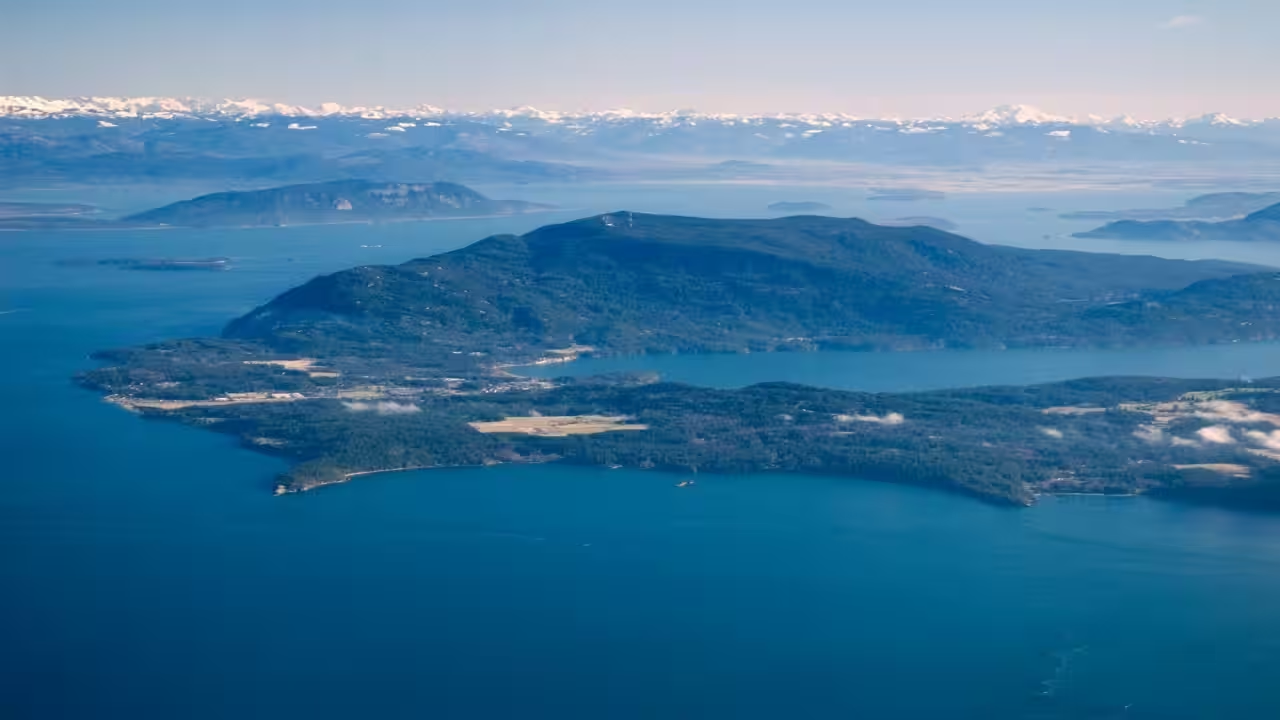
When Dr. Frank Richardson retired from the University of Washington in 1972, he did not slow down. He shifted his fieldwork from museum collections to a wetland near his home, trading decades of specimen cataloguing for hours spent watching live birds in the marsh. Two years later, he made the shift permanent, settling on Orcas Island in the San Juan Islands and turning that single wetland into the last great subject of his working life. The marsh he studied now bears his name as a protected wildlife preserve, a legacy his neighbours created after his death.Richardson spent his career as a professor of zoology at the University of Washington and headed the ornithology division at the Burke Museum, which held one of the country's largest bird specimen collections. After stepping down from that post in 1972, he did not retire from birdwatching itself, spending time studying bird life on Cypress Island before settling permanently on Orcas Island in 1974 with his wife, Dorothy, the San Juan Preservation Trust, which now manages the reserve built around his work.Richardson's academic training left him with a habit of counting and cataloguing what he saw rather than simply observing it. Near Deer Harbour, he soon began studying a modest wetland close to his new home.An unusually busy patch of wetlandRichardson found that the marsh supported an unusually high number of bird species. Despite covering only a small stretch of land near Channel Road, the site supported roughly 80 different species of birds moving through or nesting there across the seasons, an unusually high count for a wetland of its size. The marsh sat along the Pacific Flyway, the migratory corridor that carries waterfowl and shorebirds up and down the West Coast each year. That helped explain why so many species stopped there.Richardson came to believe that counting birds alone was not enough. He had watched habitats disappear across the region during his academic career, and he concluded that the long-term survival of many species depended on protecting the specific pieces of ground they relied on, not just studying them from a distance. That conviction led him to land conservation work in the San Juan Islands during his final years, applying decades of ornithological training to protect a single marsh.A preserve built after his deathRichardson died in 1985, but his work to protect the marsh continued after his death. The following year, neighbours Bob and Meg Connor donated a seven-acre conservation easement covering the eastern portion of the wetland, a gift that initiated the effort to establish the Frank Richardson Wildfowl Preserve. A memorial plaque to Richardson now sits on a boulder along Channel Road at the edge of the marsh, marking the spot for visitors who stop to look out over the water.Richardson's influence on Orcas Island extended beyond the marsh itself. Colleagues remembered him as a generous mentor, including wildlife artist Tony Angell, who said a chance friendship with Richardson at the Burke Museum shaped his career studying and illustrating Northwest birds, as documented by HistoryLink, the Washington State history resource. Angell later credited those early outings with Richardson, searching for carving stone along the Upper Skagit and examining study skins at the museum, as the spark that led him to a lifetime of wildlife art.That same generosity was reflected in how Richardson was remembered professionally after he died in 1985. An obituary published the following year in The Auk, the journal of the American Ornithologists' Union, noted the breadth of Richardson's contributions to Pacific Northwest ornithology over a career that ultimately outlasted his formal retirement by well over a decade.Today the preserve remains a working wetland rather than a museum piece, still hosting the same seasonal traffic of migrating wildfowl that first caught Richardson's attention half a century ago. Part of its acreage lies in upland forest across the road from the marsh itself, and a short pedestrian path leads visitors up to a screened viewpoint overlooking the water. It is a small piece of ground by conservation standards, but it stands as the direct result of one retired professor's decision to keep doing fieldwork long after his job ended and of neighbours who chose to protect that work after he was gone.Catch the latest World News and Live updates. Download the TOI app.
Topics in this story
Gathered from external sources. Rights to this text belong to whoever originally published it.