In cigarette-butt asphalt tests, researchers found a 1.5% filter-waste blend gave the mix its best resistance to permanent deformation
Researchers discover that a 1.5% blend of cigarette butt waste in asphalt provides optimal resistance to permanent deformation, offering a sustainable solution to road construction and waste management.
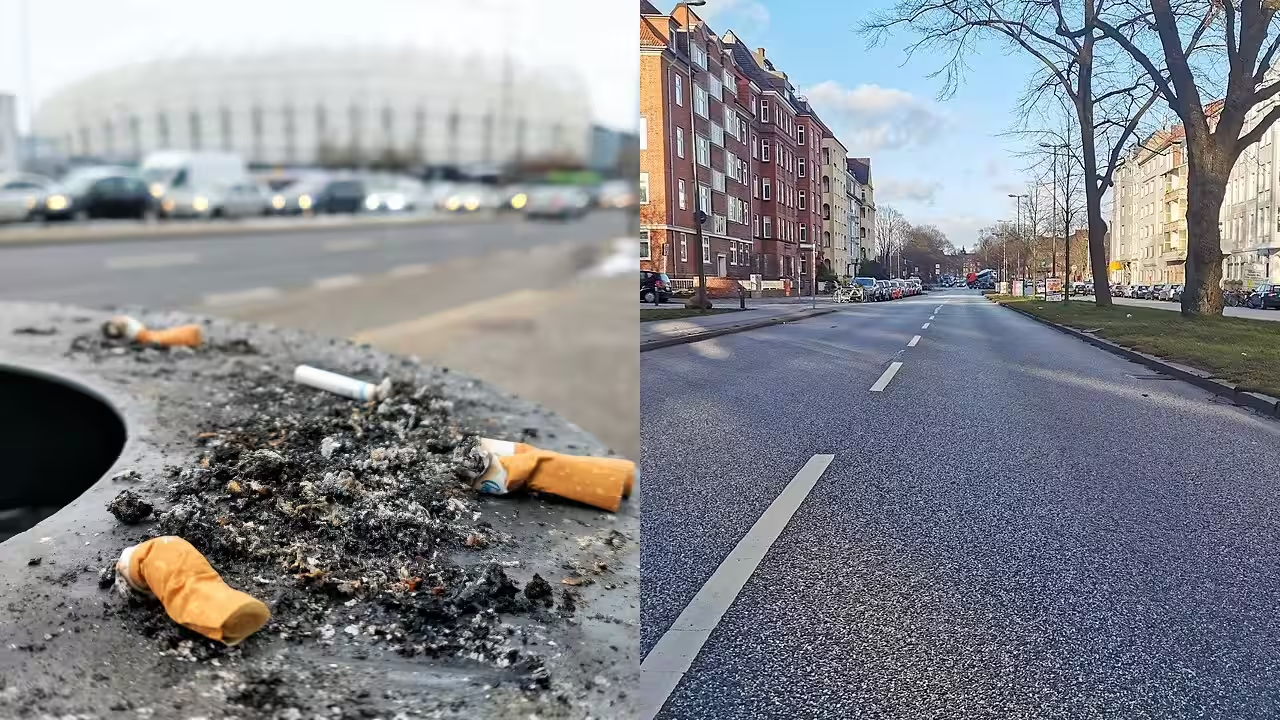
Researchers have tested cigarette-butt waste as an ingredient in asphalt mixtures, with one study finding that a mix that contained 1.5% cigarette butts had the lowest flow value among the tested concentrations, which indicates the strongest resistance to deformation by that measure. The same study found that increasing the cigarette-butt content changed the mixture's behavior under load, although its separate high-temperature rutting test produced a different optimum.The work examined cigarette butts as a waste material that could be incorporated into bituminous road mixtures, and researchers prepared samples with different amounts of cigarette butts and measured properties including Marshall stability, flow and resistance to deformation. Most conventional filters are made from cellulose acetate, which is a form of plastic-like cellulose that does not readily break down in the environment. Cigarette butts that have been used can also contain residual tobacco, tar and other substances, which has made their disposal an environmental problem. A later review of cigarette-butt asphalt research noted that researchers have investigated several ways of encapsulating or incorporating the waste into pavement materials.The 1.5% mix behaved differently under loadResearchers first tested cigarette-butt contents of 1%, 3% and 5% in the 2018 experiment, and the 3% mixture produced serious segregation, so the researchers tested lower concentrations of 1%, 1.5% and 2%. The Marshall test was then used to assess the mixtures, following which researchers reported that the 1.5% mixture had the lowest flow value among the tested cigarette-butt concentrations. In asphalt testing, flow is related to the amount of deformation that occurs under the Marshall loading conditions, and the paper therefore identified 1.5% as the best proportion for anti-deformation performance based on that measurement.In another study, the researchers examined high-temperature performance using a wheel-tracking or rutting test, and the dynamic stability increased as the cigarette-butt content increased, with the 2% mixture recording the highest dynamic stability in that experiment. “Best resistance to deformation” can refer to different measurements, as the 1.5% result came from the flow-value comparison, while the 2% result came from the high-temperature dynamic-stability test, and the study did not establish that 1.5% was universally the optimum concentration for every form of pavement deformation.Researchers have tested several ways to use the wasteOne investigation that was published in Construction and Building Materials examined cigarette butts that were encapsulated in bitumen before they were incorporated into stone mastic asphalt. That research found improved Marshall stability in mixtures that contained 1% and 2% encapsulated cigarette butts and reported increased resistance to permanent deformation, which is important because cigarette filters can contain substances that may leach out. The researchers therefore also examined leachate from the asphalt mixtures rather than treating the waste simply as an inert filler.A larger review of waste fibres in asphalt has since placed cigarette-butt materials among several experimental additives that are being investigated for pavement applications. The research has included whole cigarette butts encapsulated in asphalt, shredded filter fibres and other processed forms, with different studies having used different concentrations and testing methods, so their results cannot simply be combined into one recommended percentage.The 1.5% finding therefore belongs to a specific laboratory study and a specific performance measurement, and it does not mean that roads containing exactly 1.5% cigarette-butt waste have been proven to outperform conventional asphalt in real-world traffic. The research instead shows that a small proportion of cigarette-butt waste can alter the mechanical behavior of an asphalt mixture under controlled testing.You use AI every day. Now get your AI Quotient. Take the AIQ test.
Topics in this story
Gathered from external sources. Rights to this text belong to whoever originally published it.