In 2002, Japan widened a 70-metre road using crushed oyster shells in its base; testing found the shell section exceeded the ground improvement target
Discover how Japan transformed seafood waste into a sustainable solution for road strengthening, showcasing positive results from a unique 2002 engineering experiment with crushed oyster shells.
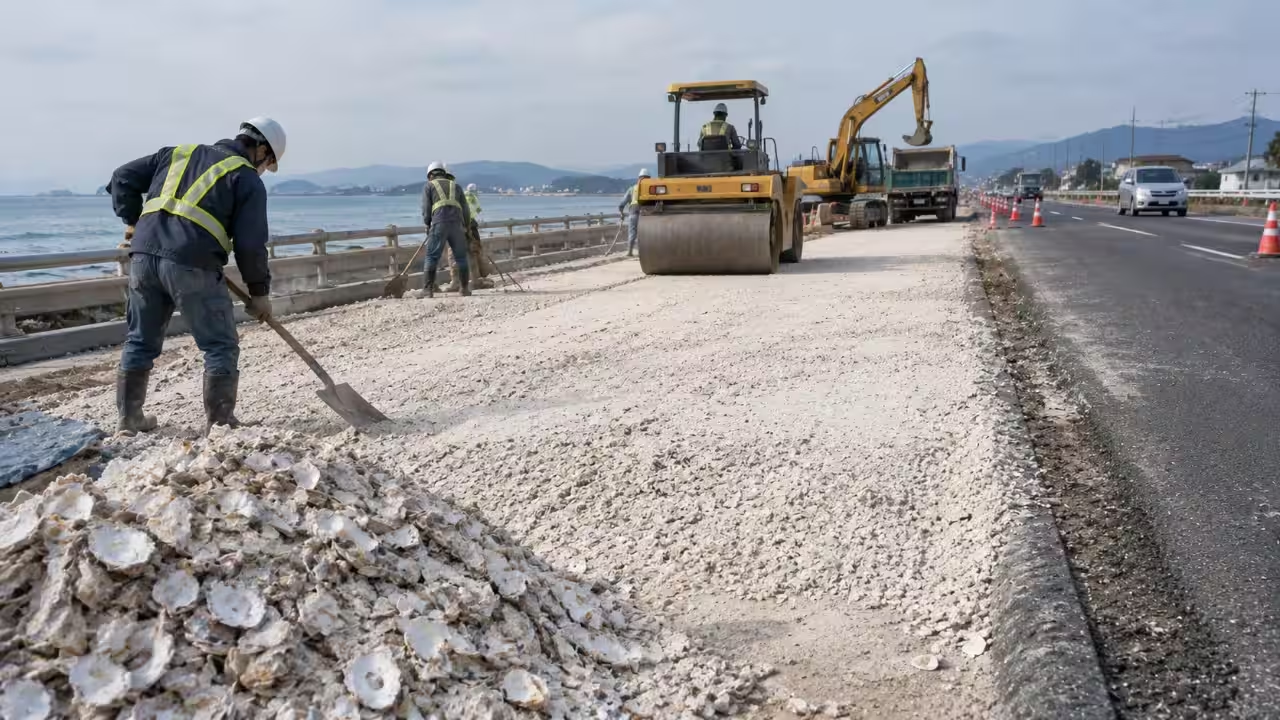
Discarded oyster shells are often associated with seafood waste, stockpiles and the challenge of finding storage space. In parts of Japan, oyster-farming shells became the focus of a practical engineering experiment. Rather than sending the material for disposal or using it only in agriculture, researchers investigated whether crushed shells could help strengthen the ground beneath roads.According to a study published in the Journal of the Society of Materials Science, Japan, crushed oyster shells were tested in a Japanese road-widening project in March 2002, with the trial covering a 70-metre stretch. Researchers monitored the road’s response to traffic using pavement deflection measurements and found that deflection decreased over time. The section containing nearly dry oyster shells also achieved an estimated California Bearing Ratio above the target set for ground improvement. The findings suggest that discarded oyster shells may be useful for strengthening road subgrades, although further testing is needed under different conditions.Why Japan was looking for a use for discarded oyster shellsThe experiment aimed to address a practical problem in oyster-producing areas. After oysters were removed, the shells would pile up in storage yards. Some of these would be used again as an additive to animal feeds, fertilisers, and soil conditioners. This method of using shells did not always keep up with production levels. Piling up shells caused problems in terms of occupying space and creating foul odours and worsening the environment. Using these shells for crushing purposes presented an alternate solution. The crushed shells would be used for making better roads.The approach was not entirely untested. A study published in Doboku Gakkai Ronbunshu in September 2002 examined the suitability of crushed oyster shells for road subgrades through laboratory experiments and simulated ground-improvement tests. The researchers found that incorporating roughly 20% crushed shells could improve the ability of construction equipment to travel over the treated ground and could contribute to the effectiveness of soil stabilisation. The study suggested that the small, irregular shell fragments could perform well beneath asphalt pavements. The next experiment moved the research outside the confines of the laboratory. Rather than depend only on the results of laboratory testing on samples, the engineers were able to see the performance of the material after the road had been built.What happened after vehicles began using the road?The researchers used a falling weight deflectometer to measure how much the road surface bent under a controlled load, helping them assess the pavement’s strength without digging into it. The Society of Materials Science, Japan also reports that maximum deflection at the loading point tended to decrease during the monitoring period, suggesting the pavement resisted bending more effectively under the test conditions. The best results came from the section containing nearly dried oyster-shell fragments, where the estimated California Bearing Ratio (CBR), a measure of soil strength and resistance to penetration, exceeded the target set for ground improvement.These findings suggested that oyster-shell fragments could be a useful alternative in the road-widening project, but they did not establish that shell powder or other forms of oyster-shell material could replace conventional road materials in every situation. Further testing under different soil and weather conditions, along with longer-term monitoring, would be needed to determine how well the material performed over time.Could seafood waste become a regular road material?The significance of the Japanese study lay in its practical approach to waste management. Rather than sending discarded oyster shells for disposal, the researchers tested whether the material could serve a useful purpose in road construction. The 70-metre trial produced encouraging results for the ground supporting the pavement, but it did not establish that oyster shells could be used directly as a road-surfacing material. The study also did not quantify the long-term cost savings or establish how the material would perform under different conditions over many years. Nevertheless, it showed that locally available shell waste could meet a specific ground-improvement target under the conditions tested.The March 2002 project provided a field-based assessment of oyster-shell fragments as a construction material, moving beyond the idea of waste reuse to examine their performance under real road conditions. Its findings offered evidence for a potential use in areas with substantial quantities of discarded shells, while leaving questions about durability, wider applications and long-term economic benefits unresolved.You use AI every day. Now get your AI Quotient. Take the AIQ test.
Topics in this story
Gathered from external sources. Rights to this text belong to whoever originally published it.