7 hours for lip gloss, 2 hours for a croissant: Welcome to line culture, where flexing how long you waited is part of the fun
Waiting in line is cool again. For young people chasing viral products and experiences, the inconvenience may be part of what makes it special.
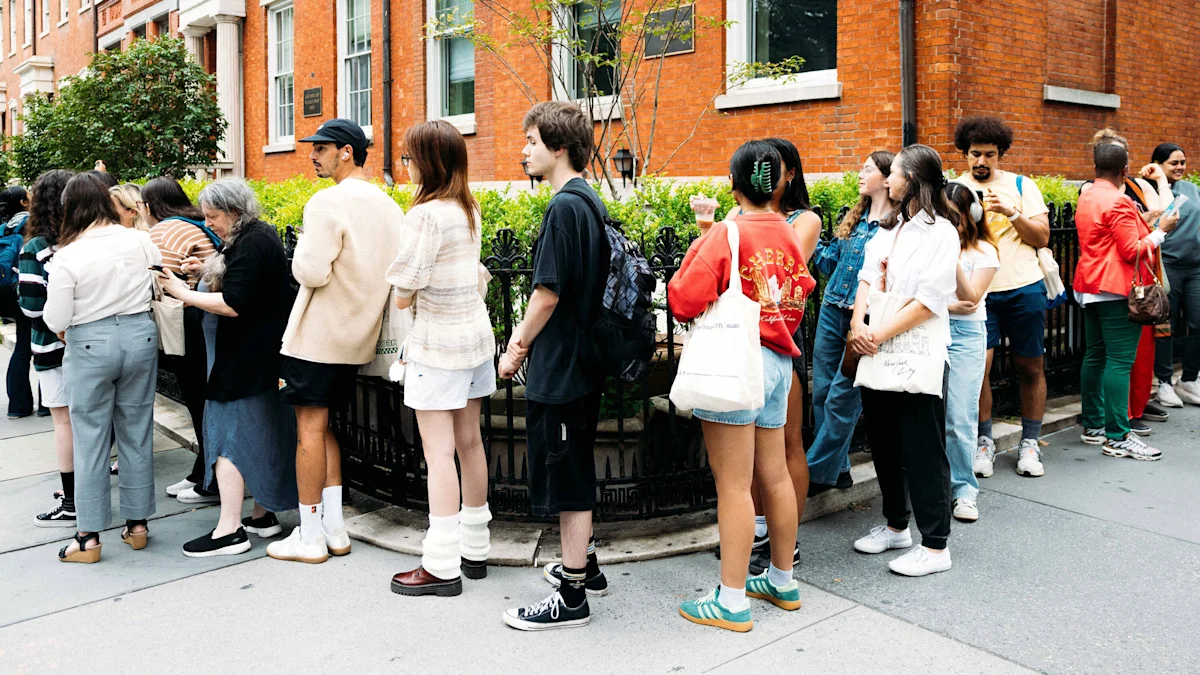
At 5:30 in the morning, Kristen and her sister arrived in Newport, Rhode Island, armed with a blanket, snacks and a suspicion that Hailey Bieber might show up. The 22-year-old had driven an hour from Connecticut for the first day of the summer pop-up from Rhode, a special event from Bieber's massively popular beauty brand, celebrating a seasonal drop . The doors wouldn't open until 11 a.m. Kristen had never done anything like this before and she expected the hours to drag. But that didn't end up being the case.
"We were just making friends with the people around us," she tells Yahoo. "It was really cool to hear everyone's story on why they were there, where they're coming from."
Even after the doors finally opened — five and a half hours after they arrived — Kristen was still about 40th in line and had another hour and a half to wait. But the waiting had begun to turn into something else.
Security handed out wristbands. Newport coffee shop Nitro Bar passed out caramelized banana lattes , a nod to a drink Bieber had talked about making at home. There were bingo cards with the chance to win free products. "The little surprises that came along the way got people so excited," says Kristen. "And that's when I was like, OK, waiting was worth it."
Kristen ended up nabbing a pocket bronzer, two lip liners and lip glosses, and an exclusive Newport Rhode hoodie. She returned again the next day and spent another six hours outside the pop-up, hoping Bieber would appear. (She didn't. But cinnamon rolls were passed around for attendees.)
Today's young people came of age in an era of one-click everything, where almost anything can be ordered to your doorstep in a matter of 48 hours. Given that fact, spending the better part of one (or two) days waiting outside a store sounds almost absurd.
Yet this summer, lines have solidified themselves as a recurring feature in the lives of young people chasing after trendy consumer products: they've formed outside beauty pop-ups and bakeries, artist activations, coffee and matcha shops and stores carrying the latest cult item. Getting the thing that you want, line enthusiasts say, is almost more special because you had to prove that you really wanted it.
The merchandise might be available elsewhere. But acquiring the thing isn't necessarily the point. "People don't wait in line for products anymore," Ryan Glick, founder of Coffee N' Clothes (CNC) , a brand-experience agency that produces more than 200 events a year, tells Yahoo. "They're waiting in line to be a part of a moment."
Glick has seen the phenomenon evolve from both sides of the rope. He started his company by organizing meet-ups for online communities and eventually grew it into a business that helps brands across fashion, beauty, entertainment and tech produce IRL experiences. "In a world where digital made everything available to everyone instantly, showing up is proof that you're physically there for something that mattered," he says.
There may also be something psychological happening as those hours tick by too, according to Derek D. Rucker , a professor of marketing at Northwestern University, who points to the concept of "effort justification" — the tendency to value something more once we've invested time or work into getting it. "The more effort we have to put into something, the more we justify it as, 'It must be worth it,'" Rucker tells Yahoo.
Kristen could've waited for the Rhode products she wanted to arrive at Sephora. But the pop-up offered something Sephora couldn't. "It's just a cooler experience when you go to an event for it," she said. With only two U.S. pop-up locations at the time, being able to attend one made her "feel special."
That distinction — between buying something and being there — runs through the line phenomenon.
When Valeria Rose, 23, recently returned to Los Angeles after attending college in Santa Barbara, she went to Ariana Grande's Eternal Sunshine experience in West Hollywood. She had seen TikToks of fans arriving at 6 a.m. and not getting inside until mid-afternoon, so she strategically went on a weekday. She still waited nearly three hours.
The fan event was cool — there was a photo booth and a flower-covered wall where fans could leave Grande notes. But more importantly, Valeria went with a friend who wanted to be there as much as she did. "Having someone to chat with honestly makes the time go faster," she tells Yahoo.
Growing up near the entertainment industry, Valeria is a veteran of line culture. She's met people waiting in line for concerts, meet-and-greets and pop-ups — some of those friendships lasted long after the line disappeared. Returning to that ritual after years away from L.A. also offered an unexpected connection to her younger self.
"It was pretty funny that on my first day back home, I was waiting in line," she says. "I felt so connected to my past self."
On vacation in Arizona, Elizabeth and her sister had an open day and kept seeing Sablé Boulangerie, a viral bakery in Gilbert, on their TikTok feeds. They decided to see what the hype was about and spent an hour and 37 minutes in line to get their hands on a selection of pastries and the bakery's internet-famous chocolate chip cookie.
Around them, people worked on laptops, played games and sat in chairs. Families and groups of friends waited together. Chef Will Porter, whose social media presence has helped make the bakery a destination, briefly "walked the line" with a cameraman and bodyguards.
Elizabeth started filming mostly because she was curious how long the wait would take. The resulting video got 50,000 views, when most of her posts typically draw around 500.
"If you post about standing in a line and say how long you stood in the line, people can't wait to tell you how dumb you are in the comments," says Elizabeth. "It drives engagement. It's essentially easy rage bait."
It creates a strategically efficient cycle: A viral place attracts a crowd. The crowd creates a line. People film the line because it is remarkable. The resulting content reaches more people, who then want to see what could possibly be worth waiting for.
It's a marketing jackpot. Whether you encounter it in person or watch it unfold on TikTok, you're seeing dozens of people weigh whether something is really that valuable in real time. Timothy D. Malefyt , a marketing professor at Fordham University, calls that "embodied social proof" and it naturally gives observers FOMO, the feeling that the people in line "apparently know something I don't."
There is, Elizabeth admits, "a bit of excitement to try something that's trending and see for yourself if it's actually good." Going also gives you something to talk about when other people inevitably ask, "Was it worth it?"
In her case, yes — with a caveat. She still thinks about Sablé's pain suisse. "The pastries truly were delicious," she says, "but I wouldn't stand in that line again."
Of course, people stood in lines long before TikTok. There were Black Friday doorbusters, concert ticket sales and Supreme drops. Glick remembers waiting outside Supreme — which was created as more of a community space than a traditional retail store — with his mom as a kid.
What has changed may be how many ordinary products can now be transformed into events — and how quickly social media can create a craze around them.
In Iowa, Anna T., 40, found herself waking up before dawn to hunt for NeeDoh squishy toys with her 11-year-old daughter. A local children's boutique would announce "drop" dates for harder-to-find designs, prompting customers to line up before opening.
The first time Anna went, she waited in the snow for roughly two hours. On another trip, she and her daughter arrived at 6:15 a.m. for a 9 a.m. opening. Eventually, Anna took her daughter and two friends at 5 a.m. By then, the wait had become an event of its own. "The store owner came out around 7:30 a.m. and had music," she tells Yahoo. "The kids were dancing, and it was a very fun and lively experience."
For Anna's daughter, the inconvenience was novel — and part of the appeal. "She told me she really wanted to because she has never waited in line to buy anything before and she said she wanted to experience that," says Anna. That struck her. "We've waited in lines for a ride, but never for a material thing."
In a childhood shaped by online shopping and instant gratification, even the hassle is part of the charm. "When something is easily accessible, we tend to think anyone could get it and that it's not as special as things that took work, energy, time or were scarce," Elizabeth Schwab , a professor in the Business Psychology Division at The Chicago School, tells Yahoo.
But the hours spent waiting can offer something else that clicking "buy now" can't: doing it with others. "We enjoy feeling like we belong; that we've found our people and our community," Schwab says.
That would explain why, for Anna, the NeeDohs themselves were almost beside the point. "I don't do it for the actual item," she says. "For my daughter, it was about getting the trendy new item, but I know these are memories that she will be able to talk about with her kids one day. And all of it is a reason for us to spend time together."
There is a limit to the romance of waiting. Elizabeth, who waited nearly two hours outside the bakery, says her ceiling is an hour or two. Valeria questions the appeal of standing around for something as fleeting as a celebrity-branded smoothie. Glick cautions that brands shouldn't manufacture lines simply to appeal popular — a badly managed wait can just as easily backfire, he says.
And even the people willing to queue for hours know how irrational it can look from the outside. Perhaps that's what makes the line work.
Convenience has stripped away much of the friction that once surrounded buying something. The line puts some of it back, but with friends, anticipation, exclusivity and a story attached.
The most telling thing about this summer of lines may be that Anna's daughter didn't simply want the NeeDoh. She really wanted to wait for it.
Topics in this story
Gathered from external sources. Rights to this text belong to whoever originally published it.