In the 1980s, Israel installed barn owl boxes to control crop-eating rodents without poison; researchers later found that threatened native gerbils formed over half the prey in some nests
Rest of World News: Discover how Israel's barn owl nesting initiative aimed to control crop-eating rodents without poison, but revealed an unexpected ecological dilemma: endangered native gerbils as prey.
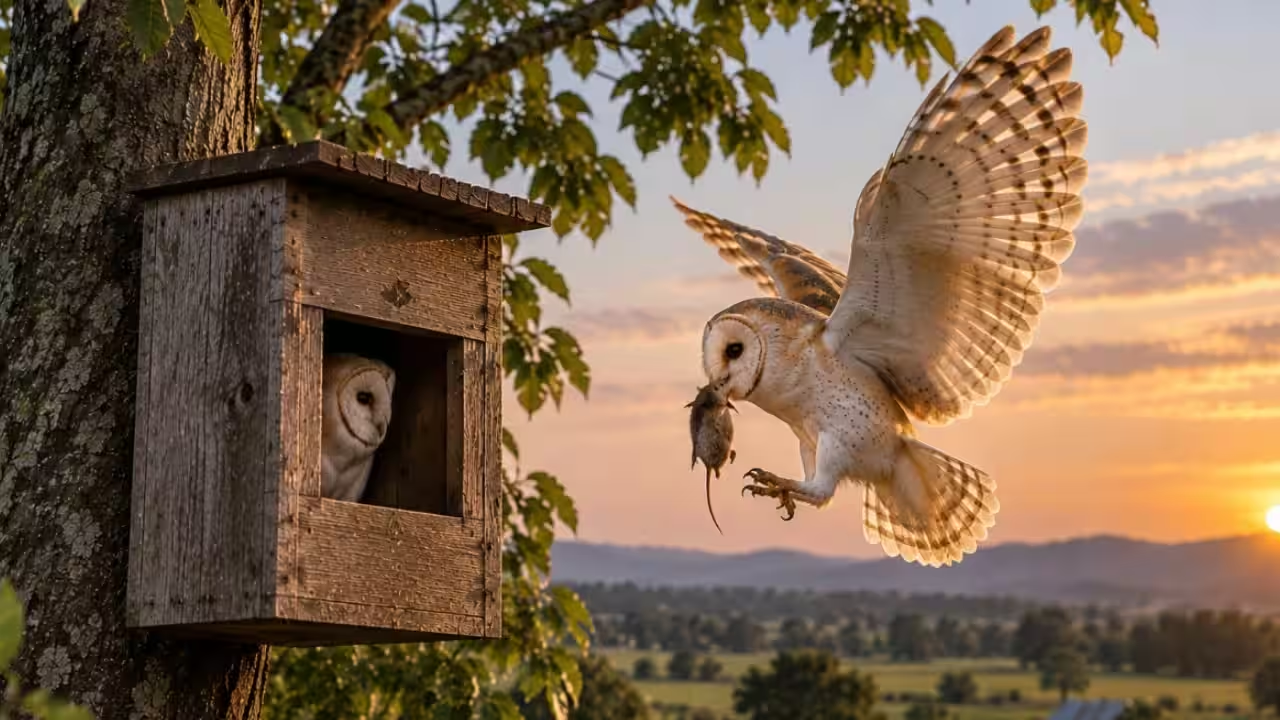
In the early 1980s, Israeli farmers and researchers started testing a natural alternative to chemical rodent control. They came up with giving barn owls artificial places to nest which were closer to agricultural fields. The aim behind this idea was to use an existing predator, instead of introducing a new species, to hunt rodents that could damage the crops. In 1983, one of the best-documented programmes began in Israel's Beit She’an Valley, where 14 nest boxes were installed across around three kilometres. What initially appeared to be a straightforward biological control strategy, however, soon became complicated as researchers faced the question of what would happen when owls encountered rodents that conservationists were trying to protect.The barn owl was already a part of Israel’s agricultural ecosystem, and the nest boxes were intended to provide additional breeding sites in cultivated lands. This allowed the owls to establish territories near fields and hunt rodents naturally. Researchers at Tel Aviv University later described the nest-box system as a part of Israel’s long-running effort to control agricultural rodents via barn owls and other raptors while lessening the dependence on chemical rodenticides.The journey from an experiment to a national programmeBy the early 2000s, the use of raptors for biological pest control had been integrated into agricultural management across several regions. In the Beit She’an Valley specifically, research showed that the programme expanded from its initial footprint to roughly 300 nest boxes covering 90 square kilometres by 2007. Tel Aviv University researchers reported that thousands of nesting boxes had subsequently been installed across the country. They also noted that this approach had been adopted in the neighbouring parts of the region as well. The scale of this initiative reflected the appeal of replacing the use of chemical rodent control with a predator which was already familiar with the local environment.Another advantage of barn owls is that they hunt largely at night, when many small mammals are active, and an established pair can make repeated hunting trips around its nesting territory. Therefore, the pest-control benefit was expected to come from owls’ natural feeding behaviour instead of any direct human intervention in every field.On the other hand, excessive use of chemical rodenticides can have consequences that go beyond the intended target. For example, other animals can encounter the poison placed for rodents, while predators may also be exposed when they consume poisoned prey. Although the barn-nest box approach can be considered a good example of non-chemical or reduced-chemical control, it also created an ecological challenge, as owls cannot be expected to recognise the difference between an agricultural pest and a protected native rodent.This point became especially important in the northwestern Negev, a different study region from the original Beit She’an Valley experiment. The northwestern Negev’s cultivated land lies close to natural sandy habitats that support native small mammals, including several gerbil species. Researchers were stumped by the question of whether artificial nest boxes placed near these areas might increase predation pressure on species that were not agricultural targets.An unexpected pattern is revealedResearchers examined 14,632 prey items from 95 barn-owl nest boxes between 2013 and 2016 in the northwestern Negev. The study identified several protected or locally endangered rodents among the prey, including Allenby’s gerbil, the sand rat, Wagner’s gerbil and the greater Egyptian gerbil. The findings did not suggest that these endangered rodents generally dominated barn owls' diet. Instead, they constituted over 50% of the recorded prey within a specific subset of nest boxes. The pattern was especially notable at boxes located within five kilometres of sand dunes.Researchers then compared those owl-diet findings with trapping data from agricultural fields and nearby dunes, and noted that in extensive agricultural areas, Gerbillus rodents represented less than 1% of the animals caught. However, in the neighbouring dunes, gerbils were much more prominent. This data mismatch clarifies a fundamental flaw in the original 1980s deployment strategy: while boxes were placed near agricultural fields to target crop pests, their proximity to native terrain inadvertently converted a targeted biocontrol tool into a structural threat vector. Because owls selectively forage across natural habitats if nested nearby, this subpopulation of boxes installed along the desert-farm ecotone drove a massive dietary shift toward protected species, drawing apex predators directly to the borders of vulnerable conservation zones.This is a classic challenge with predator-based pest management. A barn owl does not operate according to a list of species that humans have classified as desirable or harmful. Thus, if a protected gerbil becomes accessible near a nesting territory, it can likely become a part of the owl’s diet regardless of whether or not the rodent is damaging crops.The Israeli experiment illustrated why reducing rodenticide use and protecting biodiversity cannot necessarily be treated as separate goals. While using predators can reduce reliance on poisons, predator management itself must be designed carefully when agricultural land is adjacent to conservation areas.Catch the latest World News and Live updates. Download the TOI app.
Topics in this story
Gathered from external sources. Rights to this text belong to whoever originally published it.