The far right’s win in Germany is sending a chill through the establishment in Europe
Alternative for Germany (AfD) may not have won the supermajority it sought in the Saxony-Anhalt state election on Sunday, but the far-right party did take another giant step toward power in a country whose postwar democracy was designed to prevent the return of right-wing extremism.
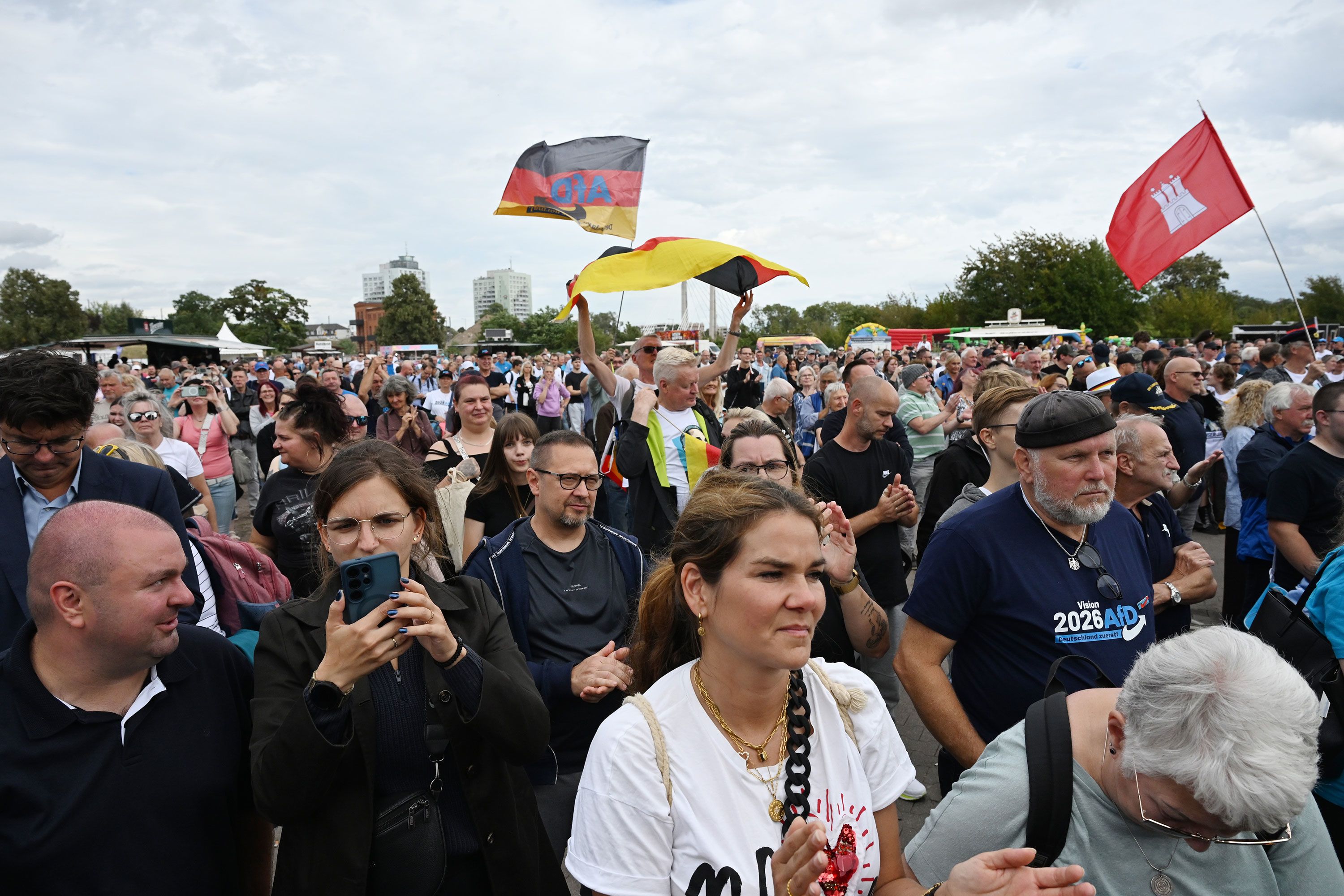
Alternative for Germany (AfD) may not have won the supermajority it sought in the Saxony-Anhalt state election on Sunday, but the far-right party did take another giant step toward power in a country whose postwar democracy was designed to prevent the return of right-wing extremism. The AfD’s win, which co-leader Alice Weidel described as “historic,” also showed that in Germany, as elsewhere in Europe, the center is not holding as firmly as it once did. German Chancellor Friedrich Merz said the AfD’s victory has shaken his conservative Christian Democratic Union (CDU) “to its very foundations” and would have “consequences” reaching well beyond the region. “It is an election result we cannot simply move past as if nothing happened,” he said Monday. “It is the most severe election defeat the CDU has suffered in years, indeed in decades.” On Sunday, the CDU didn’t just lose support to the AfD at the margins, but more than half its 2021 vote outright, with the AfD more than doubling its own share in the former East German state to 44% in a single electoral cycle. The AfD was already the largest opposition party in the federal parliament in Berlin, making the “eastern exception” argument — that this is a regional, post-Communist phenomenon — harder to sustain. The CDU’s rhetoric on migration has shifted further right as the AFD’s popularity has grown. And with each win at state level, the “Brandmauer,” or “firewall against the far-right,” that prevents ultra-nationalist parties like AfD from joining ruling coalitions is being tested a little more by parliamentary arithmetic as much as by principle. The question now is: How much longer can a democratic argument be made to justify the firewall? A similar question is also facing Europe as a whole. In Brussels, the so-called “cordon sanitaire,” the European Union’s own version of the far-right firewall, is also under pressure from mathematics. Three hard-right groups hold 196 seats combined in the European Parliament, representing parties from more than a dozen member states. Together, they represent the Parliament’s second-largest force by seat count, even though the three rarely vote as a bloc. And while they remain walled off from the EU’s top jobs, they are already reshaping the organization’s debates on migration, aid to Ukraine and the “Green Deal” aimed at reaching climate neutrality. At national level, too, far-right parties now lead coalitions in Italy and the Czech Republic and serve as junior governing partners in Finland, Croatia, Slovakia and Sweden. And where the far right doesn’t hold power, it is still setting the terms of the debate: The Freedom Party of Austria (FPÖ) topped Austria’s national vote in 2024, Geert Wilders’ Party for Freedom (PVV) remains one of the largest blocs in the Dutch parliament despite the collapse of its coalition last year, and Marine Le Pen’s National Rally has been France’s most consistently popular party for years. In Italy, Prime Minister Giorgia Meloni has spent four years proving a party with post-fascist roots can govern from the center-right without spooking financial markets. Hungary’s election in April showed that the far right’s advance is not purely linear: Péter Magyar’s center-right Tisza party ousted Viktor Orbán’s illiberal Fidesz party in a landslide, ending 16 years of authoritarian rule and proving that entrenched incumbents can still lose. But the far right doesn’t need to win everywhere, every time; it has already changed what Europe’s mainstream parties have to contend with and campaign against. The historic mainstream now also faces increasing pressure from abroad. No longer just from Moscow, but also from Washington and MAGA, too. Elon Musk endorsed the AfD ahead of last year’s federal election, appearing at a campaign rally to declare it would “save the future of civilization.” US Vice President JD Vance used his 2025 Munich Security Conference speech to attack Germany’s far-right firewall directly and met with Weidel days before the vote. One senior German politician at the time called Vance’s support “a big boost to the far right in Germany and in Europe.” AfD figures campaign on the idea of establishing good relations with both the White House and the Kremlin, as Saxony-Anhalt’s own AfD candidate, Ulrich Siegmund, did in the run-up to Sunday’s vote. None of which should distract from the very real home-grown popularity of far-right parties in Europe, which is rooted in domestic grievances over immigration, stagnant wages, deindustrialization and the failure of mainstream parties to address that discontent. What it does mean, though, is that Europe’s far right isn’t simply rising on its own. Rather, it is being actively reinforced by outside powers that have their own reasons — ideological and geostrategic — to want Europe’s postwar center to fracture. The question now is just how unstoppable the far right’s rise in Europe really is. The answer should come into sharper focus over the next 18 months, as France heads toward a 2027 presidential race. Le Pen, the far-right leader, now appears to be the favorite in opinion polls. In the shorter term, voters in Berlin and Mecklenburg, in northeastern Germany, head to the polls in under two weeks. Those local elections could show whether Sunday’s result in Saxony-Anhalt represents a ceiling for the far right’s rise in Europe — or just its latest floor.
Topics in this story
Gathered from external sources. Rights to this text belong to whoever originally published it.