In 2016, A refugee engineer filled discarded bottles with sand to build his grandmother a safer desert home; the experiment expanded into 25 houses
US News: Sahrawi engineer Tateh Lehbib Breica used discarded plastic bottles packed with sand instead of conventional bricks, along with other materials, to co.
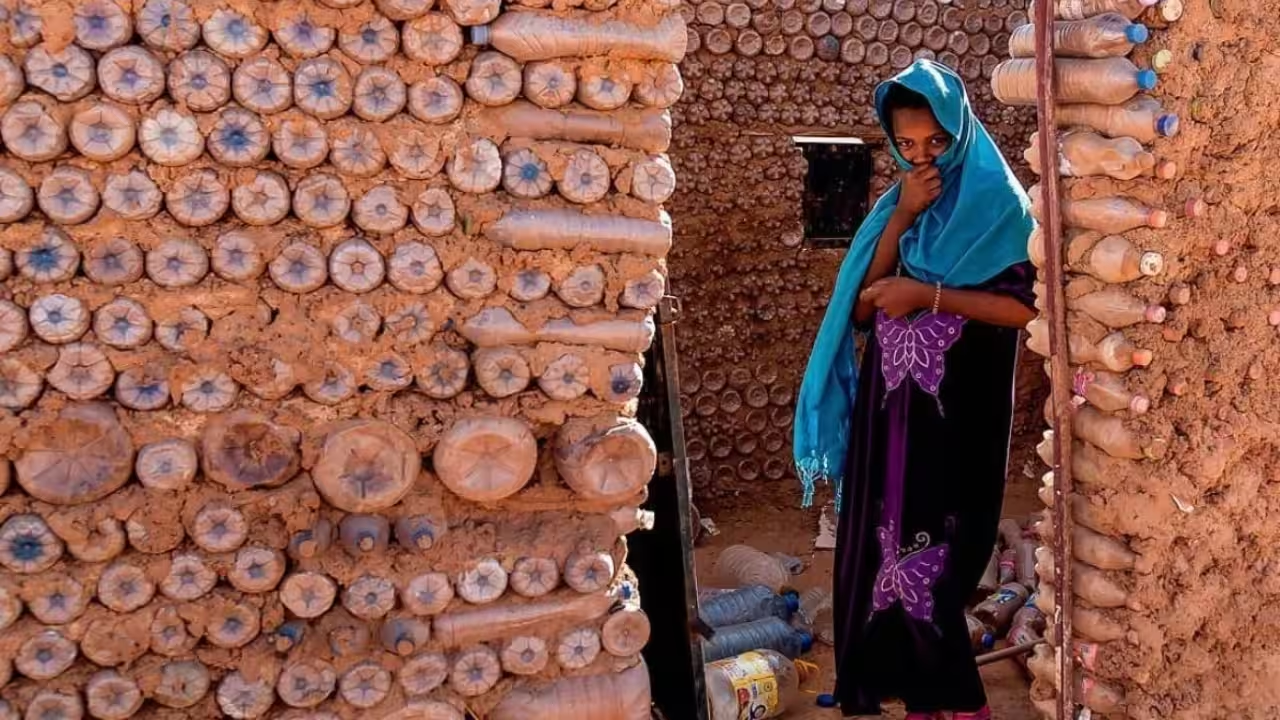
Sahrawi engineer Tateh Lehbib Breica used discarded plastic bottles packed with sand instead of conventional bricks, along with other materials, to construct a house for his grandmother. He had grown up in the Awserd refugee camp near Tindouf and later earned a master's degree in energy efficiency. His idea emerged after severe flooding had damaged homes in the camps and after he found himself with a large supply of discarded bottles that had originally been intended for a roof garden. According to the United Nations High Commissioner for Refugees (UNHCR), he remembered a documentary about building with plastic bottles and decided to try the approach himself.Why the camps needed a different kind of houseThe Sahrawi refugee camps around Tindouf face a difficult combination of heat, sandstorms and periodic heavy rain. Traditional adobe homes can be damaged by prolonged rainfall, while conventional roofs can make the interiors extremely hot. Breica told UNHCR that he was raised in an adobe house with a zinc roof and that his family dealt with high temperatures, rain and sandstorms. When he returned to the camps after his studies, he wanted to build a more comfortable home for his grandmother.Breica arranged the sand-filled bottles into a circular structure and covered the walls with cement and a mixture of earth and straw. The shape was intended to reduce the effect of strong winds and prevent sand from building up against the walls. UNHCR shelter officer Otis Moore said the circular design was aerodynamic and better suited to storms, while plastic bottles could provide a more durable structure than mud bricks when heavy rain struck. The homes also used a double roof and windows positioned to improve air movement.The first house attracted UNHCR's attentionAt first, some people around the camp were skeptical about the idea. The sight of a young engineer collecting discarded plastic bottles did not immediately look like the start of a housing project, and that changed after the house was completed. People began visiting it, and Breica's experiment eventually caught the attention of UNHCR staff working in the camps. UNHCR's Innovation Fund then backed the idea as a pilot project. In January 2017, the agency reported that Breica was working with UNHCR to construct 25 more houses across the five Sahrawi refugee camps: Awserd, Boujdour, Dakhla, Smara and Laayoune. The houses were intended for vulnerable residents. The bottles were readily available waste material, while sand was abundant in the surrounding environment, and refugees were involved in collecting, preparing and using the materials during construction.From one prototype to a larger housing projectA later assessment by World Habitat records that construction of the wider project began in November 2016 and that 27 buildings were ultimately completed by April 2017, two more than the original target. The homes housed about 50 refugees selected because they had low incomes, were elderly, or had special needs or disabilities. Each house required thousands of plastic bottles, which were filled with sand and stacked horizontally before the walls were covered and finished with conventional building materials. World Habitat's project summary says each home took roughly a week to build.The construction work involved members of the refugee community, while other workers collected and filled the bottles. The project therefore became a community construction effort rather than a structure built by Breica alone. UNHCR described its Innovation Fund project as 25 additional homes, while World Habitat's later project assessment counted 27 buildings completed. The difference appears to reflect the final number constructed rather than two competing accounts of the original plan.What happened to the idea afterward?A profile published by the University of Las Palmas de Gran Canaria described his plans for a project called Sand Ship, which was intended as a research and educational centre focused on sustainable desert architecture. The university's account says Breica wanted the centre to provide a place where refugees could learn about construction methods suited to their environment. By then, his work had also attracted attention outside the camps, including through talks and demonstrations related to desert architecture. The bottle houses remained a specific approach developed for a difficult setting, using materials that were cheap and locally accessible, but the original experiment had moved well beyond the single house Breica built for his grandmother.Catch the latest World News and Live updates. Download the TOI app.
Topics in this story
Gathered from external sources. Rights to this text belong to whoever originally published it.