In 1979, a Montana electrician promised to build a statue if his wife survived cancer: Six years later, a 90-foot figure stood above Butte
US News: Butte electrician Bob O'Bill made a promise during his wife's battle with cancer in 1979. If Joyce recovered, he would build a statue of the Virgin Ma.
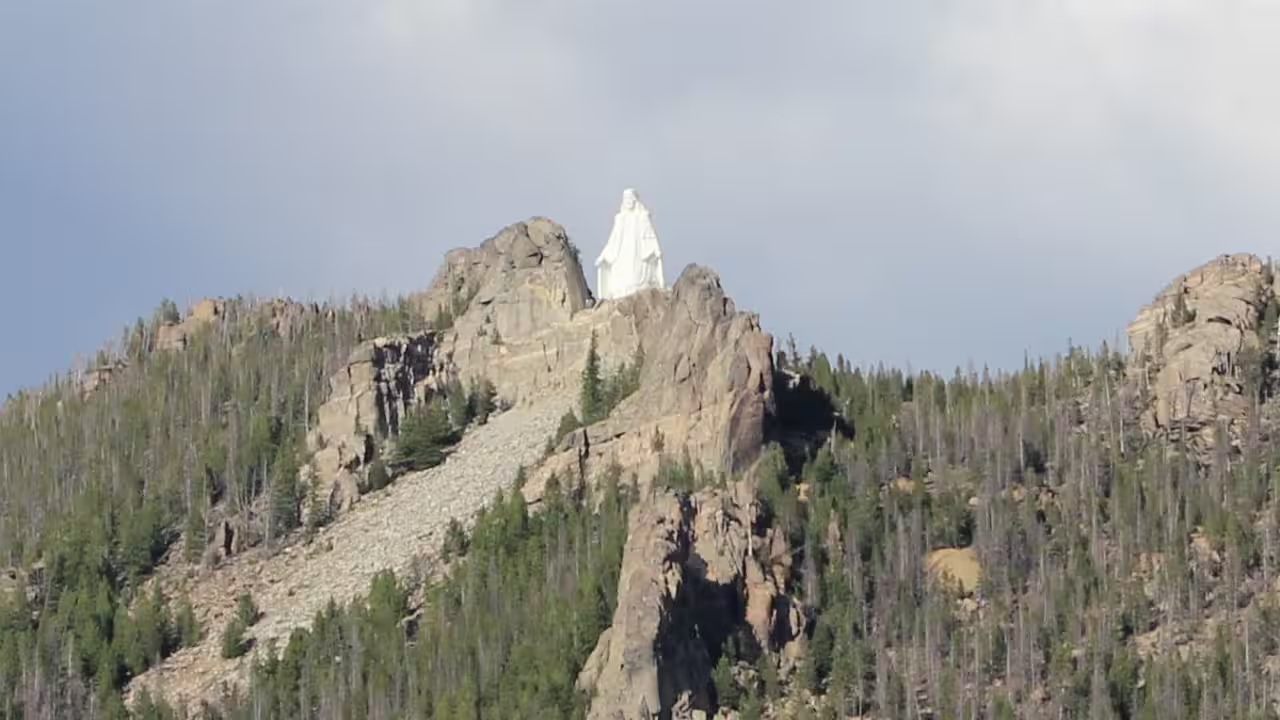
Butte electrician Bob O'Bill made a promise during his wife's battle with cancer in 1979. If Joyce recovered, he would build a statue of the Virgin Mary in her honor. Joyce survived, and O'Bill eventually turned the small idea into a 90-foot statue on a mountain above Butte. The statue is now known as Our Lady of the Rockies, and stands on the Continental Divide's East Ridge, about 3,500 feet above Butte. According to the official Our Lady of the Rockies organization, construction began in 1979 and took six years, with residents contributing labor and helping raise money for the project.O'Bill's original plan was much smaller, since he had imagined a modest statue that could be placed near his home. The project grew after other people became involved. Engineers, welders, construction workers, and volunteers eventually worked on a structure far larger than the one O'Bill had first envisioned.A small promise became a community projectO'Bill was an electrician who had worked for the Anaconda Company and Montana Power Co. before retiring. His wife's illness gave him the original reason for the project, but the statue soon became a community effort. The Butte-Silver Bow Public Archives records the beginning of the project in December 1979. The archives state that O'Bill promised to build a shrine if his wife recovered from cancer. Joyce did recover, and the project expanded beyond the couple into a community effort involving volunteers from around Butte. The archives state that residents spent nearly six years constructing the statue, while trying to build roads and raise money for the project.The proposed statue would stand on East Ridge, high above the city. Getting construction materials to the site required roads and other infrastructure before the statue itself could be completed. The project required a lot of funding and volunteer work. O'Bill organized fundraising while other people contributed labor, equipment and technical expertise. The statue was designed by Laurien Eugene Riehl, a retired mining engineer, and Leroy Lee, a local welder, fabricated the structure. The project did not require a commercial construction company to carry out the entire job; instead, different people contributed their skills at different stages.Building a 90-foot statue on a mountainButte was dealing with a difficult period in its mining history while the construction was taking place. Copper production had declined, and major changes were taking place in the local mining industry. The statue itself was constructed away from its final position, and getting it onto the mountain required another engineering operation. The official organization says workers poured a 400-ton concrete base in September 1985. The statue was ready to be transported to the East Ridge by December. It had been divided into four sections for the move.On December 17, 1985, military and civilian crews began the final operation. The Nevada Army National Guard, Montana National Guard, U.S. Army Reserve personnel from Butte and civilian workers took part in moving the sections up the mountain. The Butte-Silver Bow Public Archives records that the completed statue weighed 51 tons and was placed on the mountain in December 1985 with assistance from the Montana National Guard, Army Reserve and civilian crews. The statue was completed in December 1985, six years after O'Bill began the project. Its size was far beyond the five- to nine-foot monument originally discussed, and the finished figure ended up becoming one of the largest statues in the United States.A monument to mothersO'Bill had originally made the promise because of his wife's illness, but the completed monument was eventually dedicated to women and mothers more broadly. The official Our Lady of the Rockies organization describes the statue as nondenominational and says it is intended as a tribute to women and mothers. A memorial wall at the site carries the names of mothers from different parts of the world.The University of Montana describes Our Lady of the Rockies as a major Butte landmark. Its account says the 90-foot statue was completed in December 1985 after being conceived by O'Bill as a tribute to the Virgin Mary following his wife's recovery from cancer. The statue now sits on private land high above the city, and can be seen from much of Butte and from surrounding roads. O'Bill died in 2016, but Joyce survived him. The original reason for the statue therefore remains part of its history, while the monument itself has taken on a wider role in Butte. The project began with a personal promise in 1979, and by December 1985, a 90-foot statue stood on the East Ridge. Its construction involved volunteers, engineers, military crews and residents who spent years raising money and preparing the site. Our Lady of the Rockies remains above Butte today, standing on the Continental Divide with the city below.Catch the latest World News and Live updates. Download the TOI app.
Topics in this story
Gathered from external sources. Rights to this text belong to whoever originally published it.