Quote of the Day by Benjamin Franklin, " “Beer is proof that God loves us and wants us to be ...."
Benjamin Franklin is one of the most towering figures in this history of America.
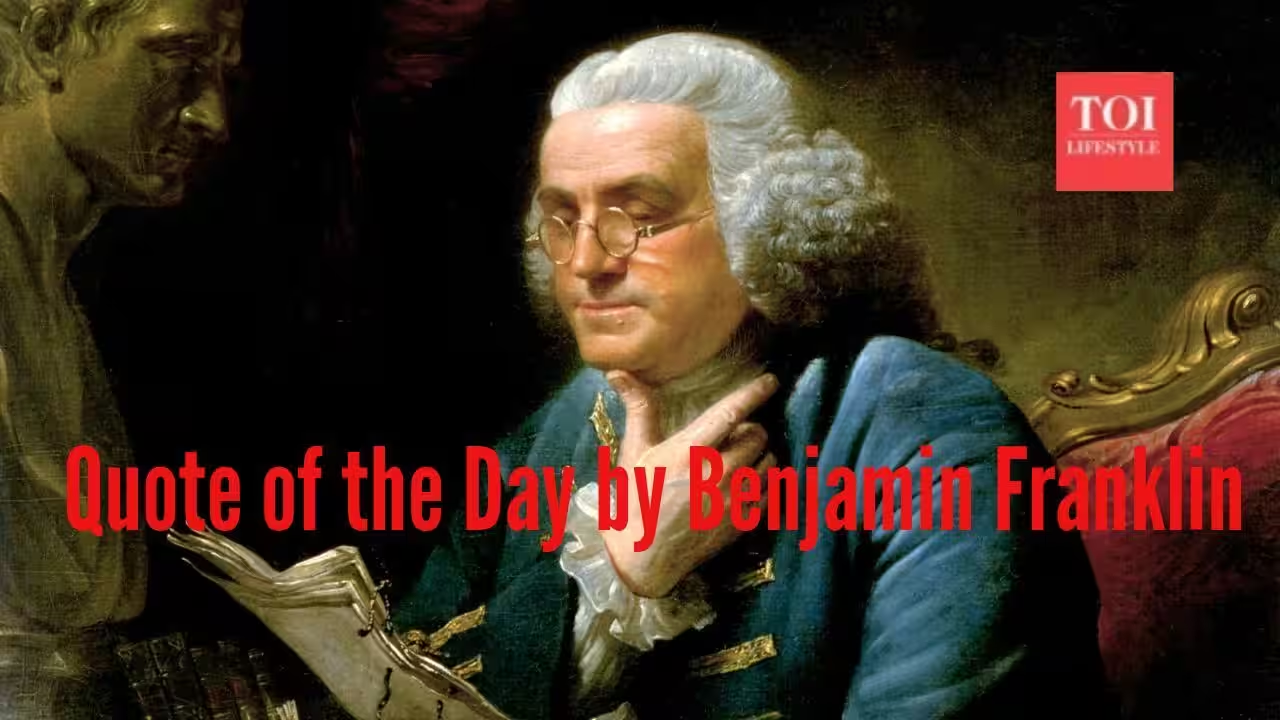
Benjamin Franklin is one of the most towering figures in this history of America. A writer, philosopher, scientist, inventor, diplomat, publisher and political thinker, his contribution is immense and unfathomable.He was born on January 17, 1706, in Boston, Massachusetts, at that time part of British colonial America. He was the 15th of 17 children of Josiah Franklin, a soap and candle maker, and his 2nd wife Abiah Folger. His family was poor and he had only a few years of formal schooling. His father had initially wanted him to join the clergy but financial hardship made a long education impossible. When Franklin was 12, his older brother, James, who had a printing business, took him on as an apprentice. The experience was transformative. His interest in literature, journalism and public debate was acquired while working with books, newspapers and written material.An avid reader, he was largely self-educated through borrowing books and independent study. He also started writing articles and essays, eventually contributing anonymously to his brother's newspaper, under the name Silence Dogood.Journey of a writer and publisherEventually Franklin moved to Philadelphia and established himself as a printer and publisher. By hard work and shrewd business sense he built up a prosperous printing establishment. In 1729, he bought the Pennsylvania Gazette, one of the most important colonial American newspapers. He used the publication to talk about public affairs, social issues, education and civic responsibility.One of his most successful literary ventures was Poor Richard's Almanack, which he first published in 1732 under the pseudonym of Richard Saunders. It became hugely popular for its witty and memorable sayings about money, work, wisdom, time and individual responsibility. His autobiography, The Autobiography of Benjamin Franklin, also became a seminal work of American autobiographical literature.His scientific inventions and contributionsFranklin’s scientific achievements brought him worldwide fame, especially his pioneering experiments with electricity. During the 1740s and 1750s he did experiments to find out what electrical charges were. In 1752, his famous kite experiment demonstrated that lightning was electrical. Next he came up with the lightning rod, a useful device to guard buildings from lightning strikes and lessen the likelihood of fire.He also invented many other useful devices, such as bifocal spectacles, which made it easier to see things both near and far, and the Franklin stove, which was designed to heat homes more efficiently. Franklin never patented his inventions, interestingly. He believed that the fruits of scientific discoveries and practical innovations should be for the good of mankind, not for personal gain. His scientific work won him international recognition including the prestigious Copley Medal of the Royal Society of London.He was one of the foremost advocates of greater unity among the American colonies under British rule at the time. He believed the colonies should unite to defend their interests and political rights. In 1776 he was selected as one of the five members of the committee appointed to prepare a statement of the colonies’ separation from Britain, called the Declaration of Independence. He was also among the signatories.One of his most important contributions was in the area of diplomacy. In the American Revolutionary War, Franklin went to France to seek support for the American cause. He was already a celebrated figure in European society by virtue of his reputation as scientist and intellectual. In 1778, his diplomatic skills brought France into alliance with the American colonies. The eventual American victory against Britain was only made possible with French military assistance, financial aid and naval intervention.Franklin also participated in negotiations that resulted in the Treaty of Paris in 1783, which officially recognised American independence. In 1787, when he was eighty years old, he was a delegate to the Constitutional Convention and a signer of the United States Constitution. He died in 1790, having witnessed the birth of the country he helped establish.Impact and contributionFranklin thought that knowledge should be available to all and that an educated citizenry could create stronger communities. In 1731 he assisted in founding the Library Company of Philadelphia, one of America’s first subscription libraries. It allowed members to read books that would have been difficult or expensive to get. He was also instrumental in founding the institution that was to evolve into the University of Pennsylvania.He also contributed to public welfare. He helped organise Philadelphia’s first volunteer fire company, advocated the establishment of Pennsylvania Hospital and worked to improve public infrastructure, including street lighting, sanitation and postal services. He also helped develop the colonial postal network of America, which allowed more rapid and reliable communication between widely separated communities. These actions were a reflection of his belief that intellectual progress and social development should be inseparable.His private life and later yearsIn 1730 Franklin married Deborah Read. They had two children together, and Franklin had an illegitimate son, William, from a previous relationship. Later, their differing political allegiances during the American Revolution strained his relationship with William. Franklin was a supporter of independence, but William was loyal to the British Crown. Franklin stayed in Philadelphia in the last years of his life, where he remained active in public affairs and intellectual circles.A very important part of his later life was his growing hostility to slavery. He did own enslaved people but went on to become an abolitionist and president of the Pennsylvania Society for Promoting the Abolition of Slavery in 1787. He lobbied US Congress to abolish slavery. He died April 17, 1790, aged 84 years. Thousands attended his funeral, a testament to the enormous respect he commanded.The life of Benjamin Franklin is an extraordinary example of how curiosity and lifelong learning can make a person an agent of change. He was not born into wealth or privilege, and he was not broadly educated. Yet through reading, experimentation, hard work and an extraordinary willingness to explore new ideas, he became a celebrated scientist, writer, inventor and statesman.Quote of the Day“Beer is proof that God loves us and wants us to be happy." This is a misquote about wine often attributed to Benjamin Franklin.The Franklin Institute notes that this statement, which has widely become common now was originally about wine. In a letter around 1779 to French economist Abbé André Morellet, Franklin wrote about rain falling on vineyards and turning into wine as "a constant proof that God loves us, and loves to see us happy.As noted by, the phrase is a modern twist on his actual remark about wine.This quote actually has a deeper meaning than just celebrating a drink. It is indicative of the fact that happiness isn't always the consequence of bigger happenings in life. Sometimes it’s the simple pleasures that allow us to stop, relax and enjoy the present moment. Franklin uses humour to make a larger philosophical point: life gives us small gifts, and we should learn to appreciate them.Franklin’s observation is a critical insight in human nature. People are so often busy chasing bigger ambitions that they forget to appreciate what they already have. But happiness is often in ordinary moments: a meaningful conversation, a meal shared with friends, a beautiful evening, laughter with family or the comfort of spending time with people we love. The message is that we should not associate happiness with getting everything we want. There is something to be said for enjoying the moment, rather than always having to put off our enjoyment until life is perfect. The quote also celebrates the social aspect of happiness. For centuries, food and drinks have been shared to celebrate friendship and community gatheringsA simple evening with friends can be more happy than an elaborate celebration. Franklin's words also have an interesting dimension of humour. His statement is intentionally playful, and reminds us that life doesn't always have to be taken so seriously. It’s also about living, connecting and enjoying the ride. Perhaps the bigger lesson is that happiness is not a destination that always feels far away.Disclaimer: This quote is widely attributed to Benjamin Franklin as a misquote about wine, but there may not be a clear evidence to establish its attribution to him.You use AI every day. Now get your AI Quotient. Take the AIQ testGet the latest Lifestyle News and more. Download the TOI app.
Topics in this story
Gathered from external sources. Rights to this text belong to whoever originally published it.