In 2005, a meteorite hunter found a 1,430-pound space rock beneath a Kansas farm; the landowner was due a share of a find valued at up to $1 million
In 2005, meteorite hunter Steve Arnold unearthed a 1,430-pound pallasite meteorite beneath a Kansas farm, leading to speculation that this extraordinary find could be valued at over $1 million. The rock’s history and geological significance make it a remarkable piece for both scientific study and collectors.
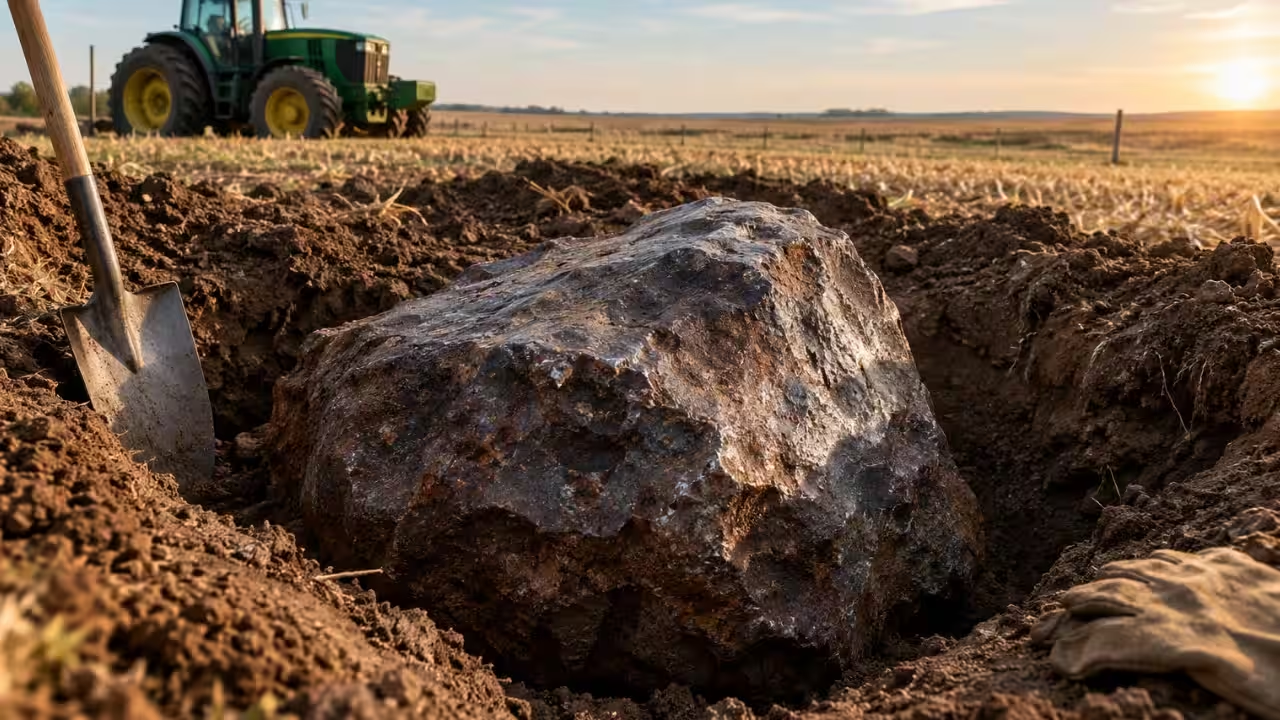
Many meteorites are found on or near the surface, but a large, dense one can sit below the ground in a field for a very long time. Meteorite hunting often involves using a metal detector and obtaining permission from the landowner before searching the property. The hunter, the hunt’s financiers and the landowner usually agree in advance on how to divide the proceeds, with the final amounts determined when the meteorite is sold.The Brenham scatter field in Kiowa County, KansasThe Kansas Geological Survey’s educational site GeoKansas says that Eliza Kimberly found rocks on her family’s property near Brenham in 1882, which drew scientists and hunters to the area. All the samples are believed to come from one meteorite that broke up on its way down. The American Museum of Natural History says the Brenham meteorite scattered more than three tons of fragments near the town and that pieces have been found as far as 1,500 kilometers from the fall site, likely carried by Native American traders and later buried in Hopewell mounds more than 1,500 years ago. The same region produced a 1,000-pound piece in 1949, now on display in Greensburg, the Associated Press reported. The museum adds that the Brenham mass is famous not just for its size, but for its nickel-iron metal and green olivine crystals, which make it a classic pallasite.Steve Arnold’s find on Allen Binford’s farmAccording to the Associated Press report republished by the Houston Chronicle, Steve Arnold, a meteorite hunter from Kingston, Arkansas, discovered the rock in Brenham Township, Kiowa County, Kansas, using a metal detector mounted on a three-wheeled vehicle. The rock was buried seven feet underground. Heritage Auctions records October 16, 2005, as the discovery date of the 1,433-pound Brenham meteorite found by Steve Arnold and Philip Mani in Kansas. Initial reports described it as a 1,400-pound rock, but later weighing on a grain scale showed it weighed 1,430 pounds. The farm belonged to Allen Binford, a photo caption from the same report noted. Steve Arnold referred to the rock as an oriented pallasite because of its conical appearance and olivine crystals embedded in an iron-nickel alloy. At the time, only two larger oriented pallasites were known: a 3,100-pound rock in Australia and a 1,500-pound rock in Argentina.A landowner’s share and a value estimated at seven figuresArnold claimed to reporters that the rock was worth “in the seven figures,” while sources contacted by MSNBC.com felt that such a valuation was not unreasonable for pallasites. The Baltimore Sun put the value range at $600,000 to $1 million. Arnold’s expedition was backed by his partner, Philip Mani, a San Antonio, Texas, lawyer and geologist who helped finance the search, while the landowner was entitled to a share of the proceeds from any meteorite sale. Later reports named three owners: Mani, Arnold and Binford.At the Bonhams auction on a Sunday in late October 2007, the rock drew a top bid of only $200,000, well short of its pre-auction estimate of $630,000 to $700,000 and the auctioneer withdrew it from sale. Mani told the Associated Press that he was disappointed, but the owners were working on their strategy. The reports used here do not say what the three owners did next.What a 2002 study and a 2022 study found about Brenham’s exposure age and pallasite formationThe 2002 study, Cosmogenic nuclides in the Brenham Pallasite, calculated that the rock was exposed to cosmic rays in space for about 156 ± 8 million years before it fell. Regarding how pallasites form, the study Isotopic evidence for pallasite formation by impact mixing of olivine and metal during the first 10 million years of the Solar System, published on March 9, 2022, in PNAS Nexus, argued that an impact mixed olivine and metal. Its authors inferred that the impactor differentiated within about 1 to 2 million years of the start of the Solar System and that the impact happened between about 1.5 and 9.5 million years after the earliest solids formed. In addition to this, the above-discussed 2002 research discovered unusually low quantities of elements like potassium, uranium and thorium in Brenham, thus making it possible to study the origin of certain nuclides uniquely.You use AI every day. Now get your AI Quotient. Take the AIQ test.
Topics in this story
Gathered from external sources. Rights to this text belong to whoever originally published it.