Australian man finds a strange 17-kg rock while searching for gold; years later, scientists identify it as a 4.6-billion-year-old meteorite; now held in a Victorian museum
A 17-kilogram reddish rock dug up in the state of Victoria turned out to be a space visitor, not the gold nugget its owner hoped for.
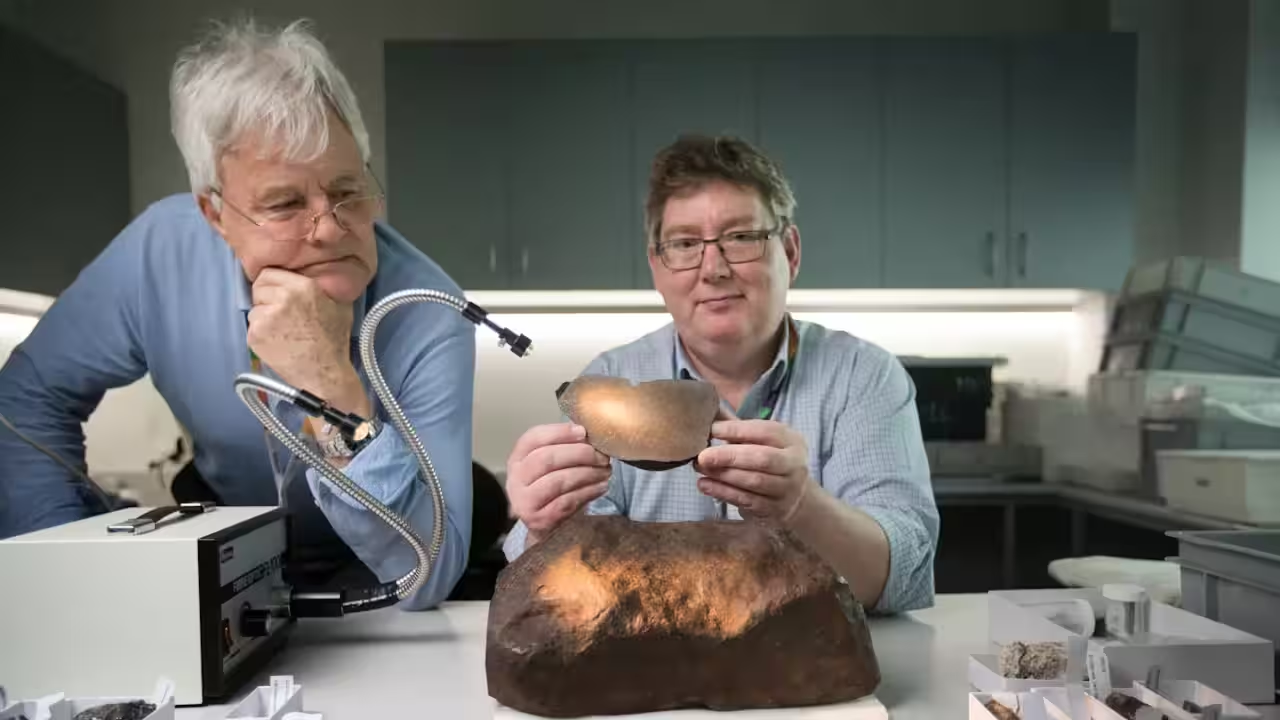
A 17-kilogram reddish rock dug up in the state of Victoria turned out to be a space visitor, not the gold nugget its owner hoped for. Named the Maryborough meteorite after the nearby regional town, it formed about 4.6 billion years ago, around the birth of the solar system, which makes it slightly older than Earth. Its owner, David Hole, kept it for years believing a fortune lay inside, and it took a museum visit to settle the matter for good. It gave researchers a sample of material among the oldest available for study.How a gold prospector’s metal detector unearthed the Maryborough meteorite in a Victoria parkAccording to Futura-Sciences, Hole was prospecting with a metal detector in Maryborough Regional Park, about 1.9 kilometres south of the town, in May 2015. The area saw a gold rush in the 19th century and remains popular with amateur prospectors.Hole dug up an unusually heavy rock that he believed contained gold, but it resisted every attempt to open it. A saw, an angle grinder, a drill, acid and even blows from a sledgehammer all failed.Why Melbourne Museum geologists suspected the rock was a meteorite almost as soon as they saw itIntrigued, Hole took the rock to Melbourne Museum in 2018. Geologists Dermot Henry and Bill Birch suspected almost immediately that it was a meteorite. Its density was far greater than that of an Earth rock of the same size, and small depressions covered its surface.Henry told The Sydney Morning Herald in 2019 that the rock had a “sculpted, dimpled look”, while Birch told the newspaper that a rock like it on Earth should not be so heavy.Such a quick verdict was unusual. Futura-Sciences reported that Henry had examined many rocks brought in by owners convinced they were meteorites, and only two had ever turned out to be genuine. The museum cut a thin slice with a diamond saw for analysis, and Birch, Henry and geologist Andrew Tomkins published their findings, ‘Maryborough, a new H5 meteorite find from Victoria, Australia’, in July 2019 in the Proceedings of the Royal Society of Victoria.What scientists found inside the H5 ordinary chondrite that probably came from the asteroid beltThe meteorite is about 39 centimetres long and 14 centimetres wide and thick. It belongs to the ordinary chondrite family, the most common type of meteorite, which generally originates in the asteroid belt between Mars and Jupiter. Chondrites take their name from chondrules, small spherical silicate grains, here up to a millimetre across, that formed when dust in the young solar system briefly melted in a sudden heating event before solidifying.The letter H signals a high iron content, while the number 5 shows the rock was substantially heated inside its parent asteroid, so its matrix recrystallised and the chondrules became less distinct. The main metallic minerals are the iron-nickel alloys kamacite, taenite and tetrataenite, often found alongside an iron sulfide called troilite. The analysis showed no sign of a violent shock in space, and only thin layers of iron oxide around the metal grains, which suggests a relatively short time on Earth’s surface.When the Maryborough meteorite fell to Earth and why scientists value it more than any gold nuggetNobody knows exactly when the Maryborough meteorite landed, but carbon-14 dating at the University of Arizona points to a fall within the last 1,000 years, according to the Proceedings of the Royal Society of Victoria. The paper says the meteorite’s unweathered look suggests the lower end of that range, so people may have seen it fall. Newspapers reported bright meteors over the district between the late 19th and mid-20th centuries, including a 1923 letter to The Argus from a man whose surroundings were lit up so brightly that he was nearly dazzled. None of those reports can be linked to the find site, and there was no sign of an impact or of further fragments nearby when the paper was written.Gold prospectors have worked the area on and off since the late 19th century, yet if the meteorite lay on the surface then, it never drew enough curiosity for miners to take it to scientists. Nor is there evidence that Indigenous people interacted with it before European settlement.The paper calls Maryborough only the 17th meteorite recorded in Victoria and the ninth chondrite. Alongside the Dimboola and Pigick finds, it is the state’s third H5 ordinary chondrite, and the second-largest single chondrite mass after the 55-kilogram Kulnine. Museums Victoria later bought it from Hole, and it now sits in the museum’s collection. The authors add that it is perhaps surprising that more meteorites have not turned up in central Victoria since metal detecting for gold boomed in the 1970s, and the museum encourages prospectors to bring in unusual rocks for identification.You use AI every day. Now get your AI Quotient. Take the AIQ test.
Topics in this story
Gathered from external sources. Rights to this text belong to whoever originally published it.