Rhode Island turned four-lane roads into three-lane “road diets”; a safety analysis found 29% fewer crashes and 37% fewer fatal or injury crashes
Rhode Island's innovative road diet approach converts four-lane roads into safer three-lane layouts, resulting in a significant reduction of 29% in total crashes and 37% in fatal or injury crashes, showcasing improvements in road safety and community wellbeing.
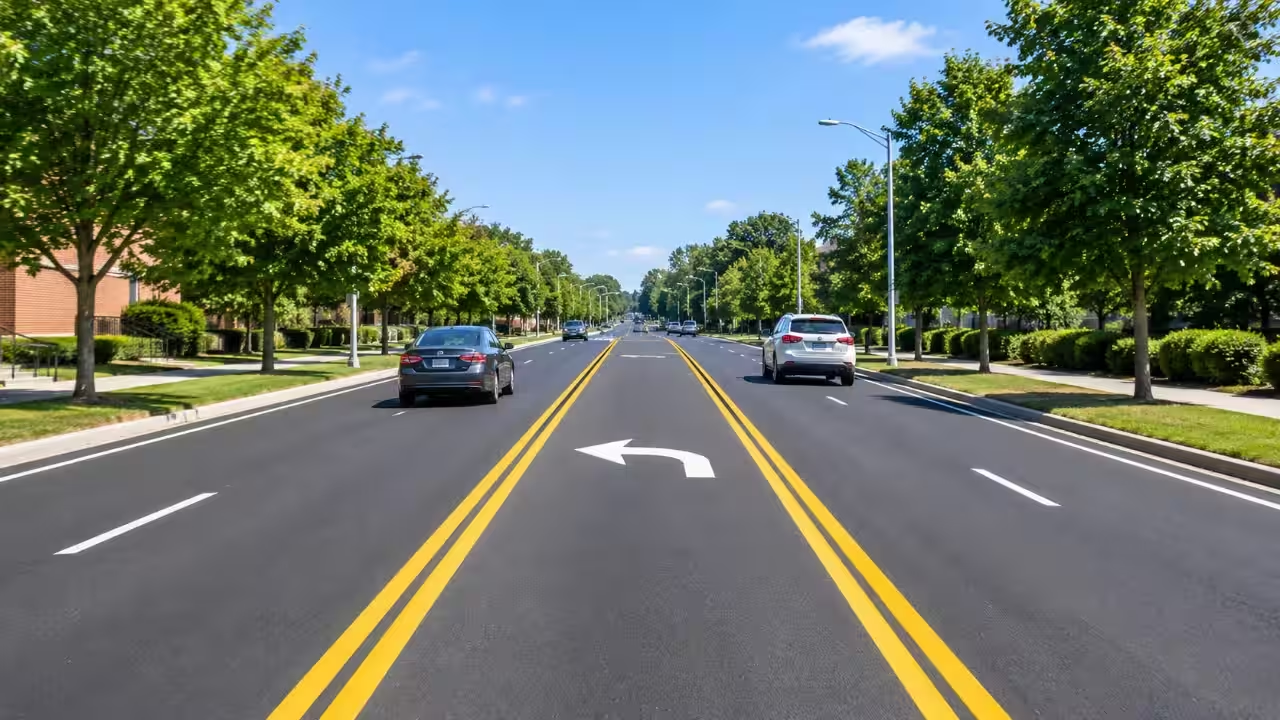
Four-lane roads can create conflicts when vehicles slow down or cross traffic to turn. Rhode Island addressed these risks by converting selected roads into three-lane layouts. The changes left one through lane in each direction and added a centre lane for left turns. A state-specific evaluation found fewer crashes after the conversions, including crashes involving fatalities or injuries.Rhode Island’s evaluation found a reduction in total and injury crashesYuying Zhou, Scott Himes, Thanh Le, Jeff Gooch, Kayla Northup and Peter Pavao published Safety Effectiveness of the Road Diet Treatment in Rhode Island In Transportation Research Record in 2022. The assessment involved the installation of road diets in Rhode Island and the calculation of crash modification factors (CMFs), which are measures of change in the number of crashes that occur due to a road treatment. The results were a CMF of 0.71 for all crashes, which equates to a 29% reduction. For fatal and injury crashes, or KABC crashes, which cover fatal, incapacitating, non-incapacitating and possible injury crashes but not property damage-only crashes, the CMF was 0.63, equating to a 37% reduction.The FHWA’s Rhode Island Highway Safety Improvement Program report describes the state’s CMF development process as based on the regression cross-section method. The Rhode Island evaluation was a regression-based before-and-after analysis of road diets installed before the study’s 2022 publication, so it could not have drawn on post-installation data from the Main Avenue project, which was completed in October 2022. There is no evidence of an untreated control group or an empirical Bayes process in the summary provided.A three-lane layout separates turning vehicles from through trafficFederal guidance also defines a traditional road diet as the conversion of an undivided four-lane road into a three-lane road. The centre lane provides room for motorists to slow down before making left turns without stopping in the through lane. This helps avoid potential issues with unexpected lane changes and slowing down due to turning traffic. The available space provided by eliminating the through lane can be used for cycling lanes, pedestrian islands, transit purposes, or parking.Virginia research found similar reductions, with bicycle lanes Linda Lim and Michael D. Fontaine examined road diet safety in Development of Road Diet Segment and Intersection Crash Modification Factors, published in Transportation Research Record in 2022. The study encompassed 36 road segments and 39 intersections that had undergone road diets from 2009 to 2018. The road diets included bicycle lanes, so the results reflect the entire treatment rather than lane striping alone.In terms of road segments, the FHWA Crash Modification Factors Clearinghouse lists the Virginia study’s CMFs as 0.62 for total crashes and 0.36 for fatal and injury crashes, which correspond to reductions of 38% and 64%. For intersections, the same clearinghouse entry reports CMFs of 0.65 for total crashes and 0.54 for fatal and injury crashes, which correspond to reductions of 35% and 46%. There was no safety benefit found at unsignalized intersections. Similar to the Rhode Island Study mentioned above, the findings from the Virginia study demonstrate a reduction in the number of crashes after road diet treatments. However, since the two studies were conducted in different settings and designs, those percentages cannot be generalised.RIDOT installed a road diet on Main Avenue in Warwick The Rhode Island Department of Transportation’s (RIDOT) October 11, 2022, travel advisory stated that the agency planned to install a road diet on Main Avenue (Route 113) between Route 5 and Jefferson Boulevard in Warwick during the week of October 17, with the three-lane section running between Bailey Street and Sycamore Avenue. Bad weather delayed the work and the new traffic configuration was expected to be in place by the morning of October 20. The new road design was implemented on October 20. The agency also conducted other road diets throughout the state.RIDOT indicated speeding, crashes and narrow roads as some of its concerns. According to the review, there were 59 crashes in the previous five years, out of which one was fatal and 14 caused injuries. The new design would lead to 25 seconds of additional travel time on average. The agency stated in 2022 that it would review the project and cooperate with the City of Warwick and that this review would be conducted separately from the statewide safety analysis. The 29% and 37% reductions come from the Rhode Island evaluation and not from any post-installation results for Main Avenue.The Rhode Island findings suggest that the road diets can help reduce crashes and improve safety on roads with suitable conditions. The research from Virginia found some reduction, but in their case, they had the bicycle lanes included in the treatment. Neither study has proven that all four-lane roads will have the same outcome.You use AI every day. Now get your AI Quotient. Take the AIQ test.
Topics in this story
Gathered from external sources. Rights to this text belong to whoever originally published it.