'Collision at 160-200kmph': Chilling details from Spain crash that killed 69
Spain’s deadly train collision, which killed 69 people and injured more than 200, occurred after a failure in the railway signalling system forced trains
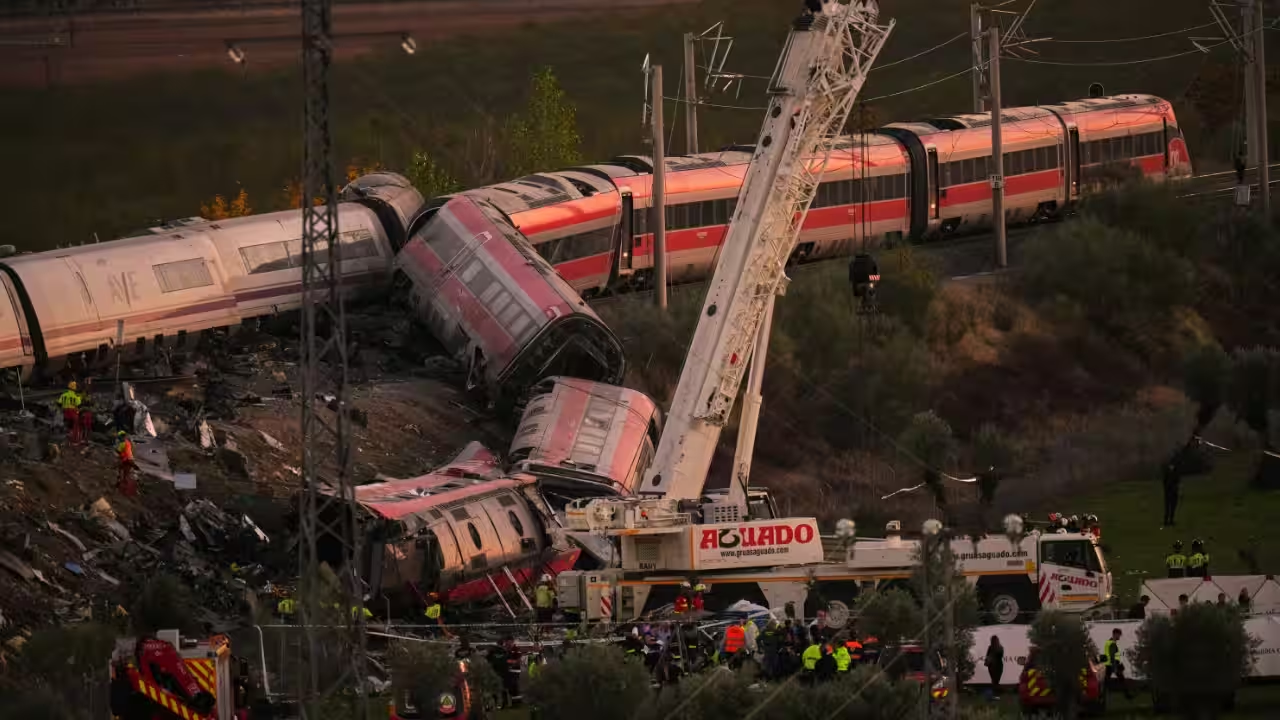
Spain’s deadly train collision, which killed 69 people and injured more than 200, occurred after a failure in the railway signalling system forced trains to switch to a degraded operating mode, with the two trains travelling on the Madrid-Seville high-speed line at different speeds. Initial findings by independent investigators have revealed that the Renfe train was travelling at an estimated 160-200 kmph when it slammed into the stationary Iryo train.The collision occurred at 8.53am on Wednesday at the entrance to Urda station in Toledo province. According to the investigation-opening notice published by Spain’s Independent Administrative Authority for the Technical Investigation of Railway, Maritime and Civil Aviation Accidents and Incidents (AITAT), the eight-carriage Iryo train, travelling from Madrid to Seville with 147 passengers and five crew members, was stationary near a signal when it was struck from behind by an eight-carriage Renfe AVE train carrying 379 passengers and seven crew members.The impact caused the leading carriage of the Renfe train to become embedded in the rear carriage of the Iryo train. Both carriages overturned and ended up at the foot of the railway embankment. The remaining six carriages of the Renfe train stayed on the track bed, while another fell down the embankment. Several carriages of the Iryo train also derailed, with three falling down the embankment.AITAT said the collision speed was estimated at between 160 and 200 kmph, although the precise figure would only be established after extracting data from the trains' onboard event recorders.The preliminary investigation has also pointed to a failure of the LZB signalling system, which began at around 8.31am and forced trains to operate under the alternative Lateral Signalling Block (BSL) system."To manage this situation, the CRC and the train drivers had to exchange a series of information and instructions through formal railway telephone messages," the report said, referring to communications between the control centre and train drivers.It added that the "sequence of failures, instructions and subsequent actions may ultimately have led to the collision, without the necessary protective barriers having intervened to mitigate the situation".However, investigators cautioned against drawing conclusions about the cause of the disaster, saying all possible explanations remained open at this stage. They said the investigation would examine the LZB malfunction, along with environmental, organisational and procedural factors that may have contributed to the accident.The findings come amid growing questions over railway safety and staffing conditions in Spain. Transport Minister Óscar Puente has criticised the decision to allow the Renfe train to resume normal operations while the Iryo train remained stationary. Railway unions, however, have blamed repeated signalling failures and inadequate staffing, arguing that human operators are increasingly being left to manage situations that automated safety systems should handle.You use AI every day. Now get your AI Quotient. Take the AIQ test.
Topics in this story
Gathered from external sources. Rights to this text belong to whoever originally published it.