Missing toll from devastating floods in Nepal and China passes 3,000
Rescue efforts are in their fourth day but Nepali authorities are warning they are struggling to cope with the number of decomposing bodies recovered. Follow for news updates.
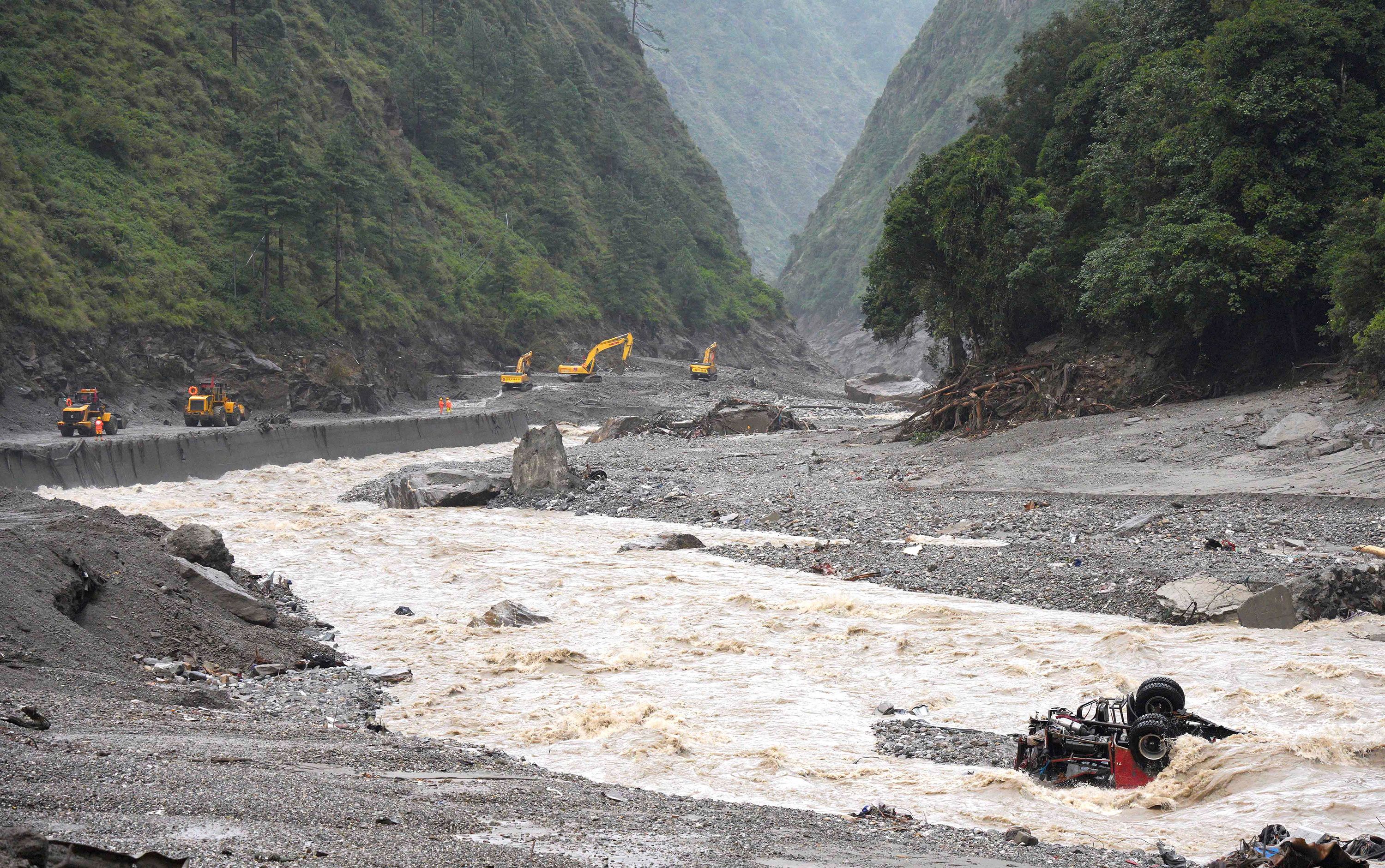
• Death toll: More than 600 people have been killed in Nepal and 7 have died in China following catastrophic flooding at the border . Officials are planning to bury unidentifiable bodies in a mass grave as authorities struggle to cope with the decomposing remains. Around 3,000 people are still missing both sides of the border.
• Flood fears: More rain is expected this weekend in flood-affected areas. Officials are closely monitoring two lakes , fueling fears of a new deluge.
• Scenes of devastation: Chinese state media reported there is no sign of survivors at a border crossing which was engulfed by the flood wave. And in Nepal, health officials said residents of a “whole village that seems to have been washed away” are in “dire need of support.”
• On the ground: CNN teams have witnessed devastated neighborhoods and families’ anguish while they desperately search for information on their missing relatives.
At Dhunge Bazaar after the rain had cleared — three JCB diggers resumed the painstaking task of reopening the road up to the China border where communities are still stranded following deadly landslides on Wednesday.
As of Saturday afternoon the diggers had cleared around 200 meters of the almost meter-high silt and mud, illustrating the enormity of the task of restoring communication to the hardest-hit areas up in the mountains.
The road — which winds through the hills for hours before reaching the China border — is Nepal’s main trade link with its giant northern neighbor.
A crowd of people gathered to watch the JCBs at work. Choppers flew overhead in a constant stream ferrying victims from a village just on the other side of the river.
Rescue teams in Nepal have located 187 tourists after deadly landslides ripped through the Himalayan nation on Wednesday, local officials said Saturday, with around 3,000 people still missing on both sides of the Nepal-China border.
Of those rescued, 114 are Indians, 27 are Chinese, and 20 are from South Korea, the US, Europe and the Gulf, according to a bulletin published by the Nepal Tourism Board.
At least 420 foreigners remain missing, the bulletin said.
The catastrophic torrents have killed more than 600 people, Nepali police reported on Saturday, as residents struggle to reconcile the mass scale of destruction left in their wake .
The devastation in Nepal is bringing back memories of the earthquake which took place in the country in April 2015 , when some of the same communities were hit by a similar disaster, a leading relief worker tells CNN.
Srijana Gurung, Nepal’s interim country director for Plan International said Saturday that “not once, but twice,” communities, children and young people are now facing “shock after shock,” with some of the hardest-hit areas once again difficult to reach.
Gurung expressed her grief over the devastation that took place when the flooding began, describing the scale of the destruction is “simply enormous” and nothing that anybody could comprehend.
The death toll from flash flooding in Nepal has climbed to 626, the country’s police said on Saturday.
So far, 2,301 people have been rescued, they added.
Officials in Nepal are planning to bury unidentifiable bodies in a mass grave as authorities struggle to cope with the decomposing remains.
An additional 7 people were confirmed dead in China today. Around 3,000 people are still missing both sides of the border.
Colossal flooding on the China-Nepal border on Wednesday was partly linked to the region’s steep terrain — a driver of landslides — and melting permafrost, an expert tells CNN.
As the long-frozen ground thaws, it weakens the slopes that are typically “glued together by ice-filled joints” along shattered bedrock near the surface, said Dr Richard Waller, author and senior lecturer in physical geography at the UK’s Keele University.
Officials raised concerns on Friday of a secondary flooding event with rain forecast in the area.
Damage from the original flood also raises the risk, with the area clogged with debris strewn in its wake, Dr Waller said.
“The original event will have deposited largely volumes of mud and rock along the course of its track,” he added.
“These accumulations will have blocked the rivers in tributary valleys such that lakes are now starting to form, posing the risk of follow up flood events.
“If this encourages the formation of a deep lake, then it could fail catastrophically and drain rapidly. There may, for example, be ice within the dam that could thaw and promote failure.”
In this event, the secondary flooding would likely be on a smaller scale, since both the lake and the amount of material involved are smaller, he added.
Residents in Nepal’s border region face widespread damage and mud-covered street after catastrophic flooding in the area earlier in the week.
Here are some of the latest images we’re seeing from Nepal.
Nepal’s Foreign Minister Shisir Khanal also warned that the bodies of those who died following Wednesday’s devastating flash flooding in Nepal are at risk of fast decomposition.
Speaking during today’s press conference, Khanal added that he had reached out to foreign governments asking them to provide freezers in order to keep people in a state of preservation, although he had so far not had any commitment on this.
He also highlighted some of the challenges search and rescue teams were facing with at least 3,000 people remain missing in the disaster.
Only helicopters can reach some of the areas hardest hit by flash flooding in Nepal, Khanal said, adding that they have to navigate their way through narrow gorges in some cases.
“Our Nepali helicopters have to stand in a queue just to get through those narrow gorges,” he said.
Nepal has sought help from neighbouring countries after deadly flash flooding, Foreign Minister Shisir Khanal has told a press conference, as search and rescue operations continue with at least 3,000 people missing.
The government has sought specific and specialized assistance from friendly neighboring countries, Khanal said.
This includes 11 personnel from India specialising in rescuing people who have become trapped in tunnels, the foreign minister said, while more of such personnel are expected to arrive in Nepal from China.
Chris Miller, the Culinary Director of World Central Kitchen, is no stranger to being on the ground when tragedy hits, but as catastrophic floods swept through villages along Nepal’s border with China, he said whole towns were gone, fast.
“What’s different about this is the speed in which this happened,” Miller told CNN’s Elex Michaelson from Kathmandu, roughly an hour to two hours south of where the devastation is. “Within 20, 30 minutes, the town was gone.”
World Central Kitchen is partnering with local restaurants in the area to provide hot meals for survivors, Miller added.
“We’re going to start setting up field kitchens with these organizations. They’re ready to cook,” he said, adding that the focus of the weekend was to reach hard-hit areas further north.
“Once we get those set up, we’ll just keep moving forward and keep moving forward and keep moving forward.”
A missing mechanical engineer uploaded a video of an emergency alert ringing through the hydro power plant where he worked in Nepal, just minutes before the torrent of floodwater hit on Wednesday.
Pratik Gautam, 26, was living and working at the Doosan camp, at the Upper Trishuli-1 project in Rasuwa, after graduating from Kathmandu University, his brother Prabhav Gautam told CNN.
At 9.06am on Wednesday, Pratik uploaded a short video to Snapchat in which sirens can be heard sounding at the camp and people are seen running in the courtyard on the mountainside.
Prabhav has not heard from his brother since and says the family are “losing hope” more than 72 hours after the disaster.
Pratik recorded the video outside, meaning he had left his office, but the family don’t know what happened next, Prabhav said.
“In another video, I saw a company boss and two small vehicles. I suspected that my brother and other engineers were in that vehicle but I’m not sure. Nobody in that vehicle was rescued or moved to a safe place.”
Prabhav said his brother had told him that there had been emergency signals at the camp warning of floods in the past.
“They used to climb up the hill or go to the high ground.”
Along a devastated main street, underneath downed power lines and past bundles of corn hung out to dry, Sadip Nepal stood outside the wrecked home he said he and his family had just managed to flee in time to save themselves.
Nepal was about to sit down to eat with his parents when he stepped outside onto a balcony and saw a torrent of water barreling into the village.
Inside the house, hardened mud two feet deep caked the ground floor and debris blocked the stairs. Flotsam from the deluge was scattered around: pieces of metal, rope, tree branches. Out in the back, two animal carcasses washed in by the river had begun to stink.
Nepal said there was “no chance” he could ever go back to live in the home he had been born in; there had been too much damage.
“We cannot do anything,” he said, holding back tears. “Now we have to start from zero.”
Seven people have been confirmed dead and 554 missing after the catastrophic flooding at Gyirong Port in Tibet, Chinese state media reported in an update Saturday.
Two villagers were also rescued, state media reported.
A police dog team was combing half-buried houses in the devastated town of Devighat on Saturday, looking for corpses.
Over the doorways filled with silt and debris, ornate signs carry the inhabitants’ family name or Hindu blessings, signs of the domesticity ruined when the nearby Trishuli river burst its banks in Nepal’s worst natural disaster in years.
A search team member poked a cane into the feet-deep silt to detect any sign of a body beneath it.
Nearby, the putrefied carcass of a buffalo lay by the road and its stench saturated the air.
The 14-member police team from the capital Kathmandu and their two dogs have been working from dawn til dusk for the past four days.
“It breaks my heart,” Krishna, one of the policemen, who did not want to give his last name, told CNN.
The last body police had pulled out was earlier this morning, of a young man. He was wearing blue jeans, Krishna said, but there was little else to identify him by. “His body had already decomposed,” Krishna said.
Tallying the dead and missing is laborious, Krishna the policeman said. Teams like his, deployed from other parts of the country, rely on the few locals still here for information on who is still missing and where they were last seen.
One policeman and a dog scrambled over debris into what once was a small shop to check the shop owner’s registration certificate fixed to the wall.
One man dug with a shovel trying to get into the ground floor to begin the long task of seeing if anything was salvageable. Others walked by carrying possessions; a microwave, a set of chairs and cooking pots.
Video from Xinhua shows rescuers attaching bags of supplies to drones for delivery to teams responding to catastrophic flooding in Tibet.
The amount of meltwater lost from glaciers in high-mountain Asia each year is enough to inundate the New York City island of Manhattan in over 1,200 feet of water, said Dan McGrath, associate professor in the department of geosciences at Colorado State University.
There are about 95,000 glaciers in the mountains of Asia, which cumulatively cover an area about the size of South Korea, McGrath told CNN’s John Berman on Friday.
“These glaciers are losing mass very rapidly,” McGrath said. “We’re looking at the top of the Empire State Building, submerged in water every single year from glaciers across the region.”
Wednesday’s disaster was caused by a glacial collapse which triggered a massive landslide and flooding .
Deadly flooding along the China-Nepal border has put a sharp spotlight on how risks from natural disasters in the Himalayas are growing, at the same time that countries in the region are rapidly building out their high-altitude infrastructure footprints.
There’s no indication that the latest disaster was linked to manmade development. But the devastation could be a reality check for governments driving a boom in dams, tunnels, highways, railways and bridges across the Himalayas as they aim to harness the region’s vast hydropower potential and resources –– and fortify their borders there.
No country has marshaled those efforts like China, where the government sees Tibet, and its Himalayan borderlands, as critical to its national and energy security.
Beijing aims to transform the region into a high-altitude green energy powerhouse, with projects that include a $168 billion megadam, currently under construction, that could stretch the limits of what human engineering has achieved.
And it’s not just China. India, and to a lesser extent Nepal, have been on an infrastructure-building spree in recent years, funneling hundreds of millions of dollars into developments in a part of the world that is acutely vulnerable to earthquakes, natural hazards and climate change.
Officials in the central Nepali district of Chitwan are planning to bury hundreds of unidentified bodies in a mass grave at a sacred Hindu site, local police told CNN.
Authorities are struggling to cope with the number of already decomposing bodies that have been recovered, with mortuaries at capacity. Out of 233 bodies recovered in Chitwan district, just four were able to be identified, said Ganesh Aryal, Chitwan’s chief district officer.
The bodies will be buried on the riverbank in Devghat, a Hindu pilgrimage town, beginning later today.
Before they are buried, DNA from the bodies will be collected so that they may be identified later, Aryal said.
Cremation is the preferred funeral rite in Hinduism. Aryal said the burial sites will be marked in the hopes that families will be able to locate the remains of their loved ones in the future.
A Nepali MP previously told CNN it has been a “major challenge” to identify bodies, which were badly disfigured and caked in mud following the tragic floods. Desperate families have been waiting outside hospitals searching for news about their loved ones.
Nepal’s Foreign Minister Shisir Khanal said the government has requested foreign help for identifying and storing dead bodies, Reuters reported.
Sumnima Uddas, a Nepali Member of Parliament, gave an update to CNN on the massive emergency response to Wednesday’s devastating landslide near the border with China.
“Time is really of the essence to search and rescue as many survivors as we can,” Uddas told CNN’s Elex Michaelson.
More than 2,000 people in Nepal are still missing, including more than 500 foreign nationals, said Uddas, who is the chair of the International Relations & Tourism Parliamentary Committee and a former CNN international correspondent.
About 15,000 security personnel have been deployed to help with the emergency response. Nearly 4,500 people have been rescued so far. There are still about 900 people trapped in hydropower tunnels, she said.
Uddas added that identifying bodies has been “a major challenge.”
It’s Saturday morning in Nepal and the 72-hour “golden window” for finding survivors of a natural disaster is coming to a close. Anguished families are still seeking information on missing relatives after Wednesday’s catastrophic flooding near the China-Nepal border.
Death toll: 616 people have been killed in Nepal, according to police on Saturday. Around 2,500 people, including Americans and other foreigners, remain missing. In an update at Friday afternoon local time , Chinese state media reported that five people were confirmed dead, with more than 500 still missing.
Scenes of devastation: Chinese state media reported there is no sign of survivors at the border crossing which was engulfed by the flood wave. And in Nepal, health officials said residents of a “whole village that seems to have been washed away” are in “dire need of support.”
Flood concerns: Authorities are monitoring a second newly formed lake. Both the lake and another newly formed body of water sit upstream of an area where Wednesday’s catastrophic flash floods happened. A scientist said it could be “extremely concerning” if the second lake bursts it banks. More rain is also expected at the flood zone in Nepal over the weekend.
On the ground: A CNN team on the ground saw helicopters taking off from Trishuli barracks , the nerve center of rescue operations, from early Saturday local time. Meanwhile in Kathmandu, family members spent the night outside a hospital and put up posters with photos of their missing relatives, hoping to get information on their loved ones.
There is no sign of survivors at the Chinese border crossing which was engulfed by a ferocious flood wave earlier this week, rescue officials told state media.
Chinese rescuers arrived Friday afternoon at the land port, an area over 3,800 meters above sea level.
“The buildings within the mudslide’s impact zone have largely been flattened, with no discernible outline of any structures,” Liu Maolin, a rescue team leader, told state broadcaster CCTV.
“The ground is covered by thick layers of mud and rubble, with extensive and deep deposits, while the port’s infrastructure has been particularly severely damaged.”
So far, no survivors have been found, but the team “will never give up as long as there is even the slightest hope,” Liu said.
Carrying dozens of kilograms of equipment, the crew is battling extreme conditions where “even taking simple steps could trigger severe chest tightness, shortness of breath, dizziness and headaches,” China Emergency Management News reported.
Topics in this story
Gathered from external sources. Rights to this text belong to whoever originally published it.