In 1965, two Texas ranch families helped preserve 3,500 prairie acres for a vanishing bird; the effort grew into a refuge protecting more than 11,000 acres
US News: In 1965, two Texas ranch families made a generous land donation that paved the way for saving the endangered Attwater's prairie chicken. Discover how their contribution created a vital wildlife refuge and the ongoing efforts to protect this vanishing species.
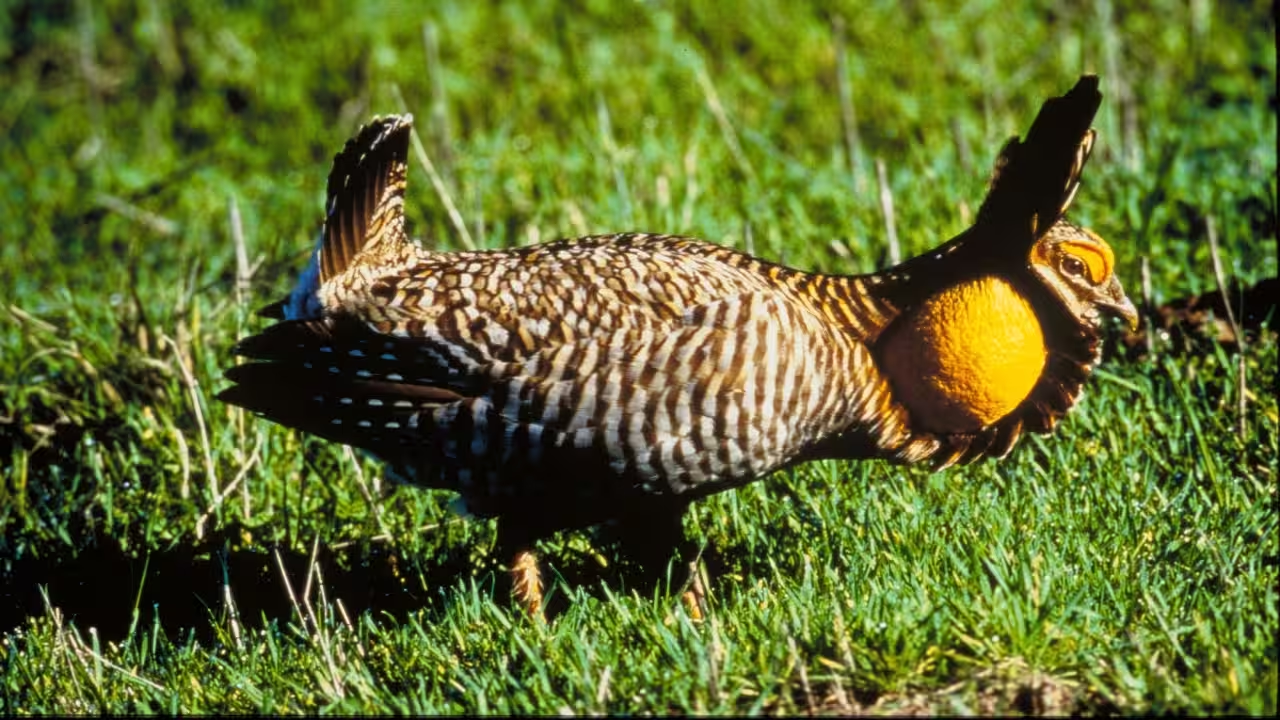
In 1965, two ranching families in Colorado County, Texas, agreed to sell 3,500 acres of their own land for roughly half of what it was worth, then donated the remaining value outright, all so a vanishing grassland could help the bird survive. That act of generosity helped create the foundation of today’s Attwater Prairie Chicken National Wildlife Refuge, which now protects more than 11,000 acres of habitat. The ground-dwelling grouse was once so common across the Gulf Coast that its booming spring courtship calls could reportedly be heard for miles.The bird was already in steep decline. A century earlier, an estimated one million Attwater’s prairie-chickens had occupied six million acres of coastal prairie stretching from Corpus Christi in Texas to southwestern Louisiana. By the 1960s, ploughed farmland, sprawling towns and the near-total conversion of native grassland to pasture had pushed the species to the edge of extinction, and fewer than 2,000 birds remained anywhere in the wild.The families who sold below market valueThe offer came together through I.V. Duncan and his son Gardner Duncan, who owned 2,580 acres of prairie in Colorado County, and Mr. and Mrs. David Wintermann, who held an adjoining 840 acres. Both families were approached by biologist Val Lehmann, whose decades of research had chronicled the prairie chicken's steady collapse and made the case that this particular stretch of Lissie Prairie habitat near Eagle Lake was worth saving before it disappeared for good.Rather than holding out for full market value, both families agreed to sell their land for roughly half its worth and donated the remaining value. The Nature Conservancy in Texas and the World Wildlife Fund helped secure and finance the 3,500-acre preserve, while retired state game warden Thomas Waddell became its caretaker.From a modest preserve to a national refugeThe 3,500-acre preserve became the foundation of a larger federal conservation effort. In 1972, the U.S. Fish and Wildlife Service formally established the Attwater Prairie Chicken National Wildlife Refuge to protect the endangered bird and its remaining coastal-prairie habitat. Additional acquisitions expanded the refuge over the following decades. By 1990, it covered roughly 8,000 acres, and later purchases increased the protected area to more than 10,500 acres. In March 2026, more than 500 additional acres were added, bringing the total protected area to more than 11,000 acres.However, the refuge’s growth did not stop the bird’s wider decline. The statewide population fell from around 900 birds in 1986 to 456 by 1992, prompting researchers at Texas A&M University to launch a captive-breeding programme. By 1994, fewer than 160 birds remained in the wild, and by 1996 only 42 were left.The local preserve showed that targeted protection could help a small population recover even while the species continued to decline statewide. Historical accounts record about 25 birds on the preserve in the mid-1960s, with the refuge population later rising to more than 200 by the mid-1980s. Across Texas as a whole, however, the population fell from roughly 8,600 birds in 1937 to 1,070 in 1967. The local increase therefore represented a limited conservation success, not a reversal of the broader collapse.A fragile comeback still being writtenToday, the Attwater’s prairie-chicken survives in the wild in only a small number of Texas locations, and the total population remains fewer than 200 birds. Captive-bred birds raised at zoos and wildlife centers across the state, including Fossil Rim, the Houston Zoo and the San Antonio Zoo, are regularly released onto the refuge to help maintain the wild population. The Duncan and Wintermann families' role is easy to overlook, but without their discounted land sale, there might have been no refuge to expand. Six decades later, the land those families helped preserve remains part of the refuge, although the bird’s future is still uncertain.Catch the latest World News and Live updates. Download the TOI app.
Topics in this story
Gathered from external sources. Rights to this text belong to whoever originally published it.