US officials make rare trip to Myanmar to free former marine as isolated regime seeks greater recognition
US officials made a rare visit to Myanmar this week to secure the release of an American businessman who had been detained in the war-torn country since June.
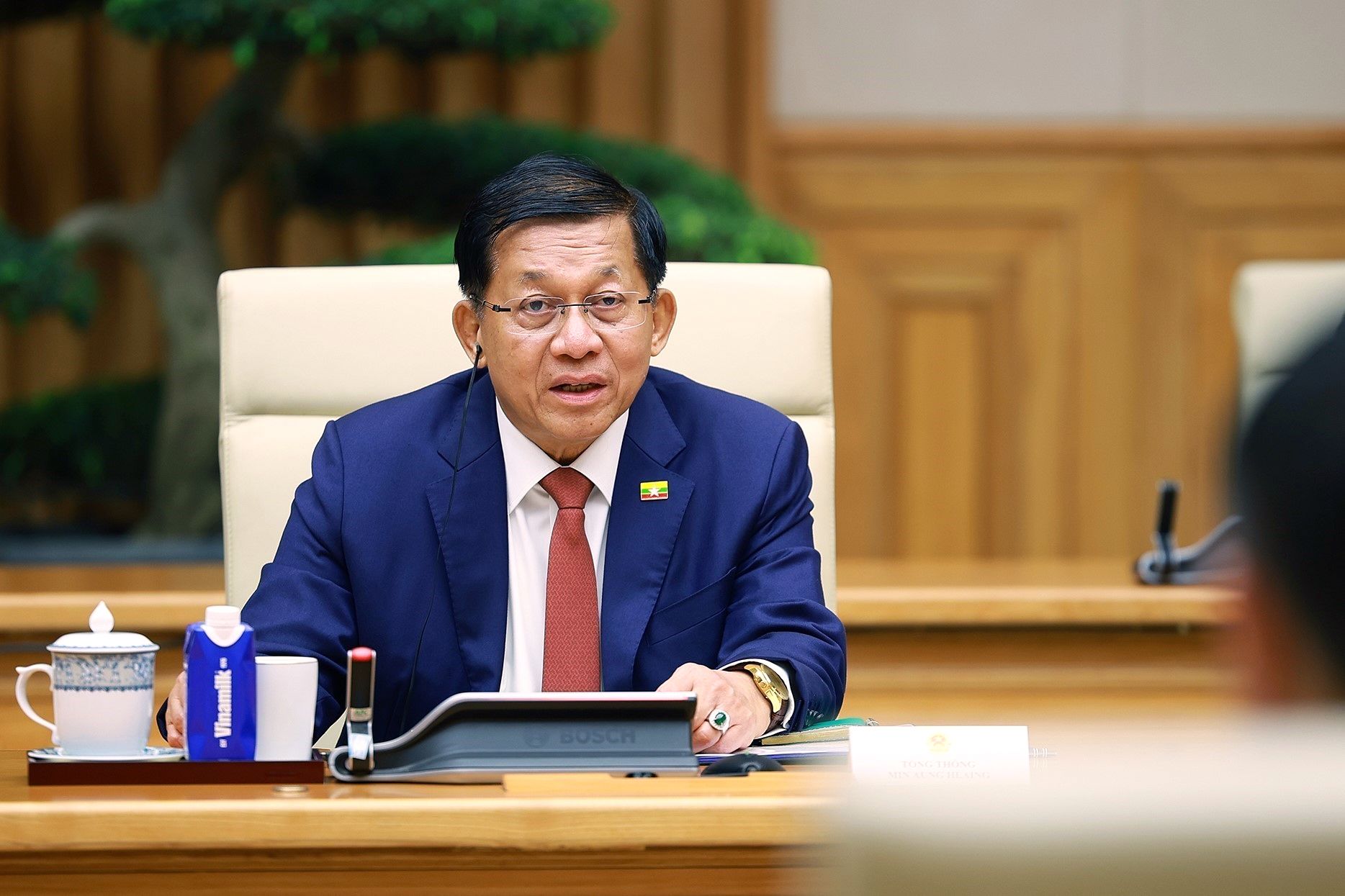
US officials made a rare visit to Myanmar this week to secure the release of an American businessman who had been detained in the war-torn country since June. The delegation met with officials of Myanmar’s military-backed government in the capital Naypyidaw on Tuesday, according to a US State Department spokesperson. The meeting was the among the most significant engagements between the US and Myanmar since the military launched a coup in 2021, overturning the elected government of Aung San Suu Kyi and plunging the country into civil war and economic ruin. “In those engagements, the US delegation secured the release of a detained US citizen Adam Castillo,” the spokesperson said in a statement. The spokesperson did not say who was part of the delegation, or which Myanmar officials they met with. Myanmar’s rulers have been ramping up efforts to garner international recognition after holding stage-managed elections earlier this year that installed junta chief Min Aung Hlaing as president. The ballot was widely denounced by critics as a sham, but the junta hoped it would convince some in the international community to re-engage with the Southeast Asian nation after years of isolation and sanctions imposed following the coup. Castillo, a former US marine who ran a security and risk management company in Myanmar’s commercial capital Yangon, was arrested on June 11 at the city’s international airport. Myanmar accused him of using his position as the head of the American Chamber of Commerce to conduct lobbying in Washington, Reuters news agency reported. However, his supporters called the charges “spurious” and linked his detention to a dispute with a Myanmar businessman. “Adam was held for 97 days in Myanmar because corrupt businessmen made unfounded allegations about him to further their own business and political interests,” his sister Amanda Castillo said in a statement. “I can’t wait to welcome my brother home, but I know it will be bittersweet for him. He had such great hopes for enhanced US/Myanmar relations, and he holds the deepest respect for the Burmese people, among whom he lived for many years.” She thanked US President Donald Trump and Vice President JD Vance for working for his release. The US nonprofit Global Reach said it also worked to secure Castillo’s freedom. He was arrested upon returning from Malaysia, where he had been promoting his new book about his experiences in Myanmar through the 2021 military coup, according to the NGO. “We are thrilled to see Adam coming home and are grateful for the collaboration and efforts from the Trump Administration. Members of the Trump Administration have been working quietly behind the scenes to secure Adam’s release,” said Mickey Bergman, Global Reach’s chief executive. “We are also grateful to the leadership in Myanmar, for their cooperation and the decision to allow Adam to return home to his family safely.” Myanmar said Wednesday that Castillo was deported “with the primary goal of maintaining friendly bilateral relations” between Myanmar and the US. The United States and most Western countries have not recognized the military-backed government as the legitimate leaders of Myanmar. The country’s most popular politician, 81-year-old Suu Kyi, remains in detention, and the military rulers continue to wage a catastrophic civil war, sending columns of troops on bloody rampages, torching and bombing villages, massacring residents, jailing opponents and forcing young men and women to join the army. The United Nations and other rights groups have accused the military of war crimes. The US, the United Kingdom and the European Union have all sanctioned the military and sought to limit contact with its representatives on the world stage. Washington and most Western capitals no longer station fully accredited ambassadors in the country, a diplomatic snub the ruling generals have long chafed at. The State Department said in its statement that the US “regularly engages with authorities in Naypyitaw on issues affecting U.S. interests.” Throughout those engagements, the US “has and will continue to raise the need to cease violence, allow humanitarian access, and release political prisoners as part of efforts to bring about conditions for durable peace,” the spokesperson said. Analysts say the Myanmar military is already using Castillo’s release to show increasing international engagement. “The release was framed as a diplomatic gesture from the outset, not as the conclusion of a legal process,” said Richard Horsey, senior Asia adviser at the International Crisis Group. “Min Aung Hlaing has made no secret of wanting to reopen a channel to Washington… Releasing an American who was being held on a business dispute costs him nothing and buys him a story of goodwill, and a reason for US officials to be talking to him.” Since the election, Min Aung Hlaing has embarked on a diplomatic push to normalize relations, especially with the country’s Asian neighbors. Last week, he met with Cambodia’s leaders in Phnom Penh after a similar visit to Vietnam. In his newly minted role as president, Min Aung Hlaing has made a series of foreign visits, including to India, China, Russia, Laos, Thailand, Kazakhstan, and Belarus, to seek greater legitimacy and reengagement, as well as much-needed foreign investment. “That is a run of diplomatic acceptance he could not have had before the election,” said Horsey. But, Min Aung Hlaing “has offered nothing of substance,” he added. “Naypyidaw is collecting handshakes and presenting them as recognition; the test is whether anyone asks for anything in return.” Even the US appears to have eased pressure on Myanmar in recent years. In July 2025, Washington lifted some sanctions against allies of the Myanmar junta and their businesses. The UN Special Rapporteur for Myanmar at the time Tom Andrews called the move “a shocking turn in US policy that risks emboldening Myanmar’s military junta and its enablers,” as the companies removed from the sanctions list had been implicated in the arms trade. Later that year, the Trump administration ended temporary legal status for Myanmar citizens in the US, arguing they could safely return, and cited the junta’s elections as evidence of an improving situation. Even a letter warning Myanmar of the US’s intention to impose tariffs on the country was spun by Min Aung Hlaing as an “encouraging invitation to continue participating in the extraordinary Economy of the United States.” Min Aung Hlaing also asked that Washington consider lifting and easing economic sanctions on Myanmar.
Topics in this story
Gathered from external sources. Rights to this text belong to whoever originally published it.