In Kenya, engineers added blue-gum wood ash to weak road-base soil; the mix achieved a 348% bearing score, over twice the 160% design requirement
Researchers in Kenya have successfully utilized blue gum wood ash to enhance weak road-base soil, achieving an impressive California bearing ratio (CBR) of 348%, significantly surpassing the standard design requirement of 160%. This innovative method could revolutionize road construction in Kenya, providing a more sustainable material option.
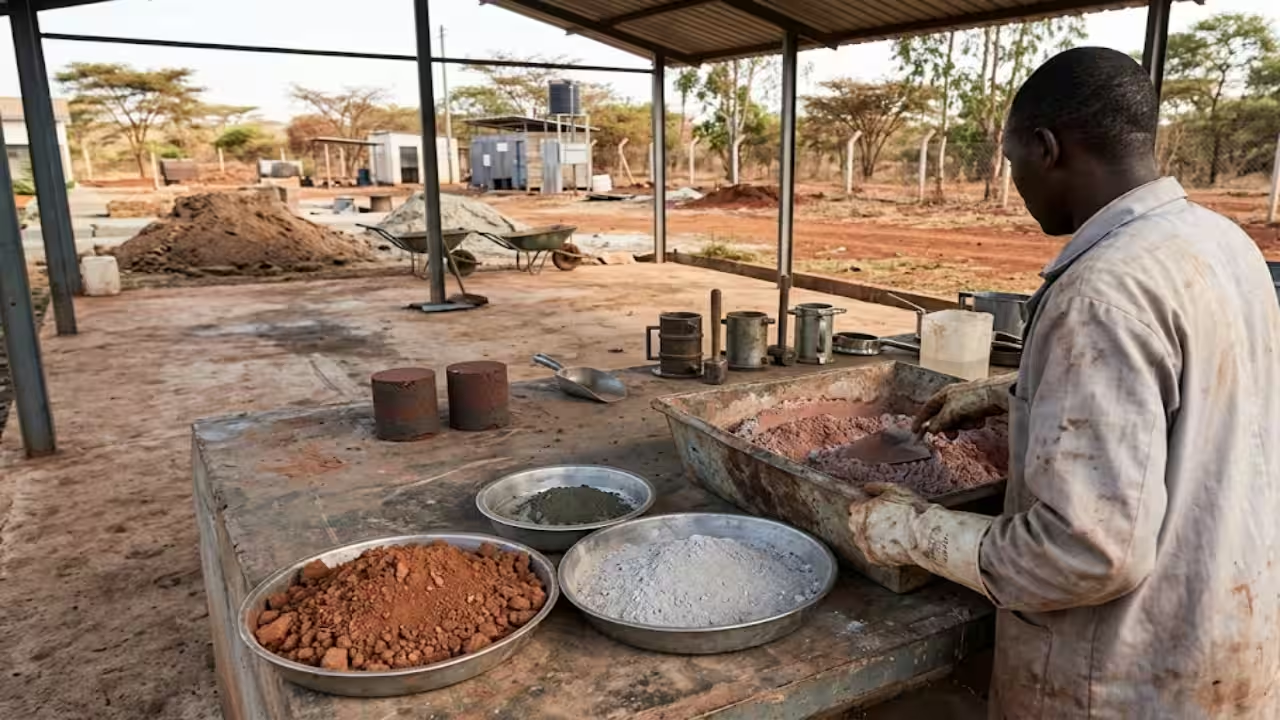
Weak soil can make road construction more difficult, so engineers often use cement to strengthen road-base material. In a 2021 laboratory study, Blaise Dabou, Christopher Kanali and Zachary Abiero-Gariy investigated whether ash from blue gum trees (Eucalyptus globulus) could replace part of the cement used to stabilize lateritic soil. The researchers reported a peak soaked California Bearing Ratio (CBR) of 348% for a mixture containing 4% cement and 2% blue-gum wood ash by weight of soil. The result exceeded the 160% road-base benchmark cited from Kenya’s Road Design Manual.How wood ashes were usedLateritic soil develops in warm regions after extended weathering and is generally rich in iron and aluminium oxides, which give it a reddish or brown colour. Its engineering qualities exhibit significant location-dependent variation. Some lateritic soils are suitable for use in road building, whereas some need to be treated to provide the strength required for a pavement base. The researchers first tested the soil with Portland cement at levels ranging from 0% to 12% by weight of soil. They determined the California bearing ratio and unconfined compressive strength to select a cement-only mix that would be appropriate for subsequent testing.The mixture containing 6% cement recorded an unconfined compressive strength of 2.88 megapascals after seven days of curing. The researchers then wondered whether they might substitute some of the cement with blue gum wood ash while still making the material work as a road base.In the investigation on lateritic soil stabilised with cement and blue gum wood ash, the levels of replacement utilising the ash were investigated in incremental values. The optimum CBR was obtained at 2% blue gum wood ash. For the best effect, the ash replaced some of the original cement in the mix and was not the only stabilising material.The significance of the 348% resultThe soaking CBR of the combination with 4% cement and 2% blue gum wood ash was 348%. The unconfined compressive strength value after 7 days of curing was reported to be 2.99 megapascals. The CBR value of the cement- or lime-improved foundation material from Kenya’s Road Design Manual was compared with the benchmark of 160%.The California Bearing Ratio (CBR) test measures a soil or pavement material’s resistance to penetration relative to a standard crushed-rock reference material. Results are conventionally expressed as percentages, and values can exceed 100%. Therefore, the reported CBR of 348% is a penetration-resistance ratio, not a claim that the soil is 348% as strong or that a road built with it would last more than twice as long. This information enables road engineers to evaluate whether a material can resist the stresses anticipated in a pavement layer. The test must be read in conjunction with the curing conditions, moisture, soil properties and other strength values.The Ministry of Roads and Transport in Kenya has a manual on materials and pavement design that provides guidance on the use of soil classifications and material testing for constructing road structures. Such parameters are important since a laboratory value is only of practical importance if the test technique and material type are compatible with the specifications of the pavement which is intended to be built.Why the ash could helpWood ash is a mineral compound. The chemical composition is dependent on the tree type, burning circumstances of the wood, and the collection and treatment of the ash. When coupled with cement and soil, adequate ash particles and chemical elements can impact the compacted structure and the processes that occur during curing.The researchers found that a mix containing 4% cement and 2% wood ash achieved a seven-day compressive strength of 2.99 MPa, slightly higher than the 2.88 MPa recorded for the 6% cement-only mix. The combined mixture retained the same total additive content by weight of soil while replacing two percentage points of cement with wood ash. Before it could be used in a road project, engineers would have to examine its chemistry, particle size and consistency. Also, the soil itself has to be tested, because the same stabiliser can give different outcomes in different ground conditions.Limits of the lab resultsThe experiment was conducted on prepared soil samples under controlled settings. Moisture changes, traffic loading, drainage conditions, and quality of construction would affect field pavement. In the best-performing mixture, cement was still an essential part of the stabilising mechanism. Construction standards would also need to include appropriate mixing, compaction and curing techniques.The findings suggest that blue-gum wood ash may be useful as a partial cement replacement in lateritic road-base material. However, the results came from laboratory tests; field trials would be needed to determine how the mixture performs under real traffic, changing moisture conditions and long-term weather exposure.You use AI every day. Now get your AI Quotient. Take the AIQ test.
Topics in this story
Gathered from external sources. Rights to this text belong to whoever originally published it.