In 1995, Discovery Channel founder John Hendricks bought a Colorado ranch and turned it into a 7,000-acre estate before listing it for $149 million
US News: In the mid-1990s, John Hendricks was already a successful television executive, having built the Discovery Channel into a major documentary and factua.
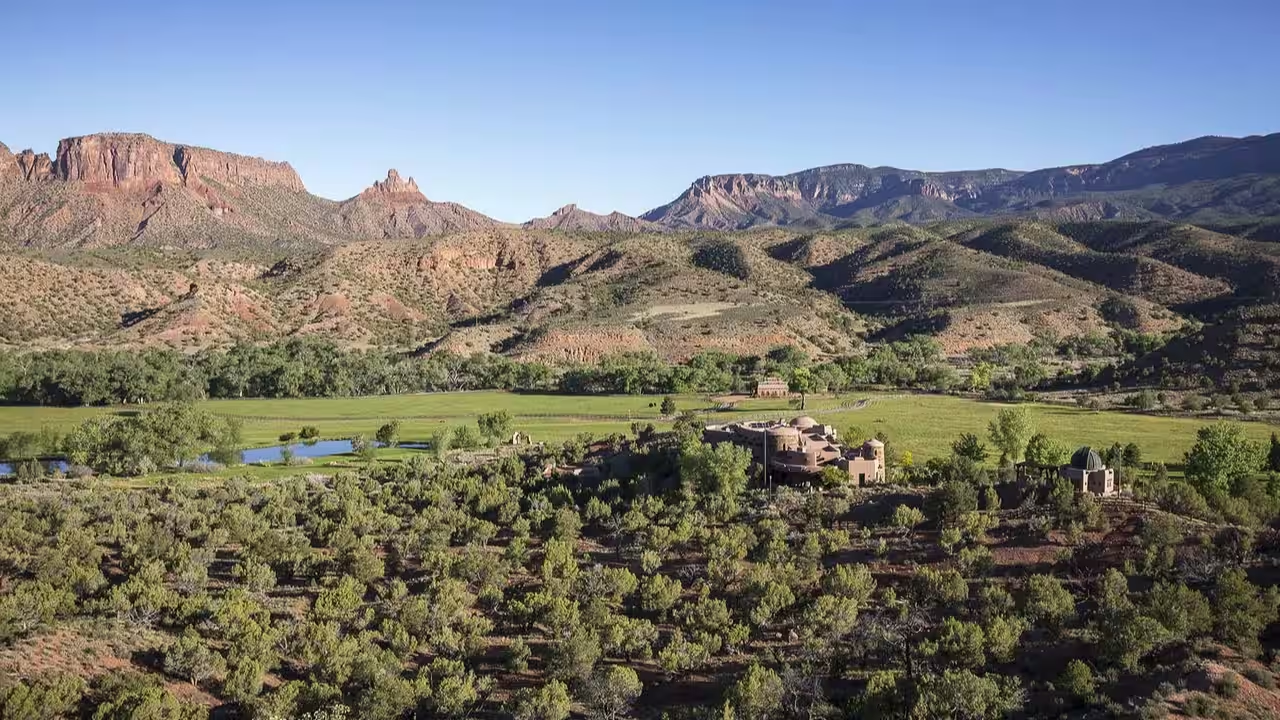
In the mid-1990s, John Hendricks was already a successful television executive, having built the Discovery Channel into a major documentary and factual programming business. In 1995, he bought a ranch in western Colorado, a property far removed from the studios and offices associated with his career. Over the years, the holding expanded into a roughly 7,000-acre estate extending across the Colorado-Utah border. According to the Wall Street Journal, by 2017, when the ranch was put on the market for $149 million, it had developed into something considerably larger than a private country home. There was a 22,000-square-foot main residence, an observatory, an aircraft hangar and thousands of acres set aside under conservation arrangements.John Hendricks turned a Colorado ranch into a 7,000-acre private estateHendricks acquired the Colorado property in 1995, when his career in television was already well established. The Discovery Channel, which he had helped launch in 1985, had grown from a specialist cable network into an international media business centred on factual programming.The ranch offered a very different setting. Located in the red-rock country of western Colorado, close to the Utah state line, it was surrounded by the kind of open landscape that makes conventional measurements of a property feel slightly inadequate.Rather than remaining a relatively modest rural holding, the ranch grew over the following two decades. By the time it was listed for sale, the estate covered about 7,000 acres.That expansion also changed the character of the property. It was no longer simply a large ranch with a substantial house. It had become a private compound designed around the landscape, with buildings and facilities spread across a huge tract of land.A 22,000-square-foot home, private observatory and airplane hangarAt the centre of the estate was a main residence measuring roughly 22,000 square feet. Its size put it in a different category from the traditional ranch houses found across much of the American West.The house was built as a place from which the surrounding landscape could be experienced rather than simply viewed from a distance. The remote setting was an important part of the property, and the scale of the estate meant that privacy came as much from the land itself as from the buildings.There were also facilities that reflected Hendricks' interest in science and exploration. An observatory formed part of the property, giving the estate an unusual feature for a private ranch.An airplane hangar was included as well. On a property of this size and in such a remote location, private aviation provided a practical way of reaching the estate.4,000 acres protected for conservationThe acreage was not all treated as conventional private development land. Around 4,000 acres of the estate had been protected through conservation arrangements.That distinction is significant because the ranch was being marketed not simply on the size of its buildings, but on the amount of open country surrounding them. Conservation restrictions helped preserve portions of the landscape from future development while leaving the property as a very large private holding.The estate's location also gave it a particular physical character. Western Colorado's landscape around the ranch includes exposed rock, canyons and broad stretches of undeveloped terrain. The state border with Utah runs through the wider property, making the ranch unusual geographically as well as in scale.For a buyer, much of the value therefore lay outside the walls of the main residence.The estate and the business of luxury ranchesThe Hendricks property appeared in the Wall Street Journal's coverage of a wider market for high-end ranches and recreational properties.At the time, luxury ranch developments were increasingly being designed around activities such as fly-fishing, with access to productive trout streams becoming part of the sales proposition. Buyers interested in fishing could purchase not just a house and acreage, but a carefully managed outdoor environment.Private fisheries were also becoming part of that market. Some wealthy landowners were spending heavily on stream restoration, fish habitat and water management, bringing biologists and other specialists into what had traditionally been a much simpler part of ranch ownership.Hendricks' ranch belonged to the same broader world of properties where the landscape itself was a major component of the estate.From television headquarters to a remote western retreatThere was an obvious contrast between Hendricks' professional life and the setting of the ranch. His name was closely associated with television documentaries and factual programming. The ranch, by comparison, was built around distance, open land and a comparatively private existence. Its observatory and protected acreage also fitted comfortably with a property designed to make the surrounding environment part of everyday life.The ranch was not in a conventional resort town or suburban luxury market. Its appeal depended heavily on its remoteness.That helped distinguish it from the large estates commonly associated with wealthy buyers in places such as California, New York or Florida. Here, thousands of acres separated the residence from the outside world.Hendricks listed the 7,000-acre ranch for $149 million in 2017According to a local Colorado news report, more than two decades after Hendricks bought the Colorado ranch, the property was placed on the market for $149 million in 2017.The asking price reflected the unusual combination of scale, buildings and protected land. A 7,000-acre estate with a 22,000-square-foot home was already rare. Adding an observatory, an aircraft hangar and thousands of acres under conservation protection made the offering even less conventional.The property was described as straddling the Colorado-Utah border in a region known for its red-rock canyons.By then, what had begun with Hendricks' 1995 purchase had become a vast western estate. The ranch's history was tied not only to the founder of a major television network, but also to a period when wealthy buyers were increasingly treating large working and recreational landscapes as highly specialised luxury properties.The buildings were substantial, but the defining feature remained the land: thousands of acres of western Colorado, with much of it intended to remain open.Catch the latest World News and Live updates. Download the TOI app.
Topics in this story
Gathered from external sources. Rights to this text belong to whoever originally published it.